
Local News
Kem C. Gardner Policy Institute expert shares real estate outlook

Rob Shelton | American Fork Citizen
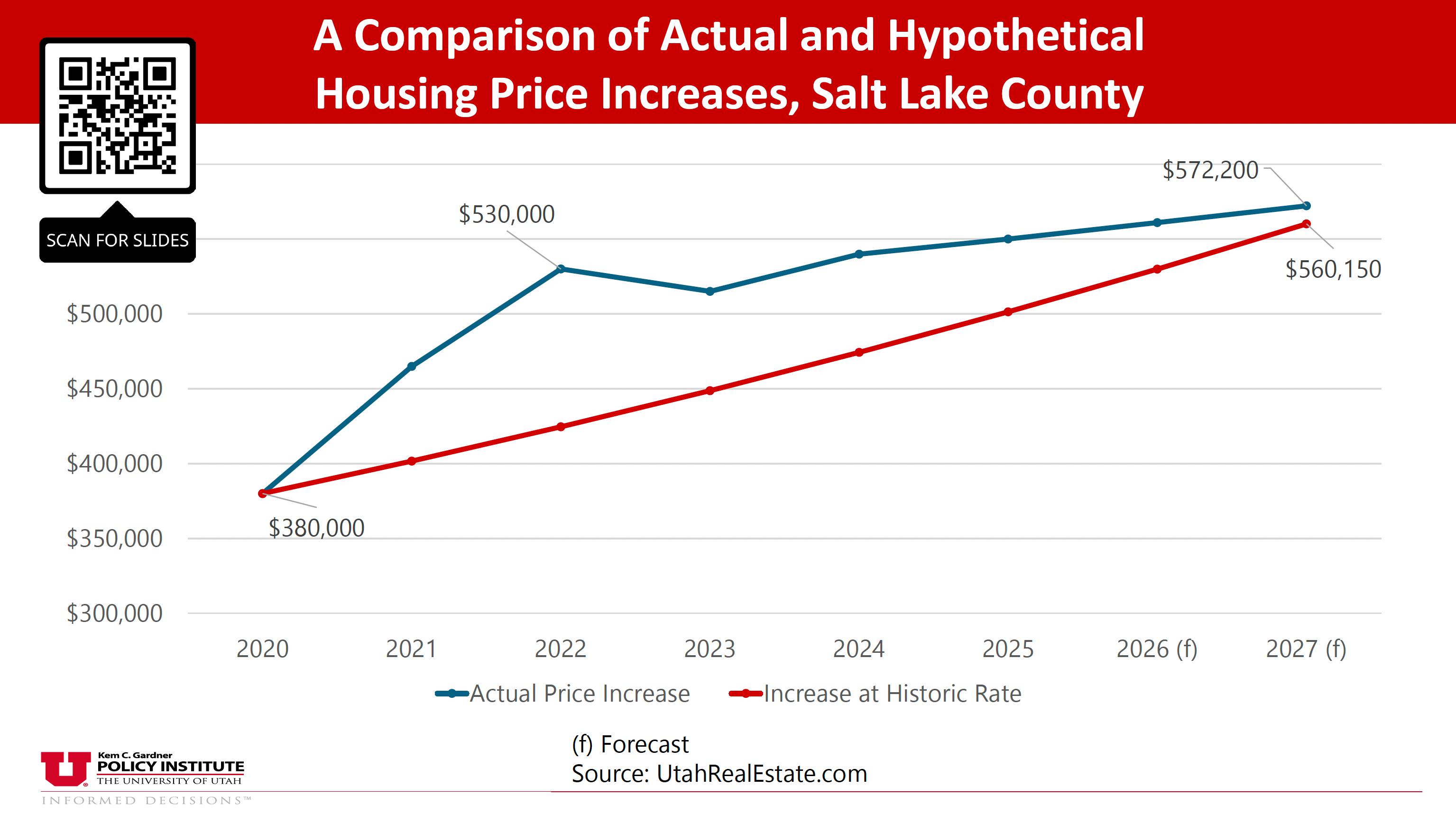
Between 2020 and 2022, Utah’s housing market was booming. During that time, prices jumped roughly 40%, the sharpest surge in Utah’s modern housing history. Since then, growth has cooled dramatically. From 2022 through 2025, prices rose less than 4% over that three-year period.
These and other interesting facts about the recent history and forecast of the local real estate market were presented to the Salt Lake Board of Realtors by James Wood. Wood is a longtime Utah housing economist with the University of Utah’s Kem C. Gardner Policy Institute. His report has tracked population growth, housing demand and affordability trends in Utah for decades and is widely cited by state and local officials, builders and lenders. Salt Lake County is used in the report as it is considered the bellwether county for real estate trends along the Wasatch Front.
In 2020, the average cost of a home in Sale Lake County was $380,000. In two years, the average home cost jumped to $530,000 and is forecast to be $572,200 in 2027. Wood compared the historical growth rate of homes in Salt Lake County with the actual growth rate. In 2027, the historical growth rate suggests the average home cost will be $560,150. While the gap between the actual cost of a home and the historical average has been closing in recent years, in 2027, there is still about a $12,000 gap between the two.
According to the National Association of Realtors, home prices from 2020 to 2025 increased by about 62.5%. Wood described the current moment as a pause after years of upheaval. “We are really catching our breath now,” he said, noting that median home prices fell 2.8% from 2022 to 2023.
Looking ahead, Wood said the county’s for-sale housing market in 2026 is likely to resemble what buyers and sellers have seen in recent years, with no major shifts expected.
“I think for 2026, I don’t see many indicators out there that can say, ‘well, we’re going to, all of a sudden, see a surge in buying or a surge in prices,’” Wood said.
In Wood’s report, he mentioned that the 2026 market headwinds include a slowing Utah economy and economic uncertainty, coupled with an interest lock: over 61% of mortgage holders have an interest rate below 4%. With home prices rising and interest rates above 4%, the market seems to offer little hope for most homeowners to upgrade or move from their current homes.
The market tailwinds for 2026 include more favorable mortgage rates (below 6%). This year also marks the fourth year of recovery from the pandemic, and a relatively high share of young households.


April Slaughter | American Fork Citizen
A recent Lehi drug investigation that uncovered large quantities of marijuana and THC products is reigniting debate among residents about Utah’s cannabis laws. A central issue: whether Utah’s medical marijuana system is accessible enough for patients, and how law enforcement should balance medical legalization with criminal penalties for recreational possession.
This case, involving the Utah County Major Crimes Task Force and Lehi Police, underscores the ongoing conflict between enforcement of marijuana laws and the expansion of regulated medical cannabis in Utah.
The Lehi Police Department said detectives seized large amounts of marijuana-related products and cash after serving a search warrant at a suspected stash house.
Police reported seizing about 74 pounds of THC “dab” and wax products, 25 pounds of marijuana, and 3,100 THC edible packages. They also found over $12,000 in cash, believed to be from drug sales.
Authorities said the investigation began after an anonymous tip to the Utah County Major Crimes Task Force. The tip claimed that marijuana, THC concentrates, and other products were being sold in the area.
The search warrant led officers to a residence in Lehi, suspected of storing and distributing narcotics. Police said the investigation is ongoing.
Utah is among the states where recreational marijuana is illegal. Under current law, possessing marijuana can bring criminal penalties. Utah Public Radio reports that possession of even small amounts can lead to jail time, though lawmakers have sometimes proposed reducing penalties for minor possession.
Utah legalized medical cannabis in 2018 after voters passed Proposition 2. Lawmakers later changed the initiative, creating a tightly regulated system that lets patients with qualifying conditions buy cannabis products from licensed pharmacies.
Since then, the program has grown. By 2025, more than 100,000 patients were registered in Utah’s medical cannabis program, up from a few thousand soon after legalization.
Patients must get a recommendation from a qualified medical provider and apply through the state’s electronic system to obtain a medical cannabis card. Once approved, they can buy products from licensed pharmacies across Utah.
Before a sale, dispensaries must check a patient’s eligibility in the state electronic system. This portal is used by pharmacies, regulators, and law enforcement to verify legal medical cannabis purchases and ensure compliance with state possession limits.
Utah allows 15 licensed medical cannabis pharmacies statewide. These are the only businesses approved to legally sell cannabis products to patients.
Despite the medical program, marijuana enforcement continues statewide with thousands of arrests reported each year.
According to national incident reporting data compiled by advocacy groups, Utah has recorded more than 7,000 marijuana-related arrests in recent years, with most involving possession rather than distribution. For comparison, this indicates that thousands of individuals are arrested annually for marijuana possession in the state.
These statistics highlight the ongoing tension in Utah’s legal landscape, where the medical use of cannabis is permitted, but strict enforcement persists against recreational use.
Utah’s approach reflects a compromise adopted after the passage of Proposition 2, balancing tightly regulated medical access with continued criminal penalties for recreational use.
Reform supporters say penalties are harsh for people using marijuana for health reasons. Opponents often express concerns about impaired driving, youth access, and public safety.
Some Utah residents say the state’s medical cannabis program creates financial barriers.
Patients typically must pay for an appointment with a qualified medical provider before receiving a recommendation for cannabis use. These visits can cost anywhere from roughly $75 to more than $250, depending on the provider.
The state also charges a fee to apply for a medical cannabis card. Insurance does not cover cannabis-related care, so patients must pay out of pocket.
Some residents say these expenses make it hard for people with chronic health problems to get medical cannabis treatment.
Opinions in Utah County vary. Some say medical programs help patients with chronic pain, epilepsy, and other illnesses. Others want strict marijuana laws, even with limited medical use.
Public debates on this issue often appear in online community forums and neighborhood groups. Residents argue about the costs and benefits of Utah’s cannabis policies.
One Utah County resident wrote online that the medical cannabis program’s system can be costly but worthwhile for some patients.
“I paid for the appointment and the card, but it has helped my chronic pain more than anything else I’ve tried,” one Utah County resident wrote in an online public discussion about the program. Another resident supports the medical program but worries about broader legalization.
“Medical access makes sense, but I don’t think Utah should rush into full legalization,” the resident wrote.
This range of opinions underscores the central debate: how Utah should balance access to medical cannabis with continued prohibition and enforcement of recreational use.
Lawmakers have sometimes introduced bills to change how marijuana possession is handled. In 2026, they again considered reducing penalties for first-time possession of small amounts, possibly making some offenses civil infractions instead of criminal charges.
It is uncertain if these efforts will succeed. For now, Utah keeps a dual system: medical cannabis for qualified patients and criminal penalties for recreational possession.
In communities such as Lehi, the question of how to balance marijuana enforcement with access to medical cannabis remains unresolved, shaped by law enforcement actions, legislative changes, and residents’ experiences navigating Utah’s system.
Residents seeking official information about Utah’s medical cannabis laws or the state’s verification system can visit the Utah Department of Health and Human Services’ Center for Medical Cannabis website at medicalcannabis.utah.gov, which provides program rules, patient eligibility information and access to the state’s electronic verification portal.
Megan Wallgren | American Fork Citizen
Residents in northwest Utah County will soon have a new option for getting around, thanks to an on-demand transit program designed to help solve one of the biggest challenges in public transportation: the gap between a transit stop and a rider’s starting or final destination.
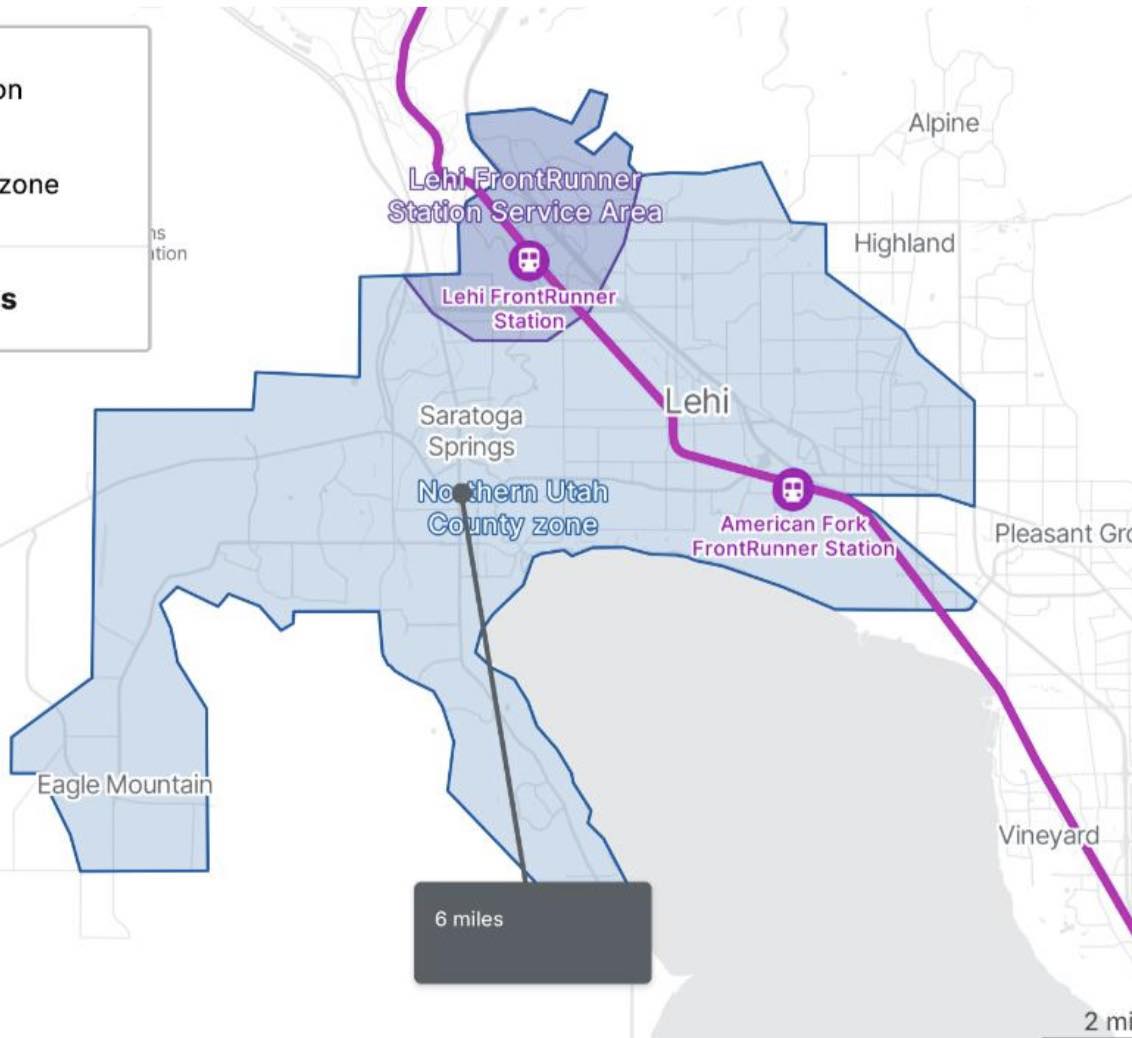
After nearly a year of meetings and negotiations, the Utah County Commission finalized an agreement with the Utah Transit Authority to create a “mobility zone” serving parts of Lehi, American Fork, Eagle Mountain and Saratoga Springs. The zone will cover about 77 square miles and serve approximately 181,000 residents.
The new service functions similarly to rideshare apps like Uber or Lyft, but is fully integrated with the region’s public transit system. Riders will be able to request a trip through the UTA app and be picked up near their location and taken to a nearby destination, bus stop or FrontRunner station.
The program is set to begin Aug. 16. Riders will access the service by requesting a ride on the UTA app.
“This service helps address the always-challenging last mile,” Utah County Commissioner Skyler Beltran said in a Facebook post announcing the agreement. “While this is certainly not a major solution to our current traffic mess, it is a meaningful piece of the puzzle.”
The new program will not only provide transportation options but also valuable data about how people travel. By tracking where riders begin and end their trips, planners hope to better identify where future transit investments could have the greatest impact in the fast-growing region.
Similar services were launched in Salt Lake County in 2019. Since that time, it has surpassed 2 million total riders and provided more than 645,000 rides in 2025 alone. That was a 13% increase over the previous year.
Utah County’s system will launch with a fleet of 16 vehicles, half of which will be wheelchair accessible to ensure riders with mobility challenges can also use the service. Trips will cost $3 per ride and allow passengers to travel up to six miles within the zone. However, trips connecting to the FrontRunner stations in Lehi or American Fork will not have a mileage cap.
The fare also includes transfers to other UTA services like buses, TRAX, and FrontRunner within two hours of the initial ride. Riders who already have a UTA transit pass will have the fee covered.
According to Beltran, the system is designed to complement existing transit rather than replace other services.
“It’s integrated with the entire UTA system, so a single trip can connect riders between on-demand service, FrontRunner, TRAX and other transit options,” Beltran said. “It’s really designed to complement the broader transit network.”
The service will operate Monday through Saturday from 6 a.m. to 9 p.m., and officials estimate it could provide about 400 rides per day.
Funding for the program will largely come from Utah County’s fifth-fifth sales tax dedicated to transportation. Beltran noted that the entire service costs less to operate than a single fixed-route bus line.
For more information about existing UTA On Demand programs, visit rideuta.com/Services/UTA-On-Demand.
Local News
Utah appeals court case could redefine survivorship rights after unpaid divorce settlement

Sally Francom | American Fork Citizen
LEHI, Utah — A 46-year-old Utah County journalist and caregiver for her disabled adult daughter is defending her ownership of the home where she has lived since 2018 after the Fourth District Court ruled that a $200,000 divorce settlement payment required before the property could transfer was never made. The case, Slaughter v. Alleman, will now be argued before the Utah Court of Appeals.
April Slaughter and her former husband divorced in March 2024. Under the divorce decree, he was required to pay $200,000 before any transfer of the jointly owned property could occur. The payment was never made, and he died in April 2024 before fulfilling that obligation.
Because the payment required by the decree was never made, Slaughter remained the surviving joint tenant on the Highland home where she lives with her disabled adult daughter, a property estimated to be worth roughly $800,000.
Following the former husband’s death, his father opened a probate estate and, acting through that estate, filed a motion in the Fourth District Court seeking to enforce a provision of the divorce decree that required Slaughter to vacate her home by May 31, 2024. Through that motion, the estate sought to assert a claim to the property even though the required $200,000 payment had never been made during the husband’s lifetime.
Judge Christine Johnson of the Fourth District Court rejected the estate’s argument and granted summary judgment in Slaughter’s favor, ruling that because the required $200,000 payment was never made, the condition necessary to transfer the property had not been satisfied.
“This home has been my residence for years, and I believed the terms of the divorce decree were clear,” Slaughter said. “The district court recognized that the condition required for the property to transfer was never met.”
The appeal raises broader questions about how Utah courts interpret joint tenancy survivorship rights when divorce decree conditions remain unmet at the time of death. Joint tenancy with right of survivorship is a widely used form of property ownership in Utah, under which full title automatically transfers to the surviving owner upon the death of a joint tenant.
The outcome of the case could have implications beyond this dispute:
• Joint tenancy is a widely used form of home ownership in Utah,designed to allow property to pass automatically to the surviving owner when one owner dies.
• The appeal asks the Utah Court of Appeals to clarify whether survivorship rights remain intact when a divorce decree includes conditions that were never fulfilled during a party’s lifetime.
• The ruling could influence how courts handle similar disputes involving divorce settlements, probate claims, and property ownership across the state.
• For homeowners, the decision may determine how much certainty survivorship deeds provide when divorce and death intersect.
Oral argument in Slaughter v. Alleman (Appeal No. 20250180-CA) before the Utah Court of Appeals is scheduled for March 19, 2026.
The court’s eventual decision may clarify the limits of probate authority and the level of certainty Utah homeowners can rely on when using survivorship deeds after divorce and death intersect.
Slaughter’s attorney is available to respond to media inquiries regarding the legal issues presented in the case.

Ryann Anderegg | American Fork Citizen
Utah County community members are invited to join the March #LoveYourWatershed Cleanup on Saturday, March 14, hosted by the Jordan River Commission. The volunteer event starts at 10 a.m. near Pioneer Crossing in Saratoga Springs, offering residents a chance to help prevent trash from reaching the Jordan River.

The cleanup is part of the commission’s Second Saturday volunteer initiative, which encourages individuals, families, and groups to join monthly efforts to remove litter from river-connected areas.
Participants will help collect trash and debris from streets, curbs, and nearby areas, which could otherwise be washed into storm drains and carried into the Jordan River. By removing litter before it reaches waterways, volunteers help protect wildlife, improve water quality, and keep public spaces cleaner for everyone.

The Jordan River is a vital environmental and recreational resource in northern Utah. Stretching over 50 miles, it flows from Utah Lake through the Salt Lake Valley and eventually empties into the Great Salt Lake. Along its route, the river passes through numerous cities and supports wildlife habitats, trails, and recreation areas used by thousands of residents each year.
Because the river flows through both urban and suburban areas, pollution prevention often begins far from the water itself. Trash left on sidewalks, roadsides, or parking lots can easily be washed into storm drains by rain or irrigation water, eventually reaching the river. Once debris enters the waterway, removing it becomes significantly more difficult.
Events like the #LoveYourWatershed Cleanup aim to stop that process early by targeting areas where trash gathers before it reaches the river system.
The Jordan River Commission emphasizes that protecting the watershed requires participation from residents, organizations, and government agencies. Through volunteer programs and community partnerships, the commission works to improve water quality, restore vegetation along the river corridor, and promote environmental stewardship across the region.
Volunteer events like the March cleanup enable community members to get involved, whether experienced or new to volunteering. Organizers emphasize the event’s welcoming and accessible nature.
Tools, trash bags, water, and snacks will be provided for participants. Volunteers are simply asked to dress appropriately for the weather and come prepared to spend time outdoors while making a difference in the community.
The cleanup takes place near Pioneer Crossing in Saratoga Springs, with parking available by a local bank and more at the north end of Riverside Drive.
Organizers note that each participant must register in advance using the online form to ensure there are enough tools and supplies available for the cleanup.
The event is free, open to all ages, and encourages families to attend and learn about environmental stewardship through hands-on community service.
Programs like #LoveYourWatershed help residents see how daily actions affect local waterways and foster appreciation for local ecosystems.
Cleanup events also build community, as friends, families, students, and civic groups often participate together for a shared cause.
The March cleanup is just one event in the Jordan River Commission’s year-round volunteer calendar. Additional cleanup days, restoration projects, and conservation programs take place throughout the year along the river corridor.
Organizers hope residents who take part in the March event will return for future cleanups and encourage others to join.
By working together, volunteers can help ensure the Jordan River remains a healthy, vibrant natural resource for generations to come.
Register now for the March #LoveYourWatershed Cleanup through the Jordan River Commission’s website at jordanrivercommission.gov and be part of protecting your local waterway.
With tools provided and a welcoming atmosphere, the event offers a simple yet meaningful way to protect the watershed, one piece of trash at a time.

Staff Writer | American Fork Citizen
Dr. Kent Stewart Udell, a Utah-born engineer, scientist and educator, is formally advancing his campaign for Congress in Utah’s new Third District this week as he prepares to file his candidacy with Utah’s Lieutenant Governor’s Office.
Udell announced his candidacy on Feb. 19 after filing with the Federal Election Commission, and has spent the past two weeks meeting with voters across the vast geography of District 3, listening to community concerns and laying the groundwork for a district-wide campaign centered on “Bread & Butter, Land & Water, and the Rule of Law.“
“Running for Congress isn’t something I planned,” Udell said. “I retired a couple of years ago and have been enjoying this new phase of life. But when our country is suffering, knowing that I can help, I can no longer stand on the sidelines. I have the capacity to do good, so I feel called to serve my country and the beautiful state of Utah. … Public office is a trust, not a reward, and our laws exist to protect people, not those in power. The separation of powers, limits on authority, and equal rights under the law are non-negotiable for me.”
Udell is an engineer and says he has “spent his career solving complex problems where facts matter and consequences are real.” His work cleaning up contaminated groundwater, restoring federal sites such as the former Naval Air Station in Alameda, and teaching engineering ethics, shaped his simple governing philosophy: “service to the public to meet their needs now and into the future.”
“As an engineer, I identify problems and fix them,” Udell said. “I do not make problems and then promise to fix them.”
Udell was born in Lehi, Utah, and has lived and worked across rural and urban communities of the West. He spent decades as an engineering science researcher and educator at the University of California-Berkeley and the University of Utah, collaborating with federal agencies including the Department of Defense, Department of Energy and Environmental Protection Agency. He retired as Professor Emeritus from the University of Utah in 2023 and now lives near Moab.
A lifelong outdoorsman and cousin of former Interior Secretary Stewart Udall, Udell speaks often about place, stewardship, and responsibility. His campaign priorities – Bread & Butter, Land & Water, Constitutional integrity, Truth and Respect – reflect what he hears most from voters across Utah’s Third District: rising costs, water insecurity, threats to public lands, and growing distrust in government.
“Our disagreements are manufactured distractions,” Udell said. “Most people want the same things: a fair shot, a healthy environment, honest leadership, physical and economic security, and a hopeful future for our children to inherit.”
Udell does not accept corporate PAC money and says his campaign will be powered by individuals who believe expertise, ethics and accountability still belong in Congress.
The campaign will continue a series of listening sessions across Utah’s Third Congressional District in the coming weeks.
For more information, visit kentudellforcongress.com.

Rob Shelton | American Fork Citizen
Dozens of residents packed the American Fork Hospital conference room Saturday, February 28 for another round of “Pancakes and Politics,” where state lawmakers and a county commissioner fielded pointed questions on everything from Front Runner rail service to public infrastructure district abuses — and didn’t shy away from disagreeing with each other in the process.
Sen. Brady Brammer, Rep. Kay Christofferson, Sen. Heidi Balderree, state school board member Cindy Davis and Utah County Commissioner Skyler Beltran spent roughly 90 minutes working through a stack of audience questions. The forum is hosted each year by the American Fork Chamber of Commerce and was moderated by Joe Phelon.
Transportation: front runner, flyovers and the ‘last mile’ solutions
Transportation dominated the first half of the forum. Christofferson, who chairs the House Transportation Committee, said lawmakers are pushing to double-track portions of the FrontRunner commuter rail line — a move that could cut wait times nearly in half.
“Right now, it’s an hour in off-peak times and 30 minutes in peak times,” Christofferson said. “We could cut that in half.”
Brammer painted a longer-range picture. He argued FrontRunner’s value will multiply as autonomous vehicle technology matures. This would solve what transit planners call the “last mile” problem: how to get riders from their front door to the nearest station.
“Autonomous driving solves a problem that no one has really been able to solve,” Brammer said. “If you have fleets of autonomous driving, they’re going to be local driving. You solve that last mile — but then FrontRunner becomes a key portion of that.”
Commissioner Beltran announced the county will launch an on-demand transit service, similar to Uber but with UTA-type fares. This service is planned to begin in August for Eagle Mountain, Saratoga Springs and North Lehi. Riders can hail a van via smartphone; trips to a FrontRunner station are unlimited distance for $3.
“There’s a lady in Eagle Mountain who posts on social media every day: ‘Can somebody give me a ride to work, and I’ll pay for your gas?’” Beltran said. “This system is perfect for her.”
The $5 million program, roughly the cost of a single fixed-route bus, will run 16 vans, half of them wheelchair accessible, Beltran said. He added the ridership data it generates will help planners decide where permanent bus routes make sense.
Separately, Brammer said he’s secured funding for an environmental study on a long-stalled flyover road connecting the Meadows area of American Fork to the local FrontRunner station. A project he said has been stuck in limbo for 15 years because it’s too large for city funding but too small for state attention.
Balderree pointed to legislation extending 2100 North in Lehi to Pony Express Boulevard and adding flex lanes to Pioneer Crossing. She said it should shave up to 18 minutes off peak commute times.
Housing: supply, satellite cities and state overreach
When asked how the legislature is addressing housing affordability, lawmakers offered strikingly different takes, and some candid self-criticism.
Brammer said forcing more density into existing cities has largely failed and suggested a different approach: state-funded infrastructure corridors into unincorporated land, with deed-restricted starter homes as the seed. Let new communities grow their own identities, he argued, rather than squeezing more people into places already straining.
“Our biggest wins on housing have been satellite cities — Herriman, Eagle Mountain, Saratoga Springs,” he said. “The biggest losses were that we did not adequately plan for the infrastructure and roads to get to and from those cities.”
Balderree was direct about two bills that did pass: HB 68, which lets cities borrow state money at low rates to build sewer and water infrastructure for new subdivisions, and HB 184, which pushes cities toward smaller residential lot sizes.
“I didn’t vote for either of these,” she said flatly. “I prefer local control and I don’t like mandates.”
Christofferson highlighted a House resolution urging Congress to open federal lands adjacent to cities for development — an idea aligned with proposals from U.S. Sen. Mike Lee. The federal government controls roughly two-thirds of Utah’s land, Christofferson noted, leaving private ownership at around 20%.
Public infrastructure districts: transparency concerns mount
Audience questions touched on public infrastructure districts (PID), special taxing entities increasingly used to finance development. Lawmakers from both chambers offered largely critical assessments.
Brammer said he carried the only bill this session reining in PIDs, requiring them to hold public meetings within their own boundaries rather than, as had become common practice, at a law firm’s office miles away.
“What they were doing was they would set up a PID through a law firm and then hold their public meetings at the law firm — even though it was down in, like, Payson or somewhere else,” he said.
Balderree went further, calling out what she described as a structural conflict: developer-controlled boards can vote to fund expensive infrastructure projects knowing future homeowners, not yet present to object, will carry the tax bill for decades.
“The people who are actually going to pay the tax — the future residents — aren’t there yet to vote on the board or the debt,” Balderree said. “This is definitely taxation without representation.”
She said PIDs can increase a homeowner’s property tax bill by 20 to 50%, creating particular hardship for seniors on fixed incomes and making starter homes less affordable rather than more.
Utah County governance: Three commissioners or five?
The forum’s most animated exchange came over whether Utah County should expand from three at-large county commissioners to a larger, district-based body. Beltran and Brammer disagreed — politely, and by name.
Beltran acknowledged concerns about representation — noting he ran in part because no one from north of Pleasant Grove had served on the commission in roughly a century — but warned that moving to geographic districts could produce horse-trading and parochialism.
“In order to get everybody else, you’ve got to make sure they’re getting something, so their people are happy,” he said. “Are we spending more money than we probably should have? Yeah, I do think that happens.”
He also pushed back hard on a mayor-council model, citing Salt Lake City’s $8 million mayoral office versus Utah County’s $1.1 million administrative arm. “The separation of powers, there’s three of us and we do control the budget, but we have eight other elected officials — I am not their boss.”
Brammer invoked Federalist Paper No. 70 — Alexander Hamilton’s argument against plural executives — and said the county has simply grown too large for three commissioners to adequately represent. He expressed support for geographic districts and separation of powers even at the cost of efficiency.
“We do believe in separation of powers, even at the expense of efficiency,” Brammer said. “I’ve never had anyone say: ‘You know what I’d like? Three CEOs, all over everything, and then a board of directors that’s the same three CEOs.’”
Balderree, who served on a good-governance advisory board, said the current three-member quorum structure creates a legal problem: two commissioners technically can’t discuss policy outside a public meeting. “That alone is the reason we need to change,” she said.
Christofferson said expanding to five members would be a reasonable first step and an easier transition than a wholesale restructuring. Davis — seated between the sparring parties — stayed quiet. “I think wisely, I shall say nothing,” she quipped.
Education: literacy scores, budget cuts and local control
Davis, finishing her eighth and final year on the State Board of Education, spent her closing remarks on reading scores and what she described as a misunderstood measurement problem.
Half of Utah students currently test below grade level, a number that has alarmed parents and generated headlines. But Davis urged context: state policy requires students to reach the upper tier of on-grade-level reading, not just the midpoint, before being scored as proficient. The legislature is now considering adjusting that benchmark.
“If you see more news stories and reading scores are changing again, just know that sometimes policy impacts the way that literacy scores come out,” she said.
On the budget, Davis said education’s base funding was trimmed by less than 1% after a 5% cut exercise lawmakers ran across all subcommittees. But additional spending added on top of the base produced a net increase of 2.7%. The weighted pupil unit, money that flows directly to local districts with no strings attached, went up by $4,870 per pupil.
“We actually came out on top,” she said.
Other bills: veterans, vaping and victim privacy
Balderree highlighted SB 90, a military licensing crosswalk bill she said has been in the works since her first legislative session three years ago. The measure gives the state’s professional licensing agency authority to convert military credentials directly into civilian licenses, removing what she called redundant and costly recertification requirements.
“The number one cause of suicide among our veterans is not PTSD, it is financial stress,” she said.
Brammer took credit for legislation banning prop betting, framing it as a gambling issue despite federal opposition, and for regulation limits on how much money can be loaded into the crypto ATMs to give fraud victims more time to come to their senses before handing over life savings.
He also touted bipartisan work with Sen. Jen Plum, a Democrat, producing what he described as the nation’s strongest laws on flavored vaping products. “Next year we’re going to do it to Zyn,” he added.
Balderree closed by describing SB 290, a victim and witness privacy bill inspired in part by the murder of University of Utah student Lauren McCluskey. The measure would limit what personal phone data can be handed to defense attorneys, routing sensitive material through a secure digital viewing room rather than handing over raw downloads.
“Now imagine that the cost of reporting a crime is that everything on your phone is going to be given to the defendant,” Balderree said.
This was the final Pancakes and Politics meeting for this 2026 legislative session. The legislative session is scheduled to end Friday, March 6.
By: Rob Shelton
American Fork Citizen
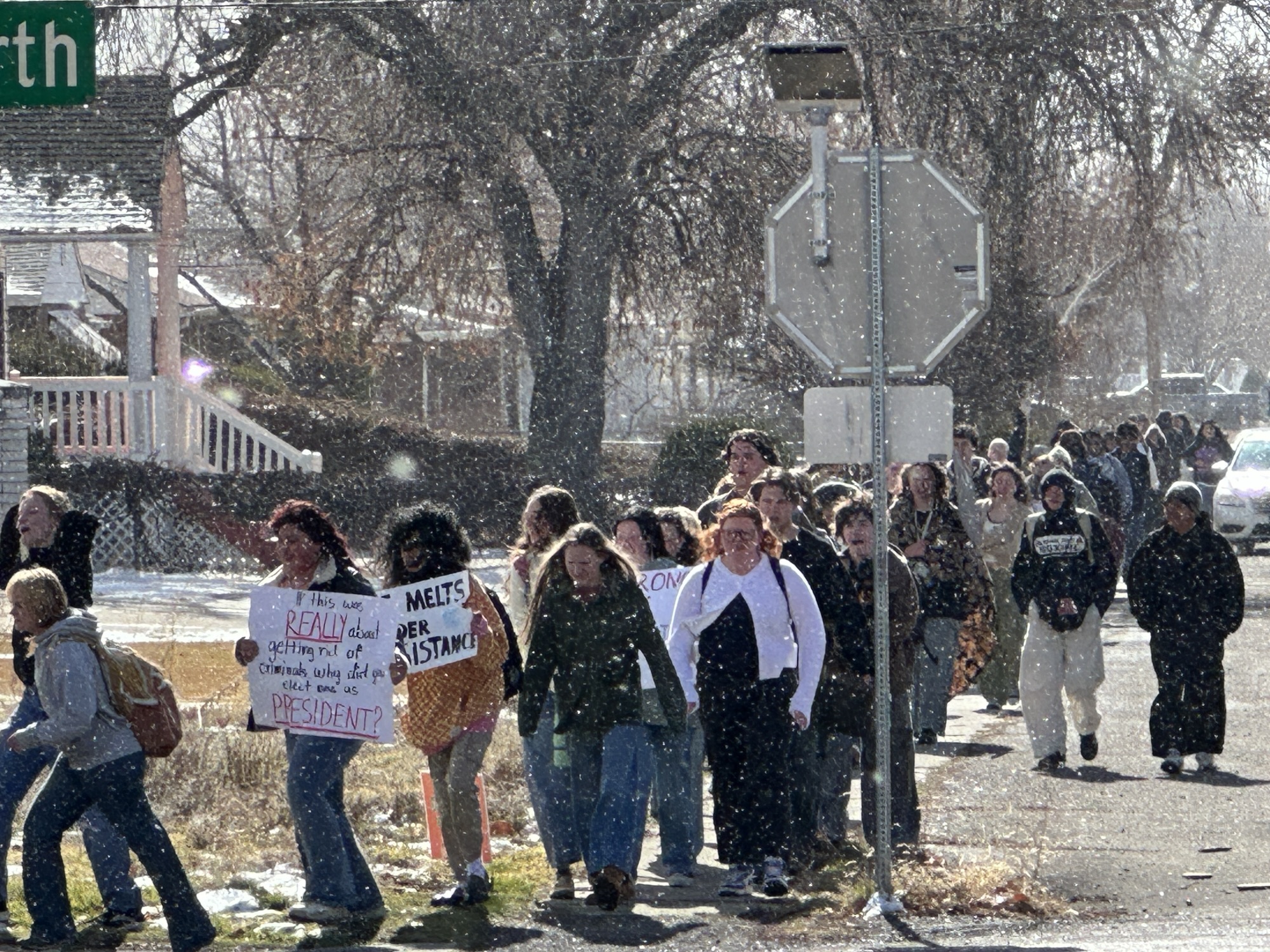
The wind was picking up, and large snowflakes started to come in sideways. It would take more than this snowstorm to keep about 50 American Fork High School students from exercising their right to assemble and peacefully protest.
They walked out the front doors just after 11 a.m. on Friday, Feb. 20, signs in hand, chanting loud enough to turn heads as they moved from campus towards downtown American Fork and back.
The target of their frustration: U.S. Immigration and Customs Enforcement (ICE) and what students called overly aggressive tactics by the federal agency.
“This is what democracy looks like,” they chanted, as they faced the winter storm elements. An American Fork police officer trailed the group at a comfortable distance, about 50 feet back, the whole way through town.
Cars honked as they passed. Students cheered back. For about an hour, this quiet Utah County city had something it doesn’t see often: a student protest, mid-blizzard, making its way through the community.
The march didn’t appear on any school calendar; it was organized entirely on social media. An Instagram post urged students to “bring signs, T-shirts, anything that shows you’re against ICE.”
The signs were handmade, and some of them pulled no punches. One read “ICE melts under resistance.” Another, perhaps the bluntest of the bunch, asked: “If this was really about getting rid of criminals, why did you elect one as president?”
From what this reporter observed, the students followed traffic and pedestrian laws throughout the march. No confrontations, no property damage — just a lot of determined teenagers with a message they wanted to be heard.
Not everyone along the route agreed with that message. As the group looped back toward campus, a handful of students stood in a driveway across the street holding their own signs — “ICE ICE Baby” — in apparent support of the agency.
Principal Peter Glahn sent a message to school families before the walkout, acknowledging the online chatter and being upfront that the school couldn’t physically stop students from leaving.
“While our campus is secure, we cannot physically prevent students from leaving,” Glahn wrote. Students who walked out were marked absent, but parents could excuse it.
Alpine School District had already gotten ahead of things with a broader statement issued Feb. 12, after walkouts at several district schools prompted the Utah State Board of Education to weigh in. The board’s guidance was measured: schools should keep students safe, apply attendance policies evenly and not let any demonstration — regardless of its message — disrupt the learning environment for kids who stayed in class.
“These issues raise passions and interest for some of our students,” the district wrote. “We will use these events as opportunities to learn about citizenship, critical thinking, and communication.”
Here’s what stands out, though. Some of these kids can’t vote yet. Most of them won’t cast their first federal ballot until 2028 — some maybe 2026, if they’re seniors and turn 18 in time for the midterms. And yet there they were on a Friday morning, in the middle of a Utah snowstorm, exercising a constitutional right that a lot of adults skip even on sunny Election Day.
Whatever your view on ICE, or on student walkouts, it’s hard to dismiss 50 teenagers marching through a blizzard. They were cold. They were loud. And they were paying attention — which, in a few years, will translate into something that actually shows up in the numbers.
That’s worth noting.
Rob Shelton | American Fork Citizen
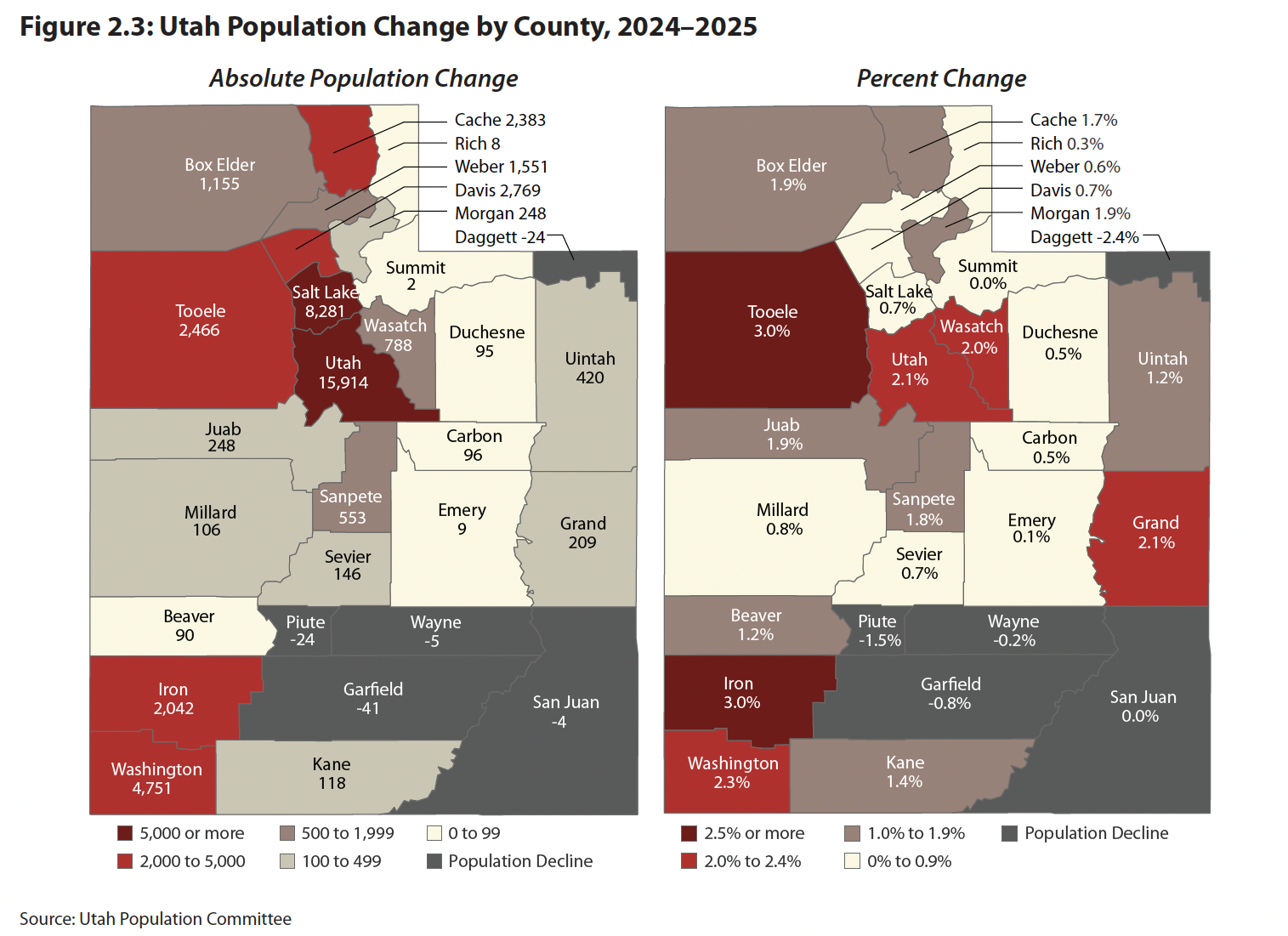
Utah County is on track to add nearly 800,000 residents by 2065, according to the 2026 Economic Report to the Governor released by the Utah Economic Council.
That growth alone will reshape cities from Eagle Mountain to Payson. Roads will carry more commuters, classrooms will fill, and housing demand will intensify. The county will shoulder nearly half of the region’s long-term population surge.
“The projections indicate Utah County will double to 1.5 million residents between 2025 and 2065, an addition of nearly 800,000 people, driving 45% of total regional growth,” the report states.
That’s not a marginal bump: it’s a transformation. A transformation that Utah County has been experiencing for the past 10 years, and there is no slowing down in sight.
Utah’s population will climb from nearly 3.6 million in 2025 to 5.6 million in 2065 — a gain of 2 million residents. Much of that expansion concentrates along the Wasatch Front, particularly inside the Greater Salt Lake Economic Region, which includes Utah County.
For residents in North Utah County, the numbers signal what many already feel: steady pressure, congestion and increased housing costs.
Utah County currently is one of the lowest-funded counties in state transportation dollars per capita, but is the one experiencing much of the growth. State elected officials who represent Utah County will have their work cut out for them. The 2050 Mountainlands Association of Governments transportation plan shows a huge shortfall of $5.1 billion for regional transportation projects in Utah County.
Employers compete for workers. Builders will need to race to keep up with expected demand. Local governments debate infrastructure, density and transportation corridors. And yet, the economy continues to expand.
“Projections indicate Utah will continue to show strong job growth relative to the U.S.,” the report notes. Over the next 40 years, Utah adds 1.2 million jobs statewide, increasing total employment from 2.5 million in 2025 to 3.7 million in 2065.
In the short term, however, the labor market shows signs of cooling.
“Utah’s labor market exhibited both resilience and general cooling in 2025, with 1.5% job growth and a 3.3% unemployment rate,” the report states.
That cooling reflects broader national uncertainty. Rapidly changing federal trade policies slowed hiring in several industries. Job openings declined. The labor force participation rate edged downward. Layoffs ticked up modestly as companies took a cautious approach. Even so, wages kept pace.
Average annual wage growth reached 3.2% in 2025, slightly above the 2.7% inflation rate. Education and health services accounted for more than one-third of new jobs — a trend that matters in Utah County, home to major health systems and higher education institutions.
Entrepreneurship remains another bright spot.
Since 2000, Utah’s quarterly new business establishment birthrate has averaged about 4%, compared with roughly 3.2% nationally. In 2024, that rate climbed to 4.5%, well above the U.S. average of 3.4%. In August 2025, high-propensity business applications jumped 24%, outpacing the 20% national increase.
That momentum shows up locally. The Governor’s Office of Economic Opportunity highlights Utah Energy’s plan to invest in a new uranium enrichment facility, creating more than 900 jobs in Utah County over the next 20 years.
Public policy also shapes the outlook. Lawmakers cut the state’s individual and corporate income tax rate to 4.50% from 4.55% in 2025. Utah maintains a AAA bond rating from all three major agencies and carries less than $1 billion in outstanding general obligation bond debt, well below its constitutional limit.
That fiscal stability, the report argues, secures a low cost of borrowing for taxpayers and reduces long-term risk. But growth carries consequences.
Households will nearly double statewide by 2065, rising from 1.2 million in 2025 to 2.3 million. At the same time, household size shrinks as Utah’s population ages. The median age will increase from 32.8 in 2025 to 45.3 in 2065. The share of residents age 65 and older climbs from 12.8% to 22.9%.
In practical terms, that means Utah County won’t just grow larger, it will grow older. This means fewer children per household, more retirees, different housing needs, and increased demand for health care and transportation services.
Most of that growth occurs in metropolitan areas. Smaller rural counties see only minor increases while the Wasatch Front remains the economic engine, representing about 88% of the state’s employment.
And the 2026 outlook calls for continued, though moderate, expansion. The Utah Economic Council forecasts U.S. real GDP growth around 2%, inflation near 3%, and unemployment slightly above 4.5%. Utah mirrors that steady trajectory.
For Utah County residents, the takeaway is straightforward.
Jobs continue to grow, though at a tempered pace. Wages outpace inflation, at least for now. Businesses keep launching, the population climbs steadily, driven largely by migration. And over the next four decades, Utah County stands at the center of the state’s expansion.
Growth is coming. In fact, it’s already here.
The real question for residents is whether state and local officials are planning — and paying for — the infrastructure needed to handle that growth. Families watching new subdivisions rise along I-15 already know change is coming. What matters now is how well the State, County and cities prepare for what the data clearly shows lies ahead.
Megan Wallgren | American Fork Citizen
Energy is at the heart of the future, powering daily life, economic growth and new technology, and how it is produced will shape communities for generations. To help guide that future, Utah Associated Municipal Power Systems (UAMPS) is investing in the next generation of energy leaders by offering a scholarship program for local high school seniors for a second year.
UAMPS, in partnership with its member utilities, will award eight scholarships worth $2,500 each. The program is designed to encourage students to explore careers that support affordable, reliable and sustainable energy, while helping build a skilled workforce for the future.
“Investing in the next generation of energy professionals is critical to the future of public power,” said Mason Baker, CEO and general manager of UAMPS. “By continuing this scholarship program into its second year, UAMPS is helping students build pathways into an industry that plays a vital role in strengthening our local communities and supporting long-term energy reliability.”
Students are eligible if they are high school seniors planning to attend a two-year or four-year college or a trade program, have a GPA of 3.0 or higher, and are U.S. citizens. Applicants must live in a household within a UAMPS member municipality, which includes Lehi.
Applicants are required to submit a 500- to 1,000-word essay, written without the use of AI, describing the benefits of renewable energy, their planned field of study, and how their education and career goals will promote or advance renewable energy. A cover page and a copy of the student’s most recent transcript must also be included.
Essays and transcripts must be emailed to [email protected] by midnight on Feb. 28. Scholarship recipients will be notified by phone and email by March 31.
UAMPS is a project-based consortium that provides a variety of power supply, transmission and other services to its 50 members serving 395,600 customers in seven western states: Utah, Arizona, California, Idaho, Nevada, New Mexico and Wyoming.

Leia Larsen | The Salt Lake Tribune
Note to readers • This story is made possible through a partnership between The Salt Lake Tribune and Grist, a nonprofit environmental media organization.
In rural Millard County, Kalen Taylor is bracing for the day the farmland across the street transforms into a sprawling data center complex.
Initial plans for Joule Capital Partners’ 4,000-acre data center site call for six buildings, each powered by 69 Caterpillar natural gas-powered generators to meet the intensive energy demands. Construction is slated to begin this spring. Once built, Taylor will likely hear the equivalent of more than 400 semi-trucks idling in his neighborhood around the clock, producing emissions year-round.
“I just would rather look out my backdoor and see cornfields than a data center,” Taylor said. “I like the sound of crops rustling in the wind, not the hum of a CAT generator making power.”
Farther north, Eagle Mountain city officials have turned to massive data centers operated by tech giants like Meta to provide much-needed tax revenue. But even in this urban, rapidly growing part of the state, developers struggle to secure the power they need from Utah’s largest electric utility, Rocky Mountain Power. Google has delayed building a campus there due to energy constraints. That prompted the City Council to explore building small nuclear reactors, to the consternation of many residents.
“It means our city would become a radioactive storage site,” said Joy Rasmussen, a mom of four who bought a home in Eagle Mountain in 2022.
This spring, in Washington, D.C., Sen. John Curtis (R-Utah) spoke glowingly to Sam Altman, CEO of OpenAI, about Utah’s aspirations to “lead” the nation “with data centers and advanced technologies” during a Senate Commerce Committee hearing on artificial intelligence.
Curtis noted the “challenges” that come with data centers’ insatiable energy demands. How, the senator asked, can the state protect ratepayers?
“The best way,” Altman responded, “is much more supply. More generation.”
With the growing demand for more data centers, Utah finds itself in a difficult position. State and federal officials have called AI the “arms race” of a new era, as the nation looks to fend off Russia and China and forge its place as the world’s leader in technology, energy and innovation. And Utah looks to position itself at the forefront of that fight.
The state’s main electricity provider, Rocky Mountain Power, doesn’t have the capacity to meet the surge in energy demand. Data center developers have instead turned to generating their own electricity, mostly using natural gas. Gov. Spencer Cox has zeroed in on nuclear as a cleaner energy solution as part of his Operation Gigawatt.
That collision of the AI boom and limited power supplies means Utah’s rush to build data centers is likely to rely on fossil fuel energy for the foreseeable future, raising concerns about the state’s already struggling air quality. Alternative sources won’t match the demand the centers generate — potentially as much as four times what Utah residents and businesses currently consume. Small nuclear plants are at least a decade away, while the Trump administration has curtailed many incentives for solar and wind power.
Lawmakers and regulators are trying to balance the needs of energy-intensive industries without ratepayers feeling the environmental and pocketbook pains felt in other parts of the country, like rising energy bills and polluted resources.
“We’re kind of in a big mess right now,” said Logan Mitchell, a climate scientist and energy analyst for Utah Clean Energy, “and it’s manifesting in all of these different ways.”
Data centers turn to self-built power
Rocky Mountain Power, like many private utility providers in the U.S., has a monopoly as the sole electricity provider in much of Utah, but it must yield to state regulation. For decades, power providers hummed along as energy demand across the country stayed relatively flat.
Conflict arose, however, when platforms like Altman’s ChatGPT, Google’s Gemini and Elon Musk’s Grok made AI a mass consumable good rather than a niche product. Demand for more data centers gripped the globe, and the utilities, which plan for energy needs decades in advance, were caught unprepared and undersupplied.
Data centers use substantial amounts of energy, with rows of servers computing day and night for services that are an increasing part of daily life — streaming services, online banking, e-commerce and the rise of AI. In arid Utah, many data centers have pivoted away from water-guzzling evaporative cooling in favor of closed-loop systems, which require more electricity to run.
Last year, the Utah Legislature passed SB 132, allowing private companies with energy demands of 100 megawatts or more to build their own generating stations that operate off the public grid used by nearly everyone else. The bill’s sponsor, Sen. Scott Sandall, R-Tremonton, specifically cited data centers as he promoted the legislation.
“It kind of un-handcuffs Rocky Mountain Power to provide these loads for data centers, for AI, for large manufacturers,” Sandall said, “those that are coming in, and quite frankly, changing the curve of power demand.”
In Millard County, both Joule and Creekstone Energy intend to build their own massive facilities, powered by natural gas.
“We are so excited for other alternative energy sources like geothermal and solar and wind and someday, maybe even nuclear,” said Mark McDougal, a managing partner of the Joule data mega-campus. “But we can’t wait for that.”
Natural gas is efficient, McDougal said, and a proven technology that can run around the clock.
The developers received support from county leaders because of their potential to create employment in construction, maintenance and security, along with boosting economic development. The rural community in central Utah lost its largest employer, the Smithfield Foods pork processing plant, in 2023 – it accounted for about a quarter of all jobs in the county. The idling of the nearby Intermountain Power Plant’s remaining coal units also caused a hemorrhaging of local jobs.
Construction of the massive sites will bring some jobs to the communities, but data centers generally employ a relatively small number of permanent workers.
Millard County’s location is attractive to data center developers because it lies on a fiber optic corridor and near a natural gas pipeline, along with large transmission lines associated with the old coal plant.
“Having both of those in the same place,” said Ray Conley, Creekstone’s CEO, “and not having a large metropolitan area that is competing for power is a very unique combo.”
It also lies outside the Wasatch Front, an area plagued for years by poor air quality that falls short of federal standards.
“It’s so hard where you have inversions and trap emissions,” McDougal said. “[Here] emissions are able to disperse.”
Joule’s applications filed with the state indicate it will produce 1 gigawatt to start — about a quarter of the electricity Utah currently uses annually. But its own public statements indicate it intends to produce more than 4 gigawatts onsite. Creekstone, less than a mile away, intends to produce 10 gigawatts, Conley confirmed.
At least a few computing campuses want to build natural gas plants on the Wasatch Front as well, despite its inversions and air quality challenges. Data company QTS received approval from the Eagle Mountain City Council to build a 20-acre, 200 megawatt plant last year, although a company spokesperson said it secured power from Rocky Mountain instead.
In West Jordan, the expanding Novva data campus received state approval to build a 200 megawatt natural gas plant in December 2024.
But “natural gas” is an old greenwashing term, Mitchell said. The fuel is methane, a potent greenhouse gas. Burning it produces carbon dioxide, nitrogen oxides and other pollutants.
Nitrogen oxides mix in the atmosphere, get baked by the sun and turn into particulate pollution in the winter and ozone pollution in the summer.
The pollutants create haze in rural parts of the state as well, and impact visibility at Utah’s famed national parks from Arches to Zion.
Even data centers on the Wasatch Front that have tapped into the existing power grid also received approval to install hundreds of diesel-fueled generators in the last five years, including QTS, Meta and the National Security Agency in Utah County and eBay, Aligned, DataBank, Oracle and Novva data centers in Salt Lake County. Those generators would only run during blackouts and other emergencies when the campuses can’t get enough grid power, according to permit applications. But diesel emissions contain even more harmful pollutants than natural gas.
In November, the federal government removed Northern Utah from its list of regions out of compliance for wintertime inversion pollution after more than a decade, thanks to state efforts like banning wood burning on poor air quality days combined with stricter federal regulations on vehicles and fuel. But it continues to struggle with meeting national requirements for ozone smog.
The new data centers coming online, with their diesel and natural gas generators, could bump the state right back out of compliance, environmental advocates say.
“They’re eating into all of the progress we’ve made to reduce emissions from other sources,” Mitchell said.
State regulators said they’re not just concerned about temporary diesel generators and year-round natural gas generators taking a bite against air quality gains in recent years.
“We’re concerned about all growth,” said Bryce Bird, director of the Utah Division of Air Quality. “Everything that has to do with people also has emissions associated with it.”
That doesn’t mean Utah can’t be a tech leader, said Department of Environmental Quality Executive Director Tim Davis. But the state’s still figuring out how to strike the right balance between affordable energy creation, environmental protection and improving public health.
“I don’t know of a state that is not having similar conversations,” Davis said. “That’s just a mind-numbing amount of new power that they’re trying to plan for.”
‘If anybody wants to criticize data centers, look in the mirror’
Novva applied for a two-year presidential exemption from the Clean Air Act in March under a program designed to benefit coal plants, smelting facilities and chemical manufacturers. The company asked for the exemption so it could operate using diesel generators while it finishes building its natural gas plant, according to records obtained by Grist and shared with The Salt Lake Tribune.
The company noted Rocky Mountain Power can’t provide the electricity needed until 2031, and even then, it’s not guaranteed. The requested exemption aligns with national security interests, Novva wrote in its application, citing the U.S. Department of State’s assertion that AI is “at the center of an unfolding global technology revolution” and can help make Americans safer.
Novva CEO Wes Swenson said he never received a response to the exemption request. He insisted, however, that data centers like his are important for protecting “American data.”
“If anybody wants to criticize data centers, look in the mirror,” Swenson said. “‘I want Netflix, I want Prime, I want Apple TV.’ … Nobody goes to the library anymore. Who uses cash? Where do people think that all comes from?”
Where will all the new energy come from, and how will it impact Utahns?
Utah leaders have honed in on nuclear power, and small modular reactors in particular, as a cleaner and more sustainable solution to the spike in energy demand. The need is not just driven by data centers, but also a hoped-for renaissance in manufacturing and the future electrification of Utah’s transportation. But Rocky Mountain’s parent company, PacifiCorp, only has firm plans for one small reactor – a plant under construction by TerraPower in Kemmerer, Wyoming. It won’t come online until around 2032, and Utah will share its projected 500 megawatts with other Western states.
Enthusiasm for small nuclear reactors within Utah’s borders appears tepid. Brigham City is the only community so far to fully embrace nuclear reactors. But in making that announcement, state leaders were light on specifics in explaining why the small city needs the power. No known data centers are planned for the area.
Ninety minutes south in Eagle Mountain, Meta’s data campus is expanding, a huge QTS data hub is under construction and Google is waiting to build on 300 acres it owns within city limits. The city made two attempts last year to adopt an ordinance to allow for nuclear development and other energy projects, including solar farms. After receiving mixed feedback, the efforts failed.
The pivot to nuclear has environmental and clean energy advocates wondering why Utah has shied away from renewables. Cox calls his Operation Gigawatt an “all-of-the-above” strategy that welcomes all energy sources. But resources like wind and solar have faded from the conversation.
“People see renewable energy as the woke liberal energy, and we have to stick with fossil fuels and nuclear, because that’s what conservatives want,” said Ed Stafford, a professor of marketing at Utah State University whose research focuses on renewables. “Politicization of energy is just a bad thing, because, as common sense tells us, we should go with the cleanest and cheapest forms of energy that spreads the wealth around.”
PacifiCorp intends to bring no new solar, wind or battery storage online in Utah over the next two decades, according to the latest draft of its long-term resource plan. Meanwhile, the utility isn’t factoring large energy consumers, like data centers, into its projections, to Mitchell’s frustration.
“Rocky Mountain Power should be planning for the reality of the future,” Mitchell said, “rather than creating a fictional reality that indicates they don’t have much load growth and they’re not going to build new resources.”
Data center developers and operators interviewed for this story said they support transitioning to cleaner energy sources. But they also need consistent and reliable power, when the sun doesn’t shine and the wind doesn’t blow.
“The economic rebates and incentives are going away, which is why it’s not as in fashion as it was before,” said Conley, Creekstone’s CEO. “But a lot of [data] customers are willing to pay a premium for green energy instead of dirty energy.”
Conley’s company recently applied with the Utah Office of Energy Development to operate the Intermountain Power Plant’s remaining coal units, which went idle this year after the plant’s customer base in California decided to transition to cleaner energy sources.
“Diversification,” the CEO said, “reduces risk.”
Risk is at the forefront of at least some Utahns’ minds, particularly as news stories across the nation call out data centers for driving up the cost of power for all ratepayers. Utilities build new generating plants and upgrade decades-old grid equipment to meet rising demand, then spread the costs among all their customers. This year, Pew reports, both data centers and cryptocurrency mining could cause the average U.S. power bill to grow 8% by 2030.
In Utah, however, SB 132 seems to serve a dual purpose of helping data center developers get the energy they need behind the meter, while protecting other customers who still use the traditional grid.
“There’s very little evidence that data centers have impacted rates to date,” said Michele Beck, director of the Office of Consumer Services, a utility watchdog part of the Utah Department of Commerce.
She called SB 132 one of the “best ideas out there” for protecting power customers in the nation. But, she said, it’s important for Utahns to remain vigilant. It’s not just utilities struggling to catch up to new demand. Regulators have struggled to keep pace as well.
“The industry in general is speeding up,” Beck said. “It just compounds everything.”
Grist reporter Naveena Sadasivam and Tribune reporter Addy Baird contributed to this story.

Miss American Fork Pageant seeks future royalty

AFHS students find connection and culture through national exchange

Utah County Commission Seat B

‘BIGGEST LOSER’ CONTESTANT FROM AF DIES TRAGICALLY

Aspen Peaks School Board “Meet the Candidates” night recap

Tragedy Strikes American Fork: Local Couple Found Dead in Apparent Murder-Suicide
-

 Local News1 month ago
Utah’s massive data centers seek to build new power sources
-

 Local News4 weeks ago
AFHS students march in blizzard to protest ICE
-

 Local News1 month ago
Utah County population will double by 2065
-

 AF City News1 month ago
Residents pack city hall over zoning fight at public hearing
-
Local News1 month ago
UAMPS to award scholarships for energy-minded seniors
-
Local News1 month ago
Utah County seeks $2 million from legislature for Tyler Robinson case
-

 Obituaries1 month ago
Mary Elizabeth Ballard
-

 Obituaries1 month ago
Carol Devitt Thomas
-
Opinion1 month ago
OPINION: A personal tribute to Jeffrey R. Holland
-
Opinion1 month ago
OPINION: Why should we participate in the caucus?