
AF City News
Utah County Commissioner Seats A and B candidates profiled


STAFF WRITER | American Fork Citizen
As part of our commitment to keeping voters informed, the American Fork Citizen invited candidates in contested Republican races appearing at the upcoming county convention to participate in a candidate profile by responding to the same three questions.
By asking identical questions, we aim to provide voters with a clear and consistent way to compare each candidate’s priorities, experience, and vision for our community. The profiles below include the responses we received by our publication deadline.
Here are the questions candidates were asked:
Why are you running for public office?
What are your top priorities if elected?
What separates you from other candidates?
If any of these convention races advance to a primary election, the Lehi Free Press will provide additional coverage during the primary cycle, May through June. Contested races for the general election will be covered in the September through October period.
For Seat A, Nate Helper and Renee Tribe did not provide a response prior to the print deadline.
For Seat B, Carolina Herrin, David Spencer, Tom Westmoreland, Truman Van Cott and William Brimley did not provide a response prior to the print deadline. Brian Voeks withdrew his candidacy.
CANDIDATE PROFILES SEAT A

Brent Bowles
I am running to bring fiscal responsibility back to Utah County government.
Commissioner salaries have increased from $111,000 in 2019 to $168,000 in 2025. During 2024–2025, more than twenty new staff members were added, along with the hiring of a County Administrator — creating another layer of bureaucracy between citizens and elected officials.
Instead of identifying areas to reduce spending, the county has increased taxes. Meanwhile, as cities expand their boundaries and county jurisdiction shrinks, county staffing continues to grow. When I asked why, I received no clear answer.
Utah County is also experiencing rapid growth, including increased high-density housing, without adequate infrastructure in place — including water, roads, utilities, and emergency services.
I propose a five-member, part-time commission. Salaries would be reduced to $60,000 per year, with representation from the North, South, East, West, and one at-large commissioner. This change would generate immediate savings of approximately $250,000 per year.
I am not running for a paycheck. I am running to restore the principle of public service.
During my nine years as a Homeowners Association President, I helped move our finances from long-standing debt to a stable position without increasing dues. I have volunteered countless hours in the community, worked with local officials, and followed a strict budget grounded in fiscal responsibility.
I retired after 23 years in firefighting and have operated my own independent anesthesia practice for 18 years. Having worked in both the public and private sectors, I understand the responsibilities and challenges of each.
My wife, Cindy, and I have lived in Utah County for 30 years. It has been a wonderful place to raise our children. As farmland continues to be sold and high-density housing expands, I believe we risk losing the family-centered lifestyle that has long defined Utah County. This deeply concerns me and is another reason I am running for County Commissioner.

Larry Evans
Having been raised in Utah County, I deeply appreciate the quality of life established here and am committed to ensuring our way of life continues for generations. Utah County faces important social issues that require thoughtful attention and a clear plan of action. My decision to run for public office stems from a desire to bring my perspective and unique experiences to address these challenges. My priorities include making the Commissioner’s office more accessible and responsive to residents, ensuring efficient and economical county operations, working collaboratively with city leaders for controlled growth, and introducing fresh ideas to county government. I believe that by listening to the community and fostering open communication, we can build a stronger, more vibrant Utah County. My goal is to serve with integrity, transparency, and dedication, always putting the needs of our citizens first and striving to preserve the values that make Utah County special.
With 40 years in Law Enforcement, I’ve developed skills in conflict resolution, problem solving, and crisis intervention. As Regional Administrator for Adult Probation and Parole, I supervised offices in Utah, Wasatch, Juab, and Millard counties, gaining experience in managing budgets, resolving personnel issues, and building partnerships with allied agencies. I am adept at effective interpersonal communication and leadership. Currently, I serve on the Utah State Retirement Board and have taught at Utah Valley University for 12 years as an Adjunct Professor. These roles have prepared me to address complex challenges and work collaboratively for Utah County residents.
Raising my family in Utah County has been a joy. I love hiking, running marathons, music, and travel. Patriotism and service are central to my life. Watching my grandchildren thrive here inspires me to give back and help ensure a vibrant, supportive community for future generations. My candidacy is an offer of service to the residents of Utah County, not a job application for a political career—I am committed to serving our community with integrity and dedication.

Christopher Forbush
I’m running for County Commission Seat A because I believe the county has a clear opportunity to hit the brakes on tax increases and improve administrative responsibility and efficiency, and I’m here for it. In recent years, the outgoing commissioner of this seat made significant budgetary missteps: (1) commissioner salaries rose 43%, from $119,000 to a staggering $170,000 annually in less than 5 years. (2) Commission-related positions exploded from 6 to 23, many unnecessary, costing taxpayers additional hundreds of thousands. (3) Failure to join the county to the Indigent Aggravated Murder Defense Fund, leaving taxpayers responsible for millions in capital case costs like the Charlie Kirk murder case. Meanwhile the commission tapped taxpayers – imposed a 48% tax increase for 2025, still here in 2026. I see opportunities to cut costs (priorities: lower commissioner salaries, eliminate commission-related staff positions) and allocate resources more efficiently to better benefit our county community.
I am currently the Vice Chair of the Utah County Board of Adjustment. I’ve served on this board in a quasi-judicial capacity for 4 years since being appointed. More importantly, I’m an attorney that has made a career of conducting corporate investigations, including at Amazon, and litigating cases involving breach of fiduciary duty, breach of trust, and breach of contract. The county commission needs another commissioner that can look at the county budget with meaningful scrutiny and will seek to maximize the taxpayer benefit from every tax dollar. I will do that.
I was born in Payson to a police officer dad and a musician mom. I served an LDS mission to Brazil. I enjoyed 8 years at BYU where I earned my law degree in 2015. During undergrad I owned a fitness company that I exited to pursue law school. I met my wife soon after law school. We have two children. Beyond the law, I was a professor of golf at UVU for 2 years.

Taylor Fox
I chose to run for Utah County Commissioner because I believe in a government that prioritizes transparency, fiscal responsibility, and the well-being of families over bureaucracy. I recognize that many residents feel disconnected from decision-making processes, and I am committed to bridging that gap to restore trust in our county’s management of resources. My top priorities include: (1) ensuring responsible budgeting and sustainable financial practices, (2) fostering transparency and enhancing public access to county decisions, (3) promoting strategic growth and infrastructure development that safeguards our quality of life, and (4) implementing policies that prioritize families and support local businesses. As Utah County continues to grow, we need thoughtful leadership that plans wisely while also being accountable to taxpayers.
My unique blend of private-sector experience and public-facing communication equips me with a distinct advantage. As a program manager at BYU and an entrepreneur, I am adept at managing projects, budgets, and stakeholder relationships. I approach challenges with a problem-solving mindset, focusing on efficiency and tangible solutions. My hands-on experience collaborating with students, customers, and community members has enhanced my ability to listen, communicate effectively, and ensure follow-through—skills essential for successful county leadership.
My name is Taylor Fox. I am a husband, father of three, small-business owner, true-blooded Utahn, and American. I care deeply about responsible government and the long-term strength of Utah County. I am running to bring practical problem-solving, transparency, and a family-focused perspective to county leadership.

Michelle Kafusi
This race isn’t about a title; it’s about putting my commitment and experience to work providing steady, principled, and reasonable leadership on the Utah County Commission. I’m running because this is home – where I’ve raised my family, worshiped with neighbors, and learned the value of caring for one another.
Government should live within its means, respect local control, and make decisions the way families do – with a limited budget, common sense, honesty, and an eye toward the future. My years as Mayor of Provo taught me that real leadership means bringing people together to solve problems, while staying true to conservative principles.
Utah County is special because of hardworking, faith-filled families who serve without hesitation. I’m running to be a steady conservative voice for them: supporting law enforcement, strengthening our economy, protecting natural resources, and planning responsibly for growth to preserve our way of life for future generations.
I bring proven executive leadership. Having served two terms as the mayor of Utah County’s largest city, I have significant experience – Running efficient government, Managing long-term investments, Leading multiple departments, Dealing with public safety issues, Understanding and coordinating transportation needs, and Making the tough decisions necessary to balance complex budgets. I believe deeply in small, efficient government, strong public safety, and well-managed growth that strengthens, not strains, our communities. Putting these values into practice is much more difficult than just talking about them. Utah County doesn’t need on-the-job training. It needs steady, experienced leadership from day one.
I was raised in Provo by a single mother who worked graveyard shift to put food on the table. We didn’t look to government to solve problems – we worked harder. These principles were deeply woven into my character – dignity comes from effort, freedom requires responsibility, and strong families – not big government – are the backbone of a strong community.
I’ve been married for 38 years and have five children and seven grandchildren.

Richard Smith
Our county’s tax system is not operating as efficiently as it should, largely because of communication failures between tax entities. The county is responsible for valuing property, setting tax rates for all taxing entities, and collecting and distributing those taxes. When communication breaks down—whether between county departments or between the county and our taxing entities—the entire process suffers.
Delays in receiving critical information from municipalities have directly affected our ability to perform our duties effectively. These are not minor inconveniences; they are systemic issues that cost time, reduce efficiency, and ultimately impact taxpayers.
I am running for County Commissioner to fix this. My priority is to establish clear, consistent communication standards among all taxing entities, so the system functions smoothly, efficiently, and in the best interest of the public.
I have experience working within the county government system, where I have heard firsthand the concerns of taxpayers regarding the burden of rising taxes and uncertainty about the future. Through this work, I have developed a strong understanding of how our local government operates, including both the strengths of our departments and the challenges they face. This direct, practical insight gives me a unique advantage in identifying opportunities for meaningful, efficient improvements that can increase productivity and better serve our constituents.
My wife and I are both from Utah, and we met while attending Utah State University. For the past four years, we and our five children have proudly called Spanish Fork home. We value being part of this community—building relationships, serving others, and contributing where we can. As a family, we spend much of our time outdoors, camping, hiking, and enjoying the natural beauty and local parks throughout our county.
CANDIDATE PROFILES SEAT B

Rod Mann
I’m running for Utah County Commissioner because I believe our county deserves experienced, steady leadership that puts taxpayers first and keeps government accountable to the people it serves. As the current Utah County Auditor, I’ve had a front-row seat to how county government works, where it works well, and where it needs improvement. This role has reinforced my conviction that transparency, fiscal discipline, and clear communication are essential. County government should be efficient, honest, and always respectful of the trust residents place in it.
Utah County is growing rapidly, and with that growth comes responsibility. I’m a leader who will ask tough questions, protect taxpayers, and plan carefully for the future without losing sight of what makes our communities great. I will apply my experience, commitment to transparency, and passion for public service to help guide Utah County forward responsibly, keeping our residents at the center of every decision
Before serving as Auditor, I had the honor of serving my community as both a city council member and mayor. Those experiences taught me the value of local decision making and the importance of collaboration between cities and the county. I understand the challenges our cities face, from growth and infrastructure to public safety and budgeting. I know that county leadership must work as a partner, not an obstacle. My goal as Commissioner is to bring practical, solutions-oriented leadership to the county and ensure the county delivers essential services effectively while keeping residents informed.
My wife, Suzanne, and I met in Utah County over 45 years ago and have lived here for the last 23 years. We have four children and fifteen grandchildren whom we adore. We both love to serve; it is part of our family’s DNA. I worked in technology for 30 years. I love data and sharing information with my constituents whether in person or via posts (see bit.ly/BlogHighland and bit.ly/BlogUCA).

Isaac Paxman
I come from a long line of people who believed in serving their community; that legacy drives me to make a meaningful impact wherever I can. We are at a pivotal moment. As the state’s fastest-growing county, we have the foundation to become the best‑run county in the nation, but that requires experienced commissioners who seize opportunities while staying true to limited government and strong family values.
We need commissioners who can step in immediately with expertise to navigate complex county issues. Working for the largest city in the county over the last eight years, I forged connections with community leaders at the local, county, and state level. And I gained the executive leadership experience necessary to preserve our heritage while preparing wisely for the future.
My priorities include:
- Public Safety
- Protecting our Water/Agricultural Strength
- Wise Investment in Transportation
I bring broad experience, from representing the United States in the Department of Justice to serving eight years as Provo’s Deputy Mayor, as a business owner, and working in the Utah Attorney General’s Office. I’ve been tested and prepared to serve as commissioner, having handled many of the same issues in Provo—public safety, transportation, overseeing department directors, and helping lead a Utah County task force recognized nationally for excellence. I’ve built a reputation for effectively managing both projects and people. This experience, both broad and specific, gives me a solid foundation to serve the people of Utah County.
I’m proud of my heritage. My great‑grandmother, Achsa Eggertson Paxman, served in the Utah Legislature, and my grandmother served on the local school board. Much of my ancestors’ service came without titles, yet they made a lasting impact on their communities. Their example inspires me to do the same. With generations of family ties throughout this great county, I’ll work hard to keep Utah County a strong home for families, taxpayers, and our shared values.


April Slaughter | American Fork Citizen
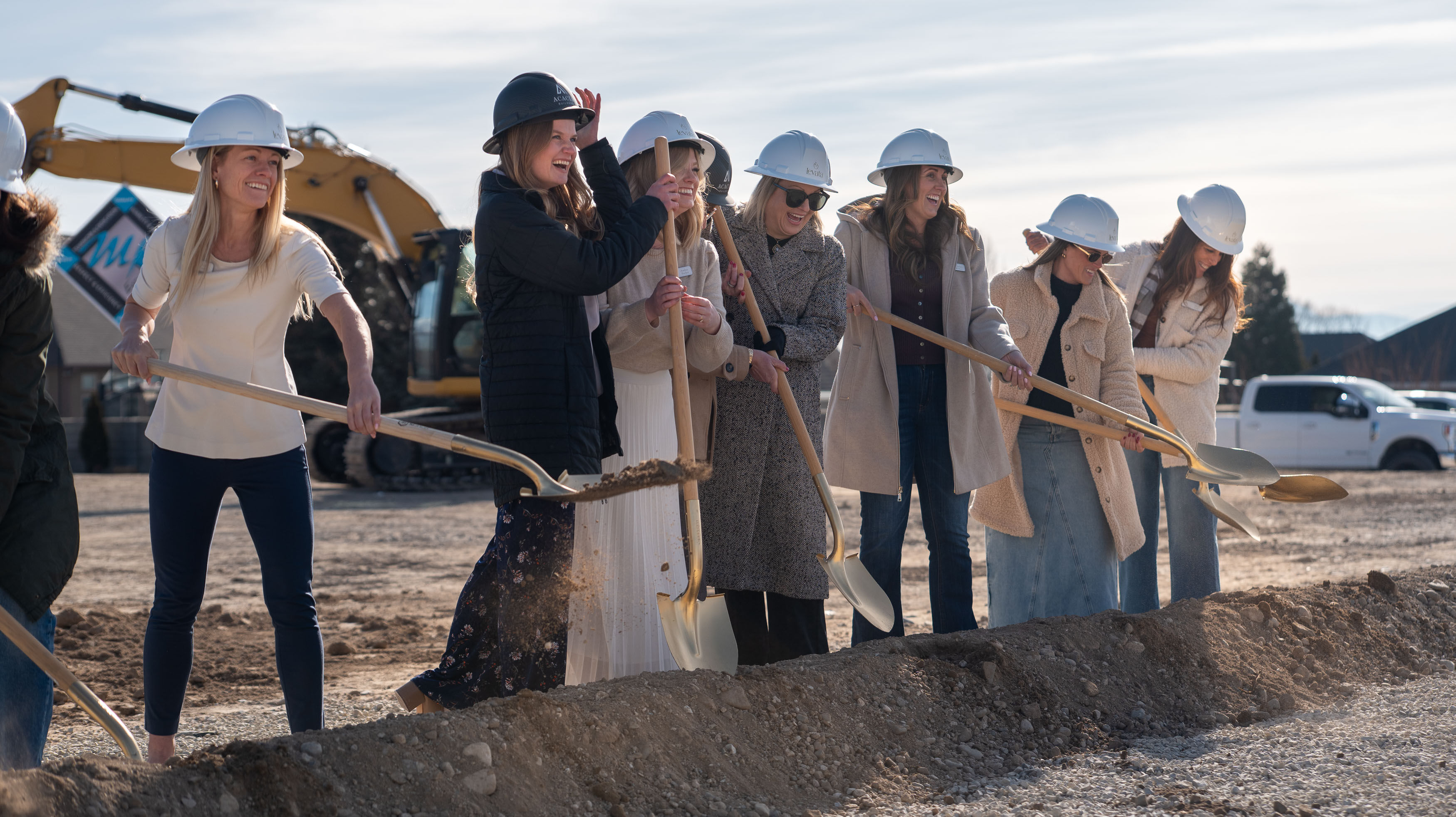
A new facility under construction in Lehi aims to redefine women’s recovery after childbirth and surgery by offering extended stays and rarely available post-hospital support.


Levata, a 38,000-square-foot retreat designed for postpartum and surgical recovery, is currently being built in a residential area of Lehi. Crews have completed the foundation and are now framing the structure, according to co-founder Amber Packer.
A groundbreaking ceremony for Levata was held in January 2026, marking the start of construction on the two-story facility. The center is expected to open early in 2027.
The facility serves two groups: new mothers recovering after childbirth and women healing from surgery. It offers medical support and extended recovery in a setting focused on rest and education.
Levata departs from traditional short hospital stays by offering longer, structured recovery periods.
The second floor of the facility will be dedicated to postpartum care, featuring private suites, a professional nursery, gathering spaces and amenities such as dining areas, physical therapy space and optional spa services. The design is intended to allow mothers to remain with their newborns while also having access to support when rest is needed.
For Packer, the idea for Levata grew out of her own postpartum experience.
“We chose this location because it is in a residential neighborhood, which offers a cozier feel,” she said. “We are also conveniently located near Common Spirit Holy Cross Hospital, Lehi Intermountain InstaCare, and just across the freeway from the new Primary Children’s Hospital.”
She added that Utah County’s high birth rate made Lehi a natural location for the project.
Stays at Levata include a private suite, meals and a 24/7 staffed nursery where trained caregivers assist with newborn care, including feeding support.
On-site lactation consultants and mental health support are also available, reflecting a focus on both physical and emotional recovery.
“I think the biggest thing is just having someone there to help,” said a Lehi mother who asked to remain anonymous. “You go home, and suddenly it’s all on you. Even having a few hours of real rest would have made a huge difference.”
In addition to postpartum care, Levata will include a separate surgical recovery floor. This area is intended for women recovering from procedures such as cosmetic, reconstructive or orthopedic surgeries, as well as other treatments requiring extended healing time.
Patients are expected to receive monitoring and assistance throughout recovery. Specific details about medical oversight are still being finalized.
“Our primary goal is to provide comfort and education,” Packer said.
The project comes at a time when postpartum care has become a growing topic of discussion nationwide, with many women reporting limited support once they return home from the hospital. Levata’s model seeks to address that gap by offering a structured environment where recovery can unfold over a longer period.
The cost of a stay has not yet been finalized. Packer said the goal is to keep services as affordable as possible while maintaining a high level of care.
Packer said the company does not currently offer insurance coverage for these services but is exploring it in the future. For now, the focus remains on completing the Lehi facility and serving local families.
While Levata’s long-term influence remains uncertain, the project represents a new approach to women’s recovery.

By: Elizabeth Spencer
American Fork Citizen
The Miss American Fork organization invites young women to an open house for its 85th anniversary pageant. More than just a pageant, the event offers opportunities for growth, confidence and friendship.
Dorinda Ledkins has been involved in the Miss American Fork Program for 12 years, with this year marking her sixth as director. Reflecting on her time with the program, she shared, “I still remember my first year helping with the pageant, watching young women walk into orientation feeling nervous and uncertain. By the time competition night arrived, they stood on stage, brave and confident. Seeing that transformation is one of the most rewarding parts of this program.”
Participants commit to weekly workshops where they learn skills such as walking, posing, interviewing and answering on-stage questions. These experiences help young women grow not only as competitors but also as confident individuals prepared for future opportunities. Each participant chooses a community service initiative, allowing them to serve the community and raise awareness for causes important to them.
Current Miss AF Whitney Wilkins grew up seeing advertising for the program around the community, but it wasn’t on her radar to participate since she returned home from an LDS mission just months before the competition.
“A friend reached out and shared the information with me. I didn’t think I was a ‘pageant girl,’ but I kept thinking about it and felt like I should do it,” shared Wilkins. “I was excited to be involved in the community, do lots of service and push myself out of my comfort zone. I knew it would help me practice interview skills, get back into dance and strengthen my confidence.”
Wilkins’ favorite week of the entire year was Steel Days. As Miss AF, she participated in numerous events. “We got to cruise around in old cars, perform our talents, be in the parade and even be on the news. I also played in so many of the fun tournaments, shared about my community service initiative, and met the cutest little girls at Tea with the Queen.”
During her time as Miss AF, Wilkins learned to work with city leaders, find sponsors and connect with the community. She also enjoyed helping at school carnivals, ribbon-cuttings and trick-or-treating on Main Street on Halloween. In November, Wilkins hosted a talent show at the senior center. “I love getting to see the light I can bring people through service.”
Serving in American Fork City placed Wilkins in the public spotlight, where younger eyes were also watching. “Seeing how little girls look up to you as a real-life princess is such an honor and tender experience.”
“Even just competing for Miss American Fork is so fun. You get to learn so many valuable skills that will bless the rest of your life. I have learned interview techniques, received scholarships and made networking connections that will help me long after this competition is over. It is also so fun to see how much the participants grow in their confidence and communication abilities,” shared Wilkins.
“One of my favorite things to say is, ‘Not everyone leaves with a crown, but they all leave with a new version of themselves,’” Ledkins said. “The Miss American Fork Program is about so much more than a title: it is about growth, confidence and discovering potential.”
“Being part of the Miss America Program is more than a beauty pageant; it is grounded in community service and lifelong success,” Wilkins shared.
Miss AF and her attendants receive scholarship money and will represent American Fork throughout the year, participating in Steel Days activities and various community events. The new Miss AFwill also have the opportunity to compete at Miss Utah 2027, where she will join a sisterhood of city queens from across the state.
“It truly is an inspiring program, and I hope more American Fork girls will come learn about it. It is an experience that can truly change their lives,” concluded Ledkins.
“Your year as Miss American Fork is truly what you make of it and what you want to be involved in,” said Wilkins.
Young women ages 17-27 interested in competing are invited to attend the open house on Saturday, March 28, from 1-4 p.m. at Fox Hollow Golf Club (1400 N. 200 E.). The event gives girls a chance to meet the Miss AF Committee, connect with other participants, and learn everything they need to know about joining the Miss American Fork Pageant. The open house is a friendly, low-pressure environment designed to share what the program offers. The Miss AF Pageant will be held June 27 at 7 p.m. at American Fork Junior High (20 W. 1120 N.). For more information about the program, text 801-636-4204 or email [email protected].

Rob Shelton | American Fork Citizen
More than 2½ hours of public comment stretched late into the night Feb. 4 as residents packed the historic American Fork City Hall for a Planning Commission hearing on proposed zoning changes.
Some attendees said the room filled 30 minutes before the 6:30 p.m. meeting began. By start time, every seat was taken. People stood in the aisles. Both staircases were lined shoulder to shoulder. Others spilled into the main floor entry, straining to hear.
“It really was,” resident Tom Clark said when asked if it was a packed house. “I counted … 25 people” just on one stairwell, he said, estimating “over 50 people there” between both staircases, not including those seated or standing in the chamber.
From where he sat, Clark said, “I couldn’t even see where the line was to go up and make comments and let alone be able to make my way over there because people were standing in the aisles in front of me.”
The turnout came despite a city Facebook post stating, “Most property owners will not be impacted by these updates.”
Several residents said that statement didn’t match what they were seeing or feeling.
High density and property rights concerns
The hearing centered on proposed updates to the city’s zoning code and general plan. Residents raised concerns about high-density housing in downtown areas, changes to agricultural zoning and new restrictions affecting private property.
Clark argued the draft code “creates special exceptions for developers to build on smaller, narrower lots to ‘infill’ neighborhoods,” while prohibiting detached accessory dwelling units, or ADUs.
“External Accessory Dwelling Units are prohibited,” Clark wrote in a Facebook post referencing Section 14.12.080 of the draft code.
He also warned of shrinking buildable space for homeowners, citing increased side setbacks and the removal of corner lot exceptions. “You are being ‘downzoned’ without even knowing it,” he wrote.
At the hearing, multiple residents echoed concerns about density increases in established neighborhoods, including areas south of the golf course and near the FrontRunner station. One resident described streets where cars already park on both sides, making two-way traffic difficult.
Others focused on agricultural impacts. Kip and Kris Bromley addressed the commission about land proposed to be designated as “civic” in the general plan.
“Designating large swaths of land as public or ‘civic’ greatly reduces options for land owners in the future — allowing them to sell only to city … which greatly reduces the value when buyers understand the restrictions placed on properties,” the Bromleys stated .
They added, “It is my sincere hope that going forward — peoples rights, especially those that have purchased larger pieces of property for animals or other building expansion plans for children or aging parents, will be respected”.
The Bromleys also cautioned against rezoning being used to “implement or set up future land grabs or eminent domain situations”.
Because commissioners repeatedly asked speakers not to repeat prior comments, it was difficult to gauge how many residents shared identical concerns. The line to speak appeared to stretch beyond view from parts of the chamber.
One attendee later observed, “having just one person speaking per issue at a hearing doesn’t tell the City if 10 people or 1,000 people share the same concern.”
Questions about process
Beyond policy specifics, several residents questioned the process itself.
Clark said he emailed city officials, including the mayor, City Council members and Development Services Director Patrick O’Brien, expressing that he was “very unhappy with the zoning, proposed zoning changes.”
He said Council Member Ryan Hunter responded briefly: “received thanks Tom.” O’Brien responded that staff were sharing his information with others and thanked him for his involvement.
“They have received response indicating that I’m being heard,” Clark said. “But that doesn’t really tell me that I’m having any influence. … We need a two way communication where we know whether not just that we’re being heard, but that they’re considering making changes.”
In a Facebook post, Clark described what he called an “Outsourcing Problem,” writing that the city appears to be using regional grant funds through the Mountainland Association of Governments and has hired a consulting firm to draft the code.
“The Risk: Large consulting firms frequently use ‘standardized templates’ designed for developer efficiency, not for our specific community,” he wrote.
He added, “Public comment isn’t a dialogue. If we catch errors, we have no way of knowing if the City is hearing us.”
Planning Commission member Rod Martin thanked attendees after the meeting.
“Sorry there wasn’t more room to seat everyone,” Martin wrote on Facebook. “The comments overall were very helpful and we are so glad as a commission to have the citizens of American Fork help in the process of deciding what we want the future to look like here.”
Martin acknowledged communication gaps. The proposed maps and documents “were meant to be a draft and not ‘how it’s gonna be,’” he wrote. “I don’t think that was communicated effectively to us as a Commission and for sure to the citizens at large. This created un-needed angst and worry in my opinion.”
He also said, “The City can (and is trying, however clunky) do a better job at fostering trust.”
One attendee expressed their opinion that “the planning commission listened to our concerns but seemed to be under informed on all of the different areas affected”.
Christine Anderson, chairwomen of the planning commission, told the American Fork Citizen, “We were inspired by the large number of residents who attended the City Planning Commission meeting to share their views and perspectives. Public engagement and feedback is a vital part of the process, and we welcome the public’s continued involvement as we proceed.”
She encouraged residents to attend meetings and sign up for notifications on the city website.
What’s next?
The meeting lasted about 2½ hours. Many left unsure what comes next.
“I honestly didn’t know how to respond” when someone asked how to stay informed, Clark said. He added that a staff member indicated the city hoped to move quickly on the changes, though he said he is “hoping that she’s misinformed.”
For residents who filled the staircases and lined the aisles, the night signaled more than routine code updates. It reflected a deeper concern about density, property rights and whether their voices carry weight.
The crowd alone suggested one thing clearly: many residents believe they will, in fact, be impacted.


Rob Shelton | American Fork Citizen
American Fork residents will see another increase on their utility bills beginning in January 2026, as higher sewer rates from the Timpanogos Special Service District and a higher city storm drain fee take effect at the same time.
For many households, the combined changes won’t feel isolated. They will add to several years of steady sewer rate increases and come as the City Council continues to debate separate changes to water billing in the first half of 2026.
The sewer portion of the bill is primarily driven by decisions made at the regional level. The Timpanogos Special Service District, which treats wastewater for much of northern Utah County, approved a long-term rate plan in 2023 based on a detailed financial study prepared by Zions Public Finance.
That plan has already reshaped monthly bills.
Sewer rates jumped 40% in 2024. Then rose again by 15% in 2025. Another 15% increase is scheduled for 2026. This pattern of increases is anticipated to lead to an over 100% increase in the TSSD sewer bill over the course of four years, and it has caught the attention of residents and users.
According to the Zions study, the increases are tied to a combination of rapid growth, inflation-driven operating costs and a massive slate of capital projects needed to expand and modernize the sewer system. The district is managing hundreds of millions of dollars in planned construction over the next several years, along with long-term debt obligations that stretch into the 2040s.
The TSSD board is using rate table six in the Zions study, which shows that the increases won’t stop in 2026. Under the option the district has been following, sewer rates are expected to rise another 15% in 2027. After that, the study anticipates more modest increases of about 3% per year to keep pace with costs and maintain required financial reserves.
For the average household, those percentages translate into noticeable monthly changes. The Zions analysis shows the typical residential sewer bill rising from roughly $18 a month before the increases to more than $39 a month by 2027, even before more minor annual adjustments in later years.
City officials stress that American Fork does not control the district’s sewer rates. The city acts as a billing agent, collecting sewer charges on its utility bill and passing them through to TSSD. The city, however, does have an appointed representative who is a voting member of the TSSD board.
Still, the impact shows up on the same statement residents open every month.
At the local level, the City Council has also approved an increase to the storm drain fee, which helps fund maintenance and upgrades to pipes, channels and flood control infrastructure throughout the city. That higher fee will also begin in January 2026, adding another layer to utility costs.
Storm drain fees are intended to cover expenses that general taxes do not. City staff have pointed to aging infrastructure, stricter stormwater regulations and increased runoff from new development as reasons the system needs more dedicated funding, according to the council’s December 11 city council packet.
The timing is what concerns some residents.
The storm drain increase arrives as sewer bills continue to climb, and before the council finalizes any changes to water rates. City leaders are actively studying how to shift secondary water customers from a flat fee to a usage-based model, a move that could significantly alter summer bills for households with large lawns or irrigated landscapes.
Those potential water changes are not included in the 2026 sewer or storm drain increases. But taken together, they raise questions about affordability and long-term planning.
Beyond sewer and storm drain rates, residents may also face future, still-undefined rate hikes tied to a proposed $50 million bond to build a new public works complex. The plan was brought to public light for the first time at the December 11th City Council meeting and would not require a vote of residents.
City documents show the maximum annual cost to service the debt would exceed $3 million, with an undefined portion expected to come from user fees rather than property taxes, leaving unanswered questions about which fees could rise and how much additional pressure the project may place on monthly utility bills.
As January 2026 approaches, American Fork residents may want to plan. The sewer increase, the higher storm drain fee, the unresolved question of water rate restructuring, and potentially paying for a $50 million bond are all converging into a broader conversation about how the city pays for growth, infrastructure and the systems most people only notice when the bill arrives.

Brynn Carnesecca | American Fork Citizen
As one of the biggest libraries in North Utah County, the American Fork Library has served as a gathering place for families and the community since 1923. This year, the library was presented with an award from the Utah State Library Division recognizing its excellence in services provided at the library.

The library was first established in 1923 through a Carnegie Grant, special funding given to libraries. The original building was smaller and more basic, while the current building was constructed in 2000 to hold more books and resources.
“We get a lot of visitors from other parts of the county,” said Cassandria Crane, director of the library. “It’s a great place to be.”
In addition to books and other media resources, the library also provides many free services to help the community. An academic lab in the basement provides one-on-one tutoring in reading and math, various programs involve people in Dungeons & Dragons, and various events held at the library cater to all interests and age levels. During election season, the library also serves an important function as a polling place and a location to drop off ballots.
Storytimes remain among the most popular activities, providing a fun environment for kids ages 0-5. Similarly, the Summer Reading program is always popular with the community. The activity provides an opportunity for residents of all ages to continue reading and earning prizes during the months off school.
“We try to make most of what we do very adaptable to what anyone’s situation is,” Crane explained. “We provide programs and resources that serve our community and are completely free. There is a rare occasion that we would ever charge.”
In the coming months, the library will have Christmas in the Rotunda, a tradition including choir performances, music rooms and sometimes special performances of Charles Dickens’ “A Christmas Carol.”
To celebrate their achievements as a library, the Utah State Library Division gave the American Fork Library the Quality Library Award. The award is given based on a recertification process that the library completes every year. The award is given each fall at the Director’s Summit Event to a library that goes “above and beyond” with basic services.
Not only does the library host various programs, but it also tries to listen to the community and its needs.
“We recently did our strategic plan. A year ago, we started asking our community what their needs are, polling them and talking to different shareholders in the community. That is really how we become a quality library, not just in name but in reality,” Crane said. “Since we are owned by the public, we really care a lot about what their changing needs are and what our community is becoming.”
The research the library has done in the community has changed many things, most notably getting rid of book fines. To help widen their scope of books, the library also participates in a co-op program with the Pleasant Grove and Highland libraries, where books are shared between the facilities.
“Reading is the gateway to information. It’s knowing things and being skilled at school and at work,” Crane shared. “It’s the first step to literacy of any kind. … We are very committed to that and making it fun.”
In the future, the library also hopes to develop a Winter Reading Program starting in January. Author visits and other various events will also be held at the library in the near future. For more information about the award or to see a list of libraries awarded, visit www.library.utah.gov/quality-library-awards/. For more information about AF Library and its services, visit www.americanfork.gov/203/Library.

Beky Beaton / American Fork Citizen
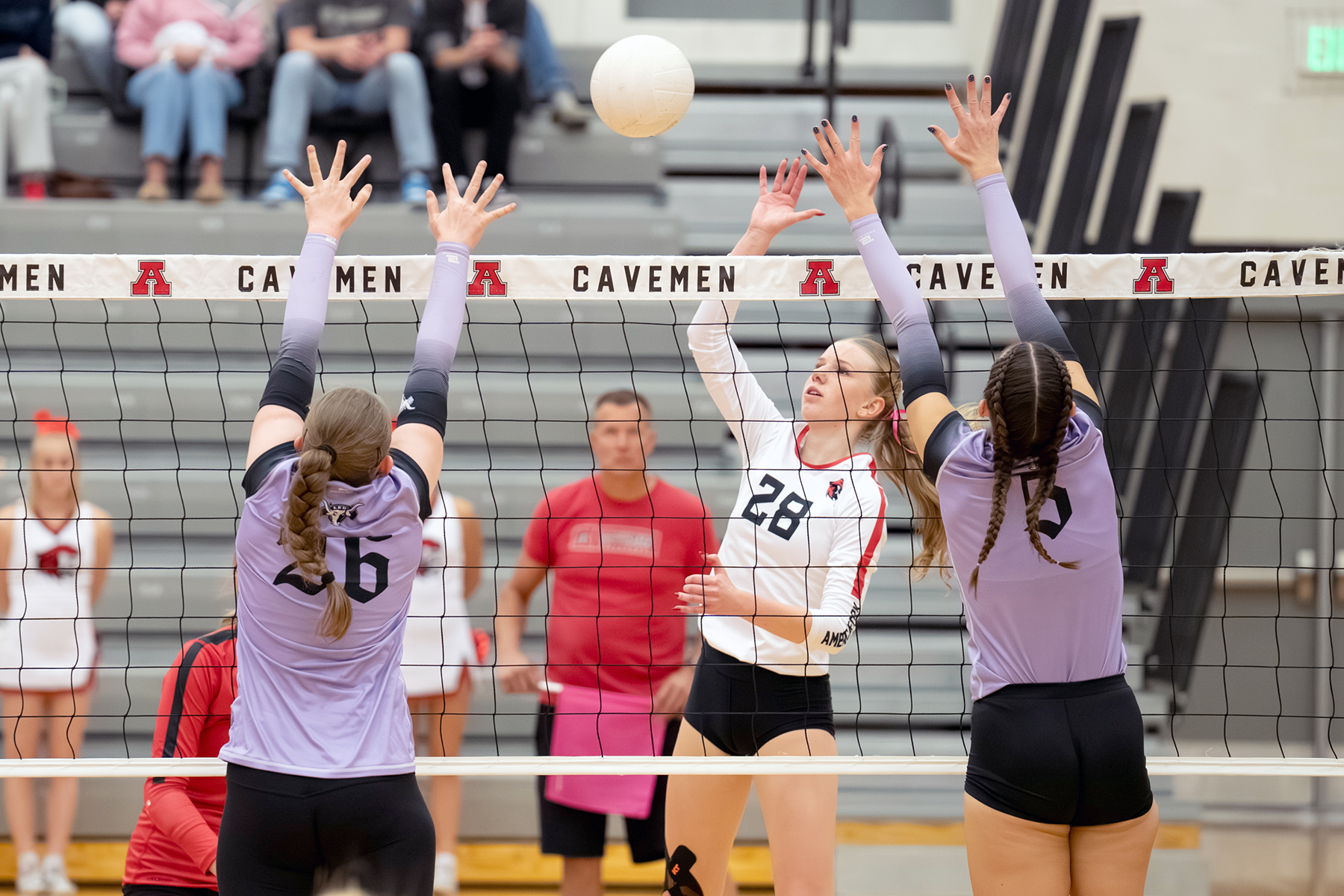
The American Fork High School girls volleyball team played true to seeding in the 6A state tournament. The Cavemen received the No. 7 seed in the final RPI rankings and advanced to the quarterfinals in the playoffs, finishing their campaign with an 18-11 record.
Oct. 29: American Fork 3, #10 Lehi 1
The Cavemen played crosstown rival and Region 3 stablemate Lehi to start the tournament in the second round after a bye. The Pioneers put up a stiff fight at the start and American Fork needed extra work to pull out the first set 28-26.
Lehi claimed the second game 25-21 but the Pioneers weren’t able to sustain the momentum as the Cavemen won the final two sets comfortably 25-14, 25-16 to secure the match.
Junior outside hitter Macy Melville led the effort with 14 kills, four combined blocks, 10 digs and 30 serve-receives. Junior hitter Destinie Hampton added 10 kills and four aces while sophomore hitter Alivia Lemon posted seven kills with four combined blocks.
Junior setter Brynn Murray served six aces to go with 10 digs and 16 assists. Senior libero Halle Smith was tops in digs with 21 and also took 17 serve-receives. Senior setter Ellie Dickey provided 11 assists.
Oct. 29: #2 Corner Canyon 3, American Fork 0
The Cavemen advanced to the quarterfinals only to face another Region 3 team, the second-seeded Chargers. American Fork competed hard but Corner Canyon won the battle 25-21, 25-19, 25-16 and went on to capture the 6A title.
Melville tallied 10 kills, four aces and 31 serve-receives. Hampton scored eight kills with seven digs and six serve-receives. Senior outside hitter Rachel Hale registered five kills while Murray made four kills, three aces, 10 digs and 14 assists.
Smith dug eight times and took 10 serve-receives. Dickey dished out 13 assists and senior libero Mele Latu picked up 12 serve-receives.
“This year our team was extremely driven and determined to grow,” said Coach Melissa Guymon. “We focused on our values and worked to deconstruct our beliefs. This helped us to show up to practice each day with the process in mind.
“Because of that foundation and journaling every single day, we started making changes and improvements so quickly,” she continued.
“We experienced some adversity and struggle towards the middle of our season and it really helped us continue to grow and peak at the right time: the state tournament,” she said.
“We went from entering the tournament as the #16 seed the last three years and losing our first round match to entering ranked #7 this year and winning in the first round.
“I am so proud of this team. I am honored to coach them and love representing American Fork High,” Guymon concluded.
The team graduates just four seniors so the future is looking promising for the program.
Rob Shelton | American Fork Citizen
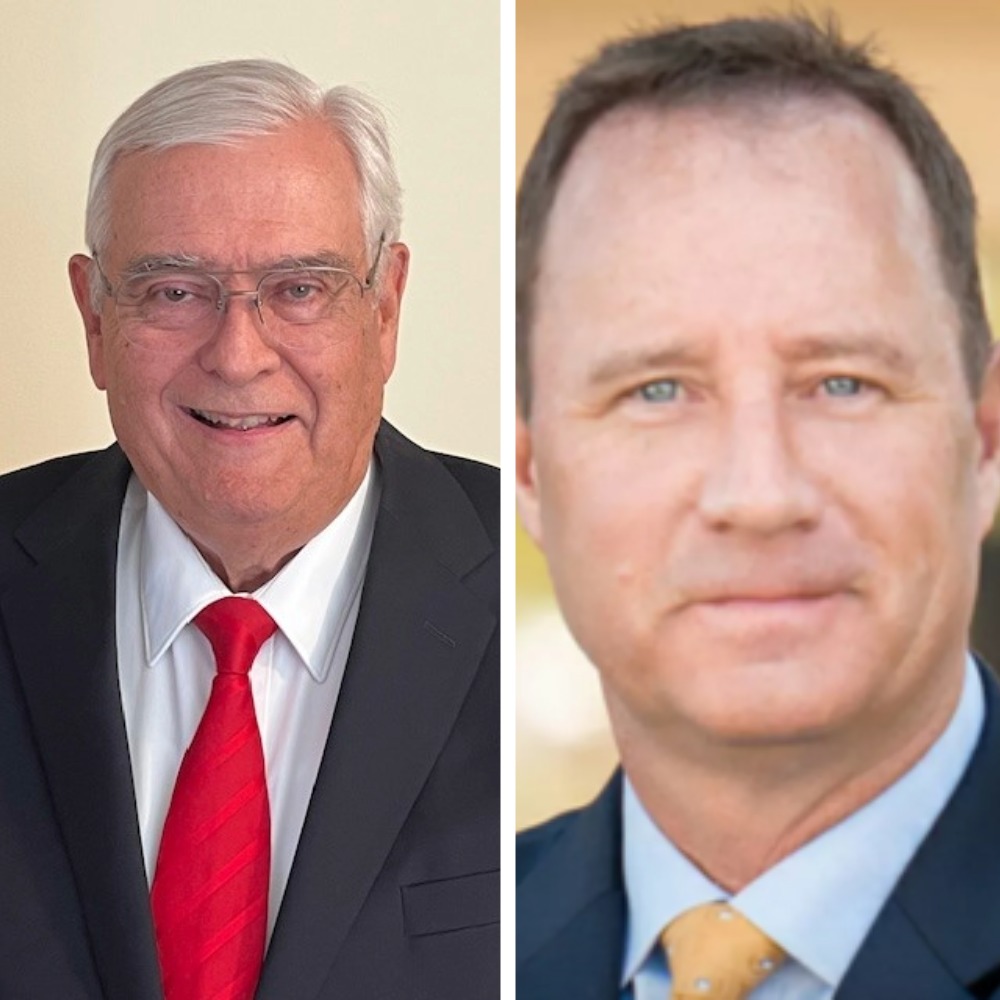
Former City Councilman George Brown is challenging incumbent Brad Frost, who’s seeking his third term as mayor. Brown says the main reason he’s running is to help prevent attacks in the community. Frost defends his record of managing growth.
Both candidates sat down with the American Fork Citizen to answer reader questions. They each got 15 questions with one minute to respond, tackling topics from road funding to taxes to immigration enforcement. This article highlights the key points; however, you can watch the full interviews on YouTube to gain a more comprehensive understanding (see the links at the end of the article).
Growth and density concerns
High-density housing emerged as a flashpoint. The 2024 city survey showed 61% of residents expressed concerns about density.
Brown opposes additional high-density development. “I am not in favor of having more density, high-density housing in American Fork,” he said. “I think we’ve got enough high-density structures now.”
Frost defended the city’s approach. He said American Fork purposefully designed density around transit access and I-15. “We have, in a very purposeful way, designed it in and around areas that have easy access,” Frost said. But he drew a hard line on commercial zones. “We are done as far as giving up other spaces for the density.”
Road infrastructure challenges
Both candidates acknowledged problems south and west of the freeway. Growth has outpaced road development in the transit-oriented area. Candidates were asked about immediate solutions for this area.
Frost pointed to regional solutions involving UDOT and UTA. “We have the funds in place to finish 200 South,” he said. “We have other things, but they will take time to have it built out into a grid that will connect it over to the boat harbor road.”
Brown offered fewer specifics. “I don’t think there’s a way of saying immediate,” he said. He’d sit down with the City Council to discuss problems and move forward with their support.
On general road policy, Brown drew from his National Guard engineering experience. “They taught me about roads, they taught me how important the crown of a road is,” he said. He wants to ensure proper road crowns to extend pavement life.
Frost emphasized measuring success in terms of lane miles treated when asked how to measure road improvement success beyond just dollars spent. He said the city now uses internal departments for road work. “We’re using our own people,” he said, noting this approach maximizes efficiency during inflationary periods.
Budget efficiency and communication
Asked about fiscal responsibility, Brown stressed caution. “I think we should always be very, very cautious with expenditures of the city, because it comes from taxpayers’ contributions,” he said.
Frost identified three efficiency priorities: cutting-edge technology, including AI; an employee mindset focused on daily improvements; and conservative use of city infrastructure, particularly water.
Both supported transparency in communication. Brown backed the online streaming of work sessions. “I think the public should know what’s going on,” he said.
Frost supported transparency but noted that work sessions present challenges. “Sometimes we go there to learn things, even for the first time,” he explained. Frost mentioned that complete information becomes available when items move to council action.
Fitness center and other priorities
The 2024 survey identified the fitness center rebuild as the top project priority for residents.
Brown, a regular fitness center user, sees its value but wants to prioritize other needs. “I just don’t want to spend a lot of money right now, when we’ve got other things that are pushing us, like the irrigation systems and the water systems,” he said.
Frost expects the fitness center to be on next year’s ballot. The 1990s facility was built for 35,000 people. The city has avoided significant investments pending a decision on the bond. “Leave it to them to make that choice,” he said.
Immigration enforcement
The candidates diverged on whether local law enforcement should assist ICE.
Brown supports cooperation. “I do support that,” he said, citing concerns about illegal immigration and security. “I think we should participate with them.”
Frost took a more cautious stance. “I’m going to leave that direction” to federal policy and law enforcement professionals, he said. “Compassion has to be a part of this equation.”
Election details
The American Fork General Election will be held on Tuesday, Nov. 4, 2025. Ballots have been mailed to registered voters beginning Oct. 14.
Mail-in ballots must be received by the Utah County Elections office by 8 p.m. on Election Day to be counted. Voters should mail their ballots early or use an official county drop box. Those who don’t receive ballots should call Utah County Elections at 801-851-8683.
Rob Shelton | American Fork Citizen
Two city council seats hang in the balance as American Fork residents prepare to decide who’ll tackle the city’s thorniest issues. Some of those issues include crumbling roads, high-density housing with its accompanying problems, and an aging fitness center. The Nov. 4 election pits four candidates for two open seats.
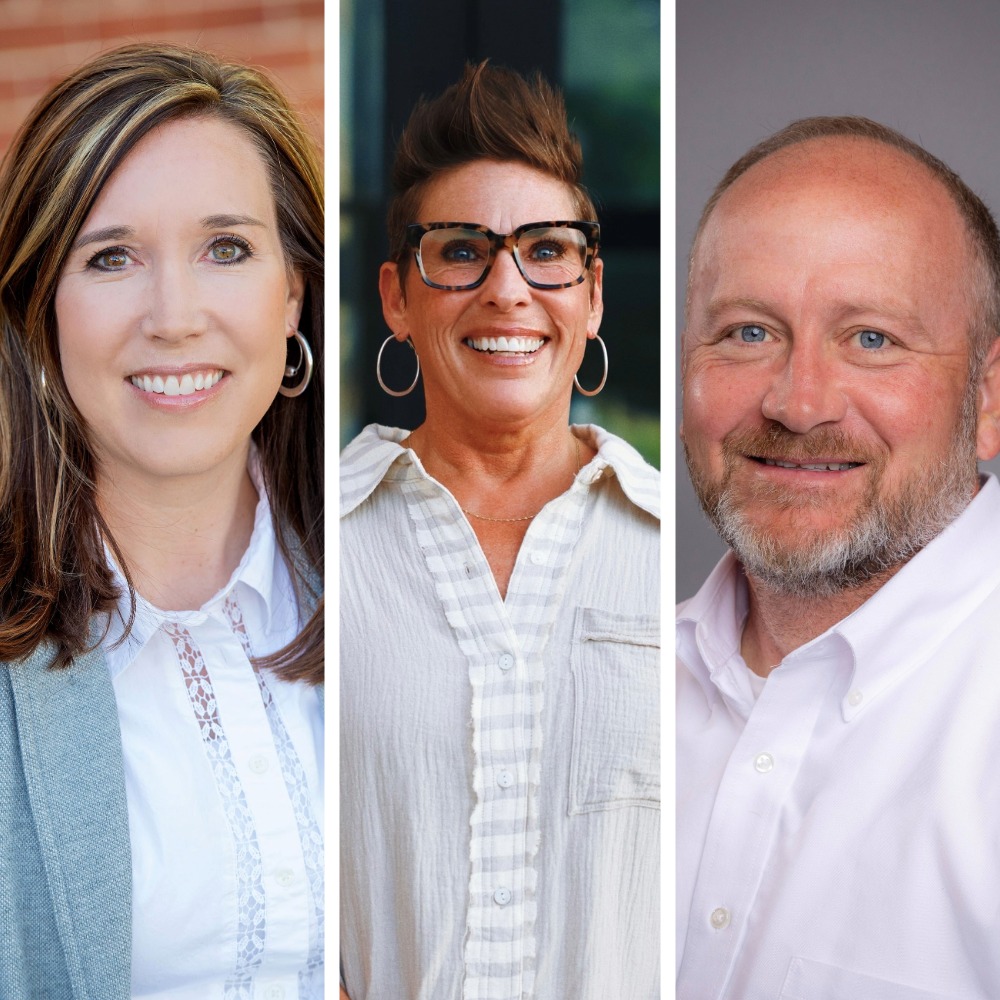
Ryan Hunter, Deb Anderson and Staci Carroll sat down with the American Fork Citizen to answer questions from its readers. Seth Stewart received multiple invitations but never responded. Each candidate tackled 15 questions with one minute per answer, covering everything from road funding to immigration enforcement. What follows hits just some highlights, but the full interviews are on YouTube (see the links at the end of this article), and readers are encouraged to watch them to gain a complete picture.
High-density housing emerges as a key issue
All three interviewed candidates oppose adding high-density housing beyond what’s already in the city’s general plan. This sentiment comes after a 2024 resident survey showed 61% of residents are concerned about density.
Hunter emphasized his consistent voting record. “I am not in favor of increasing densities anywhere in the city that aren’t already master planned for that,” he said. Hunter noted he was the lone dissenting vote on a recent density change and met with a developer requesting “significant density increase to the tune of basically double.”
Anderson agreed the city has enough. “I think we have plenty of high-density housing,” she said, adding that infrastructure needs to improve before considering more development.
Carroll clarified recent decisions. “We did not put in any high-density in that area. We just increased it from very low density to a medium density,” she explained regarding a controversial rezoning near the train station.
Road infrastructure tops concerns
Areas south and west of I-15 have seen explosive growth, but roads haven’t kept pace. Each candidate outlined plans to address the problem.
Anderson acknowledged the severity. “I’ve been out there at 5:30 at night, and I agree 100% that something needs to be done,” she said, though she cautioned against expecting immediate fixes to such a significant problem.
Hunter identified specific projects as prerequisites. “The first thing would be the extension of the Lakeshore drive,” he said. “The second thing that we need to tackle is a frontage road between basically paralleling the on-ramp southbound of I-15 and the train tracks.”
Carroll pointed to funding progress. “We have the funding mechanism, finally, for 200 South,” she said, noting plans for a new roundabout at 300 West and improved connectivity throughout the area.
Fiber internet divides opinions
Since 2019, American Fork has explored city-owned fiber while neighboring cities like Lehi and Pleasant Grove have moved ahead with construction.
Carroll backs a public-private partnership approach. “I don’t want the city running an internet service. I want a private industry to do that,” she explained, noting this model hedges costs while maintaining city revenue share.
Anderson strongly supports the project, citing personal frustration. Her street lacks access to quality internet providers. “For me and for my husband, who works from home most of the time, absolutely, I would like to see something better,” she said.
Hunter changed his position on full city ownership. “I used to believe that we could fund it and own it 100% as the residents of American Fork,” he said. Construction costs pushed him toward supporting significant partial ownership instead of complete control.
Fitness center rebuild sparks debate.
The aging fitness center topped the 2024 survey as residents’ preferred project, yet candidates split on priorities.
Carroll wants more analysis first. “We need a pretty good options analysis,” she said, promising any rebuild would go to voters for approval.
Hunter supports rebuilding eventually, but not yet. “I believe it’s a desire, not a need,” he said, ranking it fifth or seventh on his priority list. He opposes bonding for a facility where “45% of our people who are patrons at the fitness center are not from our city.”
Anderson backed reconstruction based on her seven years working there. “There is not another place in American Fork that can service people from birth all the way up to we had patrons coming in that were in their 90s,” she said.
How to vote
Ballots were mailed to registered voters beginning Oct. 14. Voters who don’t receive a ballot in the mail should call the Utah County Elections Office at 801-851-8683.
Mail-in ballots must be received by the elections office by 8 p.m. on Election Day to be counted. Voters are urged to mail ballots early or use an official county dropbox to ensure they’re counted.
Voters will vote for two candidates to fill the two open seats.


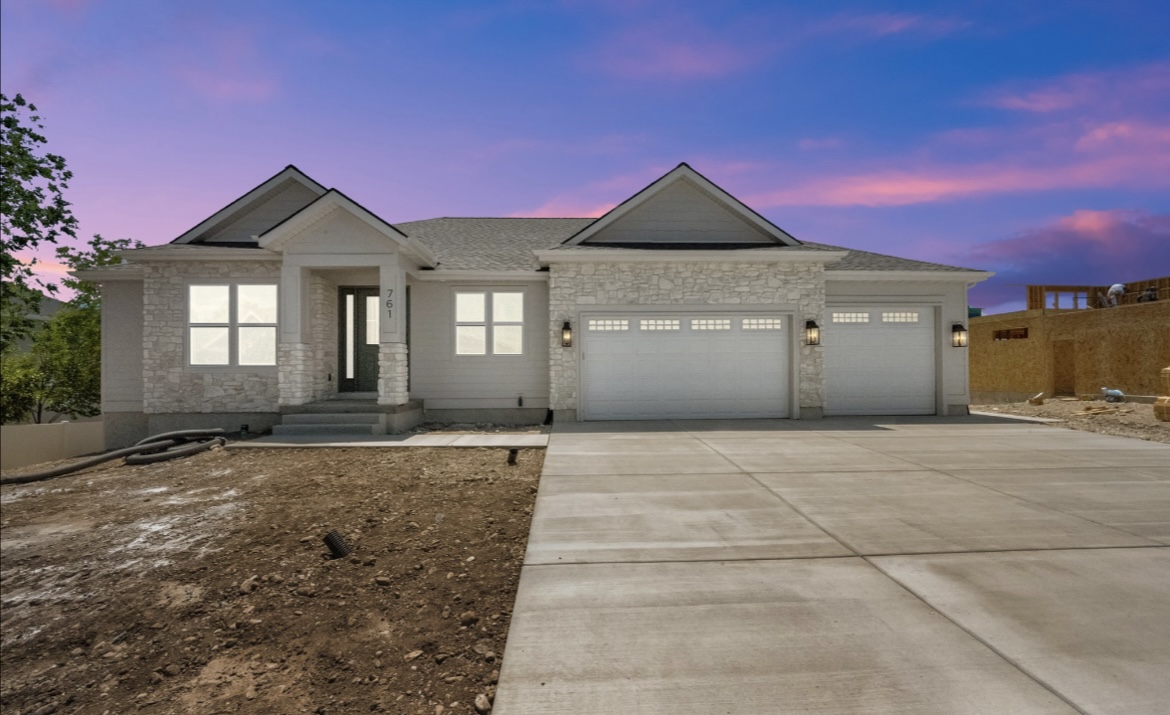
American Fork Real Estate Snapshot: September 2025
September 2025 vs (2024)
Homes sold: 38 (35)
Average home price: $541,175 ($553,145)
Median home price: $529,250 ($551,143)
Average days on the market: 56 (44)
Average square feet: 2,267 (2,229)
Average price per square foot: $252.80 ($252.40)
Most expensive home sold: $1,150,000 / 3 bedrooms / 2.5 baths / 4,984 sq. ft. / .28 acres
Least expensive home sold: $190,000 / 1 bedrooms / 1 bath / 706 sq. ft. / condo
Total listings currently available: 96 (existing homes) and 38 (new construction)
Listings over $1 million: 12
*According to the Wasatch Front MLS as of 10/5
Presented by: Skyler Beltran – Realtor / Coldwell Banker

Chick-fil-A cookies: hope for kids like McKynzee

Lehi welcomes first-of-its-kind postpartum and surgical recovery center

OPINION: The ripple effect

‘BIGGEST LOSER’ CONTESTANT FROM AF DIES TRAGICALLY

Aspen Peaks School Board “Meet the Candidates” night recap

Tragedy Strikes American Fork: Local Couple Found Dead in Apparent Murder-Suicide
-

 Local News1 month ago
AFHS students march in blizzard to protest ICE
-

 Local News1 month ago
Elected officials discuss North Utah County’s big issues
-

 Local News1 month ago
Man with Lehi heritage vies for a seat in congress
-

 Local News3 weeks ago
Utah appeals court case could redefine survivorship rights after unpaid divorce settlement
-

 Local News4 weeks ago
Volunteers invited to help protect the Jordan River
-

 Art/Culture4 weeks ago
AFHS goes green with their “Shrek”tacular musical
-
Opinion1 month ago
OPINION: Meals on Wheels asks for support in March
-

 Local News3 weeks ago
Northwest Utah County to receive UTA On Demand transit service
-

 Politics3 weeks ago
Utah County Commission Seat A profiles
-

 Politics3 weeks ago
Utah County Commission Seat B