
Schools
Advanced music groups shine at the AFJH Grand Concert

Elizabeth Spencer | American Fork Citizen
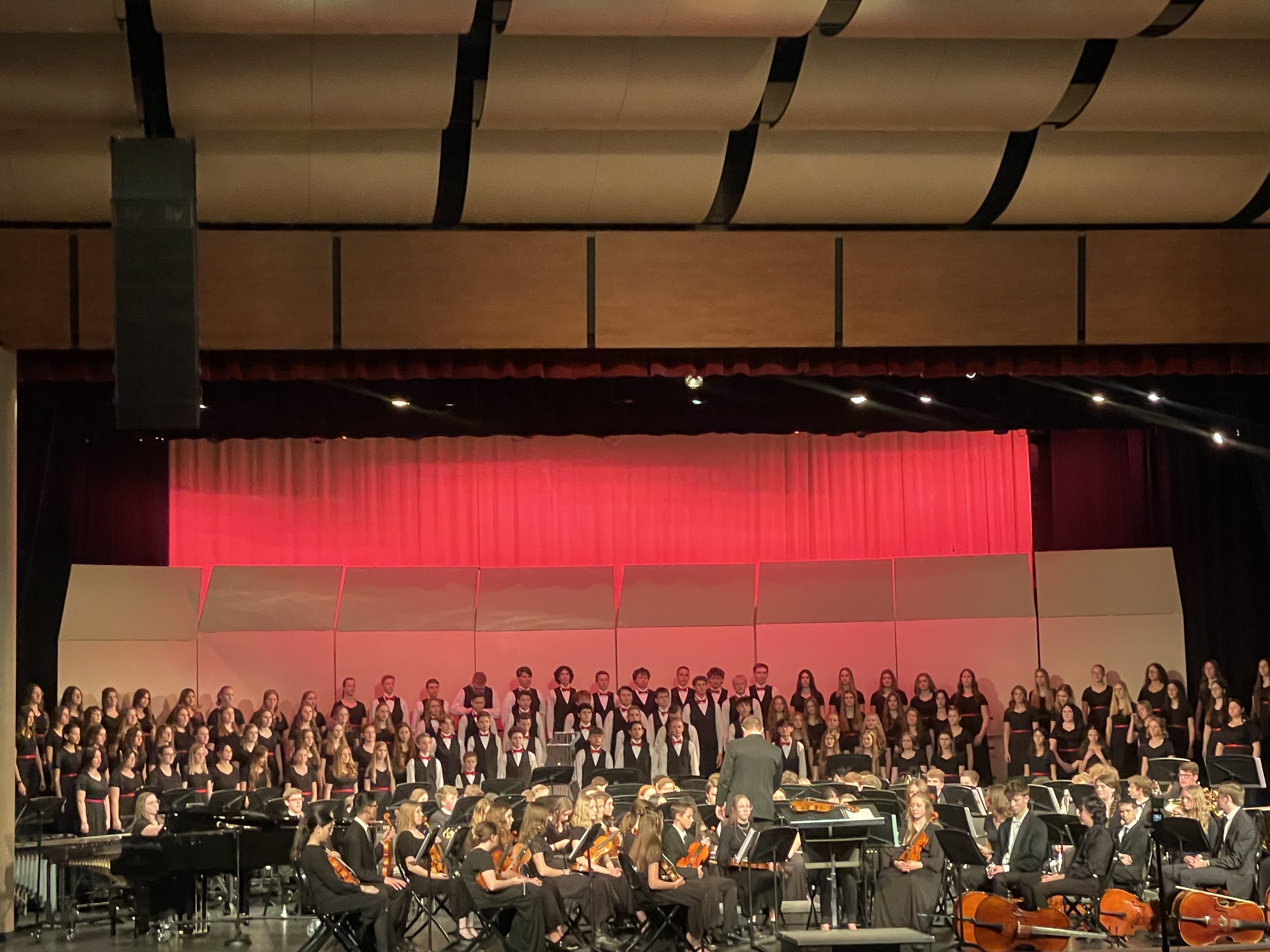
American Fork Junior High’s top musicians joined together to create an evening of musical magic. The AF Singers, Advanced Orchestra, Honors Band and Advanced Percussion groups collaborated to make the event a success.
“I have been continually amazed by the talent and magic that happens when seventh, eighth and ninth grade students come together to perform,” shared AFJH orchestra teacher Shauna Smith. “What started as a simple concert has grown into one of the most meaningful highlights of our year.”
The AFJH performing arts program has hosted the evening for more than 20 years. “Our first performance looked very different from today. We were in the old auditorium, performing in the round without acoustic shells or many of the resources we now enjoy. There wasn’t enough room for everyone on stage, so the choir stood on the stairs for the final number while the rest of us squeezed together. It wasn’t perfect, but it was special,” added Smith.
Pulling off a program including all of the advanced-level musicians isn’t easy. The choir, band and orchestra had to prepare after school and on Saturday mornings.
“Collaborating with the orchestra and band is an amazing experience that most students don’t get until they are in high school or college. The band and the orchestra are such wonderful programs, and it’s a pleasure for the kids to be able to sing together with other students who love music so much,” shared AFJH Choir Director Matt Thornton.
“Over time, the concert has evolved to include our advanced percussion class and even steel drums for a few years. I’ll never forget one performance when the steel drum music was so fun that the band director and I were backstage dancing. The students thought we were crazy, and maybe we were, but that joy is what music is all about,” added Smith.
The Honors Band played three amazing numbers, including “Rain” by Brian Balmages, which sounded like a storm with thunder and lightning. The AF Singers performed a moving rendition of “Modimo” arranged by Michael Barrett. Choir members learned hand movements to the drumbeat. The advanced orchestra played “Arabian Dreams” by Soon Hee Newbold. Advanced Percussion also added to the evening with their performance of “Minor Infraction” by Rick Dior.
Freshman Ava Searle sings in the choir. Her favorite part of the Grand Concert was the evening’s concluding number, when the band, orchestra and AF Singers performed “When You Believe” by Stephen Schwartz. “When the sounds of all of the instruments come together with the voices of the choir, it’s a powerful feeling,” shared Searle.
“I’m grateful to work with outstanding colleagues who are deeply dedicated to their programs and students,” wrote Smith. “My favorite part, though, is watching the audience — parents, grandparents, families and friends — smiling with pride at how polished and advanced these young musicians sound. It makes me incredibly proud of the students and the hard work they put in to truly perform at such a high level.”
“One thing that’s great about this year is that we get to sing “When You Believe,” one of my favorite combined pieces that we do. I like all the pieces we’re doing this year — they’re some of my all-time favorites. ‘Where the Light Begins’ is a new piece I hadn’t heard until this year, and I feel like it has an especially powerful message,” added Thornton.
“After 23 years, the Grand Concert remains one of the true highlights of my year,” concluded Smith.


Megan Wallgren | American Fork Citizen
Three students from American Fork High School are among this year’s award winners at the 54th Annual Utah All-State High School Art Show, currently on display at the Springville Museum of Art. McKinley Clements, Evie Cardon, and Claire Elggren earned prestigious statewide recognition for their artwork in the highest level of competition for high school artists in Utah.

Clements received a Third Congressional District Honorable Mention for her oil-on-canvas painting “Untitled (Southwest).” Cardon earned the Artist Nosh Award for her colored pencil piece “My Freckles,” while Elggren was selected for the highly competitive JKR Academy Award for her oil-on-board painting “Enlightenment.” Each honor places the students among Utah’s top emerging young artists.
This year’s show includes 352 artworks chosen from 1,073 submissions, representing 109 Utah high schools, and showcasing exceptional student talent in painting, drawing, sculpture, ceramics, photography and mixed media. With no set theme, the exhibition highlights each artist’s unique voice and creative vision.
“There’s nothing else like this for high school artists in Utah,” said Jacquelynn Sokol of the Springville Museum of Art. “This is the highest level of recognition they can receive at the state level.”
“This really is the Utah state championship of art,” Sokol continued. “We’re really proud of these students. So often, it’s athletes who get highlighted. We love being able to show that the arts have champions too.”
Roughly 50 student artists receive awards each year, with more than $30,000 in cash prizes and scholarships distributed through a combination of juried selections and special recognitions sponsored by organizations, artists and government offices. Jurors select the main award winners, while outside groups and sponsors, including the Utah Senate and individual congressional offices, present additional honors.

Congressional awards, like the one received by Clements, are selected by each congressional office and recognize outstanding student artists from within their districts. While the top artwork from each district is chosen for display at the U.S. Capitol in Washington, D.C., honorable mention recipients are also formally recognized and awarded for their work.
The Artist Nosh Award, presented to Cardon, is selected by a collective of professional artists and highlights exceptional technique, originality and personal expression. Sokol said awards like these help students understand the real-world value of their creativity.
Elggren’s JKR Academy Award is one of the most competitive honors given at the show. The award is selected by renowned Utah artist J. Kirk Richards and includes a scholarship opportunity to attend his artist academy. Only two students statewide receive the award each year.
This year, all award-winning students were invited to the Utah State Capitol, where they were recognized by legislators from their home districts during a special ceremony. Photos and videos from the event were shared by the museum and state leaders on social media.
For Sokol, however, the most powerful impact of the All-State Art Show goes beyond prizes.
“Most of these students won’t go on to be full-time professional artists,” she said, “but this show is a huge confidence booster. It gives them proof that they can make something, put it out into the world, and that it has value to someone else. That confidence carries into whatever career path they choose.”
She added that one of her favorite moments each year has nothing to do with the artwork itself. “I’ve never seen such proud parents,” Sokol said. “Watching families see their students celebrated like this is incredible.”
The 54th Annual Utah All-State High School Art Show runs through March 20 on the main floor of the Springville Museum of Art. Admission is free, allowing the public to view the work of American Fork’s award-winning students alongside the best high school art from all over Utah.
Megan Wallgren | American Fork Citizen
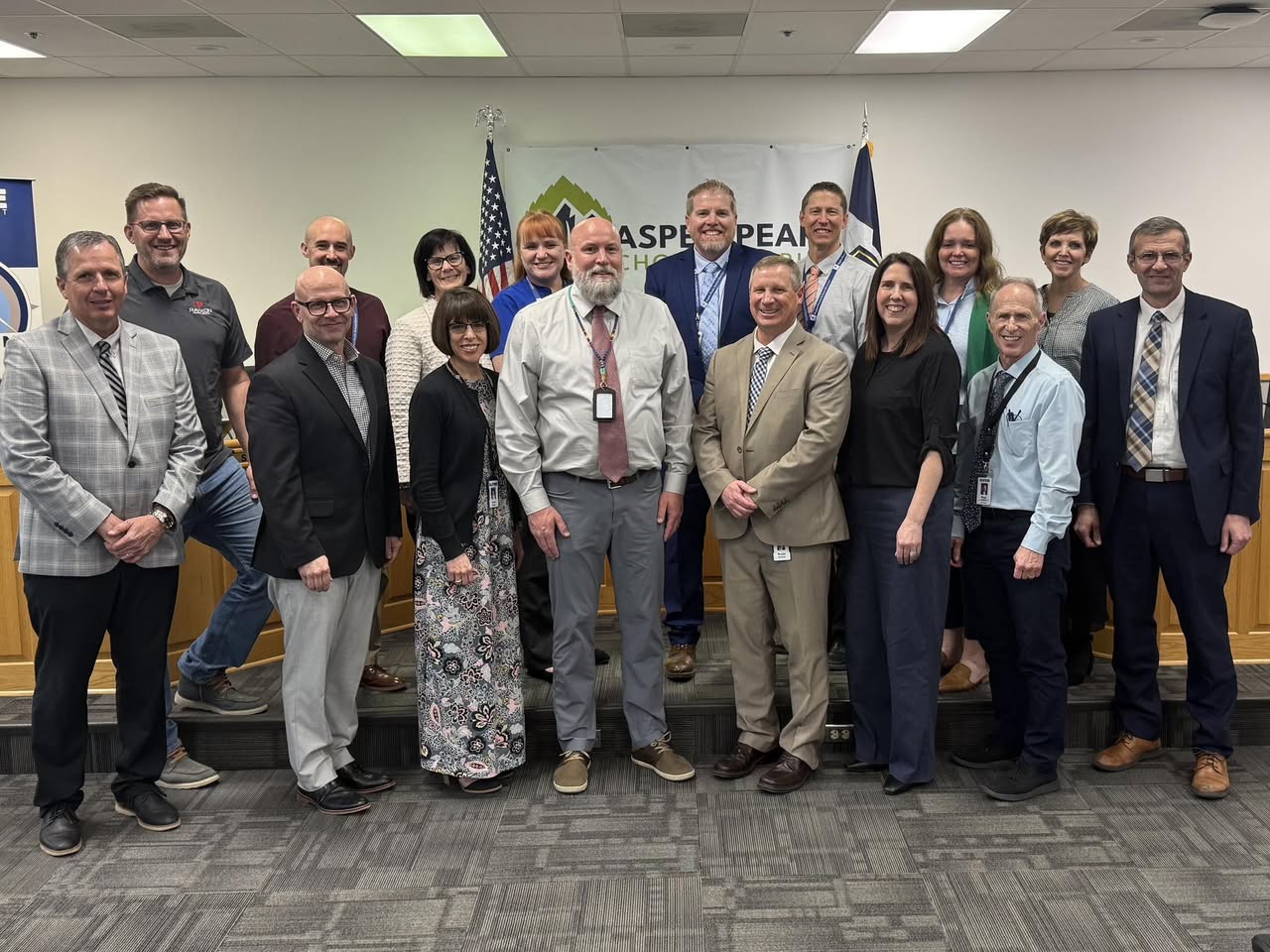
Aspen Peaks School District announced a group of new hires on Wednesday, March 11 as they try to fill out the administrative positions needed to successfully run the new district.

The newly announced cabinet includes several key leadership roles designed to guide the district’s academic, operational and strategic direction. Doug Webb will serve as Associate Superintendent and Chief of Schools, while Eric Woodhouse has been named Associate Superintendent and Chief Learning Officer. Cami Harper will oversee human resources as Chief Talent Officer, and Dr. Rich Stowell will take on the role of Chief of Staff and Strategic Engagement.
Additional appointments include Kevin Henshaw as Assistant Superintendent for Secondary Schools, Brady Rowley as Assistant Superintendent for Elementary Schools and Kari Shirk as Assistant Superintendent for Student Learning. Paul Lewis will lead technology efforts as Executive Director of Technology, and Sam Rencher will serve as Executive Director of Elementary Schools and Curriculum.

At the March 12 board meeting, the board unanimously approved another significant hire. Bea Twede was appointed as the district’s Business Administrator. Twede, who is currently serving as Alpine School District’s Budget Director and Assistant Business Administrator, brings a strong background in both private industry and education finance.
Board member Diane Knight praised the selection, noting the importance of both technical expertise and public communication skills.
“We have hit another out-of-the-park home run with Bea Twede,” Knight said. “Everyone I spoke to holds Bea Twede in the highest regard. We wanted someone who was skilled at their job and could interface with the public and explain complicated finance issues. We have found all of that and more.”
Knight clarified that while the school board is responsible for hiring the superintendent and business administrator, the superintendent selects cabinet members. Cabinet candidates were interviewed and hired by Superintendent Joel Perkins.
Aspen Peaks board member Jeanne-Marie Burrows described the week as a pivotal moment in building the district’s leadership foundation.
“It’s been an incredible week,” Burrows said. “Our cabinet positions of the admin team were announced yesterday and at tonight’s board meeting we hired our first Business Administrator. These men and women are incredible. I cannot tell you how excited I am to have them help create Aspen Peaks School District.”
In addition to building out its leadership team, the Aspen Peaks Board of Education unanimously voted to launch a district-wide boundary study aimed at evaluating and potentially adjusting school boundaries to better reflect current community needs.
“This is an important step in making sure we start our district providing the best education for all of our students,” Burrows said.
Community members and board representatives emphasized that many existing school boundaries may no longer align with current population patterns.
“A lot of the schools in Aspen Peaks have been around for a long time and the community around the schools have changed a lot,” said Amber Bonner. “Do the boundaries make sense, or were they just added on as things are built?”
Information about the boundary study is available on the Aspen Peaks School District website, alpineschools.org/o/aspen-peaks-district/, under the heading Boundary Presentation.

Elizabeth Spencer | American Fork Citizen
Nineteen soon-to-be graduates from American Fork High School will be traveling abroad this summer. The American Exchange Program (A.E.P.) gives high school students the opportunity to visit parts of the country for free while being hosted by families across the nation for a week-long experience.
Students and AFHS staff gathered at Kneaders Bakery & Cafe in Pleasant Grove to open their assignments. Principal Peter Glahn addressed the students before they opened their destinations. “This program is about people. I want you to remember that. I think you are all going to fabulous locations. I can guarantee you, you will love the people you encounter on this journey.”


Students were assigned to different states, including New York, Massachusetts, Louisiana, North Carolina, South Carolina, New Jersey, Connecticut, Arkansas, Texas, Virginia, Minnesota, Oregon, California, Washington, and even Hawaii.
Vanessa Gaisford’s son experienced A.E.P. Last year. She said he has lifelong friends from that one week. “Even on his way to college, he met up with a friend in Wyoming whom he had gone to New York with last year.”
This year, Vanessa’s daughter Maddie is participating. “I know Maddie is going to have the same experience. She is going to meet people her age from different areas in the United States, and she’s going to love them, and they’re going to be great friends. I’m really excited for her to go to Hawaii.”
“I think it’s awesome to be able to get to meet a bunch of different people from a bunch of different places, and I think it’ll help me see a different culture than what I’m used to in Utah,” shared Maddie.
She is so excited to go to Hawaii, calling it a “dream vacation.” Maddie has never been to Hawaii.
Senior Ava McBride is headed back east. “I have never been to New York. I’ve always wanted to go. It’s such a cool place. I’m excited to get to know the people there, see what New York is like, and how they live. I love traveling to places and getting to know the people and culture.”
Kirsten Cluff had an older child who went to Paris, Texas, years ago. She has also hosted two students here in American Fork. This year, her senior is also heading to Texas, but to a different city than her older sibling. “They get to meet kids from all different cultures and backgrounds and get into their actual lives, where they live and see what they do.”
Liberty Harrison is heading to North Carolina. She said it sounds magical, and she is excited. “It just felt like such an awesome thing to do in such a wonderful way to feel united with the country and with people from my own school. It does bring people together in such a special way that can’t be replicated.”
Rachel Wells helps with the program at A.F.H.S. While participating in the A.E.P., her daughter went to Kilgore, Texas. “She had the opportunity to do all kinds of different things. She went to different churches and experienced how they worship. She also got to brand cattle. She shot guns and got to experience the whole culture of Texas.”
Wells said the experience prepared her daughter to interact with people and cultures of different kinds. “The program is all about bringing connection across our country. When you spend time with people, you learn to love them. It doesn’t matter if you have differences in opinions or lifestyles. You just learn to love each other. It’s amazing what can happen in one week.”
This is AFHS Principal Peter Glahn’s 4th year participating in the program. “It’s important for every kid to have an out-of-the-bubble experience. We think because we live in Utah County, we are the only ones living in the bubble, but as they surveyed kids around the country, every student felt like they were living in a bubble,” shared Glahn.
He says the experience is for kids to go out, meet people from different places, and realize they have more similarities than differences. “Their similarities are strong enough to overcome those differences. It’s a pretty special experience. They remain close to the people that they met.”
When the death of Charlie Kirk happened in Utah, Glahn said kids reached out to AFHS students from different parts of the country to check to make sure they were okay and to let them know they were thinking about them. “These are kids who have different political beliefs, but they know each other as humans now.”
Glahn loves the day when the students find out where they get to go. His favorite part of the experience is when it’s host week for AFHS. He said when locals host, they rediscover their own hometown while showing other students the Beehive State. “All the kids who come here are just awed by the scenery, the mountains, and the red rocks.” Glahn still keeps in touch with his host students. He met up with one of them on a trip to New England and got a tour of Harvard from another one of his exchange students. “They give us news of their lives. We stay connected,” stated Glahn.
A.E.P. Is funded by private donors who see the value of having the country come together through the program. If you have a student who will be a senior next year and would be interested in participating, you may find more information at Americanexchangeproject.org. If you would like to host a student, you may contact Cole Perry, Assistant Principal at AFHS, via email at [email protected]

Elizabeth Spencer | American Fork Citizen
The American Fork High School auditorium turned swampy as the musical theater students presented a phenomenal production of “Shrek: The Musical.”
Each night, the cast rotated through the beginning scene with faculty members portraying Shrek’s parents. On closing night, principal Peter Glahn and school counselor Bree Toone played the parts, kicking out their 7-year-old ogre son, Shrek. Audience members saw the two actors in a different comedic light as they sang and danced through the expulsion of their boy.

This wasn’t Glahn’s first appearance on the AFHS stage. “It’s always fun to see how hard the kids are working backstage,” said Glahn. Working behind the scenes, he said he saw the students differently. “It is a full team effort, and I love that our kids step up to the challenge.” Glahn calls the academic theater experience “authentic learning” because students’ work is displayed for everyone to see.
“I’ve worked at AFHS for 13 years, and the musicals blow me away every year,” shared Toone. “When Mr. Johnson chooses a musical, he teaches the students how each show has a purpose, a deeper meaning, and something that becomes a personal journey for all of them. As a participant in the musical this year, I witnessed hours of rehearsals, hard work, creativity and amazing talent.”

The perfectly cast production follows the movie’s storyline, with the green ogre and his talking donkey friend journeying to Duloc to reclaim Shrek’s swamp from the infamous Lord Farquaad. Farquaad wants to be king by marrying royalty, so he will only grant Shrek his land if he rescues Princess Fiona from the tower guarded by the fire-breathing dragon.
The audience went wild when the very small Lord Farquaad made his debut on stage. Jacob Parson played the perfect little Lord, on his knees for the duration of the show. He clearly had a blast ad-libbing and improvising on stage to fit the character. He wore knee pads to shorten his height, which made it easier to act. Singing was more difficult on his knees: Parson noticed he couldn’t hold his notes as long without being able to stand. His makeup, hair and demeanor were spot-on throughout the musical.
Watching the friendship grow between Shrek and Donkey on their voyage came very naturally as the story progressed. Junior Griffin Rubert was surprised when he got the lead role of Shrek in the production. He said his favorite thing about playing the ogre was learning the accent. Rubert relates to Shrek and the musical’s message. Rubert says the moral of the story is “be as you will, love as you are, but don’t stop loving or don’t stop being who you are, no matter what. I feel like that’s my own personal philosophy.”

Donkey, played by Benjamin Kland, was reminiscent of Eddie Murphy’s portrayal of Donkey in the movie.“I’ve never been so excited for a role,” shared Kland. He said the best part about playing Donkey was “I could just do anything I wanted.” Kland felt natural in the role and enjoyed being himself on stage, portraying the part “his way.”
Once Shrek and Donkey rescue Fiona, the romance between the ogre and the princess begins, proving that looks don’t mean a thing. The audience couldn’t help falling in love with the idea of Fiona and Shrek as a couple, making them root for Shrek every step of the way.
Claire Hendershot played Fiona. She said it was fun presenting all of Fiona’s emotions, including sadness, silliness, and going crazy. Hendershot related to Fiona because she says she’s a “bigger personality” herself, “so it was fun to be able to get that energy out on stage.”
Director and performing arts teacher, Neal Johnson, said students chose Shrek as their production through a survey earlier this year. He said the production pushed kids outside of their comfort zone.
Johnson’s favorite part of producing the musical was when he saw the light bulbs start to go on in the young actors that Shrek wasn’t just a kids’ play. “The play is actually embracing things that people usually hide, or feel embarrassed about, or feel like they aren’t going to be accepted if somebody exposes it. It’s the idea that their own self-discovery of who they are and the uniqueness they have actually creates a 100% three-dimensional person.”
Creating the set was a huge endeavor, with a swamp, a tower and a royal palace all on the same stage. The team rented a massive dragon who became Donkey’s love interest. Many of the cast members learned to tap dance for one of the musical’s most entertaining scenes. Hours of acting, singing and dance training went into the program.
“The first time I watched ‘Shrek’ all the way through, I laughed continually and also cried at the end,” wrote Toone. “This show became a celebration of individuality, inner beauty, friendship and adventure.”
Johnson said Shrek “hit a different demographic than I have ever seen.” The light-hearted production brought in a new crowd. Audience members were seen during the musical smiling ear-to-ear, leaving uplifted.
The themes of unconditional love, being true to oneself, and acceptance were common throughout the musical; a perfect message for students and adults alike in today’s social and emotional climate.
“I absolutely loved it, and I’m glad I had the opportunity to sing, deepen friendships with students and faculty, and enjoy every moment of the show,” added Toone.
Glahn calls Johnson “inspiration-oriented.” He says much of the school’s theater department is student-driven, and Johnson doesn’t over-direct. The combination of those two teaching techniques foster a growth mindset among the young actors.
“I love the program here. Neal Johnson is really good at his craft,” shared Parson about his experience in musical theater.
Rubert also agrees. “I think the musical theater program here is amazing, and I think it is definitely the best that I’ve ever been a part of.” Rubert says Johnson is “not just talented, but he cares.”
AFHS juniors and seniors will have the opportunity to try out for the 2026-27 musical theater class coming up on March 23.

Megan Wallgren | American Fork Citizen
A new Utah law governing how technology and artificial intelligence are used in public schools, with an emphasis on reducing screen time for younger students and carefully controlling student AI use, was approved by the Utah Legislature on March 6, the last day of the 2026 legislative session.
HB273 requires the Utah State Board of Education (USBE) to create a model policy to guide schools in the balanced use of technology and the responsible use of artificial intelligence. Local school districts will then develop their own policies aligned with the state’s guidance. The law will go into effect on July 1, 2026.
The law establishes different expectations for technology use depending on grade level, particularly limiting screen time for younger students.
For students in kindergarten through third grade, the bill largely prohibits classroom screen time except in limited situations, such as teaching basic computer science standards or administering state assessments. Schools are also prohibited from requiring a one-device-per-student ratio in those grades. Instead, instruction is expected to emphasize hands-on learning, printed materials, and developmentally appropriate activities.
Students in those grades also will not be allowed to take school-issued devices home, and homework assignments cannot require internet access or technology.
The requirement seems to be at odds with the state’s Early Intervention Reading Software Program. The program was designed to increase the literacy skills of students in K-3 through adaptive computer-based literacy software. School software use is funded by legislation passed in 2012 (HB513) to supplement students’ classroom learning with additional reading support in the form of computer-based adaptive reading programs.
According to a USBE Report dated October of 2025, “The consistent use of early literacy software is associated with meaningful gains in reading proficiency, particularly for multilingual learners, students receiving special education services, and those who began the year with lower reading scores. Based on our models and analysis, Utah’s statewide share of third graders reading on grade level in 2024-25 would have been approximately four percentage points lower if the software had not been used. These findings position EISP as a key strategy among the interventions identified in Utah SB127 to support the state’s goal of having at least 70% of third graders reading on grade level by July 2027.”
The report showed 149,428 students across 726 schools were using these reading software programs in 2025. USBE will need to provide guidance on K-3 technology use in this area.
For students in grades four through six, technology may still be used in classrooms, but must be balanced with traditional instruction. Devices cannot be sent home with students, and any technology use must be supervised by teachers and tied to a specific academic purpose. Homework in those grades will continue to focus on activities that do not require internet access.
Darren Draper, administrator of technology and digital innovation for Alpine School District (ASD), said, “Many of the principles in this law already align with how we approach technology in Alpine School District. We believe technology should support strong teaching and meaningful learning, not replace it.”
“Teachers will continue focusing on assignments that students can complete without requiring internet access or technology at home,” Draper said. “For example, homework may emphasize reading, writing, practicing math skills or other activities that reinforce learning without requiring a device.”
Middle and high school students will have more flexibility under the law. Middle school students may take school-issued devices home only if parents provide written consent. At the high school level, students will generally be allowed to take devices home unless parents choose to opt out.
According to Rich Stowell, director of communications for ASD, while teachers may adjust some lesson plans, the fundamentals of classroom learning will not change.
“Our best practices rely on the knowledge, skills and dispositions of our professional educators rather than on tools or technology. We pride ourselves on creating conditions for student learning in every classroom. Though tools often change, the foundations of subject matter expertise, love of learning, compassion for students and high expectations remain constant,” he said.
Another major component of the law focuses on the use of AI in education. USBE will create a model AI policy that districts must follow when developing their own local guidelines.
The policy will encourage educators to use AI tools to support instruction and potentially reduce workload, but it also sets clear limits. Teachers must maintain professional judgment and instructional responsibility when using AI, and generative AI tools cannot independently grade student work or make high-stakes academic decisions.
Students will also face restrictions on how they use AI. The law states that students cannot use generative AI to complete academic work unless a teacher specifically authorizes it for an instructional purpose. Schools must also ensure that any AI tools used with students meet developmental standards and protect student privacy and safety.
Draper said the district is already thinking carefully about how AI tools can be used safely and effectively.
“Artificial intelligence is an emerging technology that is developing very quickly, so our approach is to be thoughtful and responsible as we introduce it into learning environments,” Draper said. “Our goal is to make sure AI is used as a learning tool, not as a substitute for the thinking and effort that help students grow.”
The law also requires districts to communicate clearly with parents. Schools must notify parents if generative AI is used in instruction, and districts must outline expectations for how students can and cannot use AI tools. Stowell said the district plans to use several channels to keep families informed, including parent-teacher organizations, district emails, school leaders and alpineschools.org.
“As we strive to create student-centered learning experiences, we anticipate that this law will help us focus our efforts in two important areas,” Stowell said. “Additional screen time restrictions for students, particularly for younger students, will strengthen our practices around culture and connection, helping us to create strong foundations for learning as they get older. New standards for AI will open exciting opportunities for teachers and students.”
“Leveraging our teacher coaching model and strong professional development philosophy, Alpine and subsequent school districts are poised to become models of the appropriate blend of technology, connection and expert teaching,” he said.

Megan Wallgren | American Fork Citizen
One student from the future Aspen Peaks School District is playing a central role in shaping the district’s visual identity as the winner of a student-designed logo contest that drew creative entries from every secondary school in the Aspen Peaks boundaries.

The winning design was created by Noah Parker, a student at Lone Peak High School. Parker made a few adjustments to his design following feedback, and district leaders say his work will continue to influence the development of a broader style guide.
“This is a fun and exciting start to the process of branding for our new district,” said Aspen Peaks School Board member Jeanne-Marie Burrows. “Noah’s work gives us a strong foundation to build from.”
According to Burrows, the contest received 55 logo entries, with at least one submission from each of the district’s ten secondary schools. Board members and the Superintendent initially narrowed the field to 15 designs, then invited those students to refine their work using professional feedback through a partnership with area tech giant Adobe.
Students were given guidance on key design elements, including the importance of versatility for use in print, online platforms and embroidery. Designers who incorporated trees or leaves were also encouraged to ensure they reflected an actual aspen tree, tying directly to the district’s name. The 15 finalists were offered the opportunity to meet virtually with an Adobe professional for advice and technique instruction, an opportunity about half of the students chose to take advantage of.
After revised designs were submitted, the board and Superintendent selected five final logos, which were shared in a public poll on the district’s Facebook page. Community members were invited to vote, and the results helped determine the final outcome. The three designs receiving the most votes on the poll were further considered by APSD Board members and the superintendent, who then selected the winner. Parker’s logo also received the most public support, with 36% of the online vote.
All five finalists were recognized at the APSD Board meeting on Feb. 12, where students were honored with a framed copy of their logo, a certificate and a monetary prize. In addition, winners received a prize donated by Crumbl Cookies. Two students were unable to attend the meeting and will receive their awards at a later date.
“Having this contest was a great way to begin developing the identity of our district while including students in the process,” Burrows said. “I was blown away by the talent of our students and am grateful for the support of our secondary school principals and teachers.”
The contest not only highlighted student creativity but also set the tone for collaboration and community involvement as APSD prepares for its official launch.
April Slaughter | American Fork Citizen
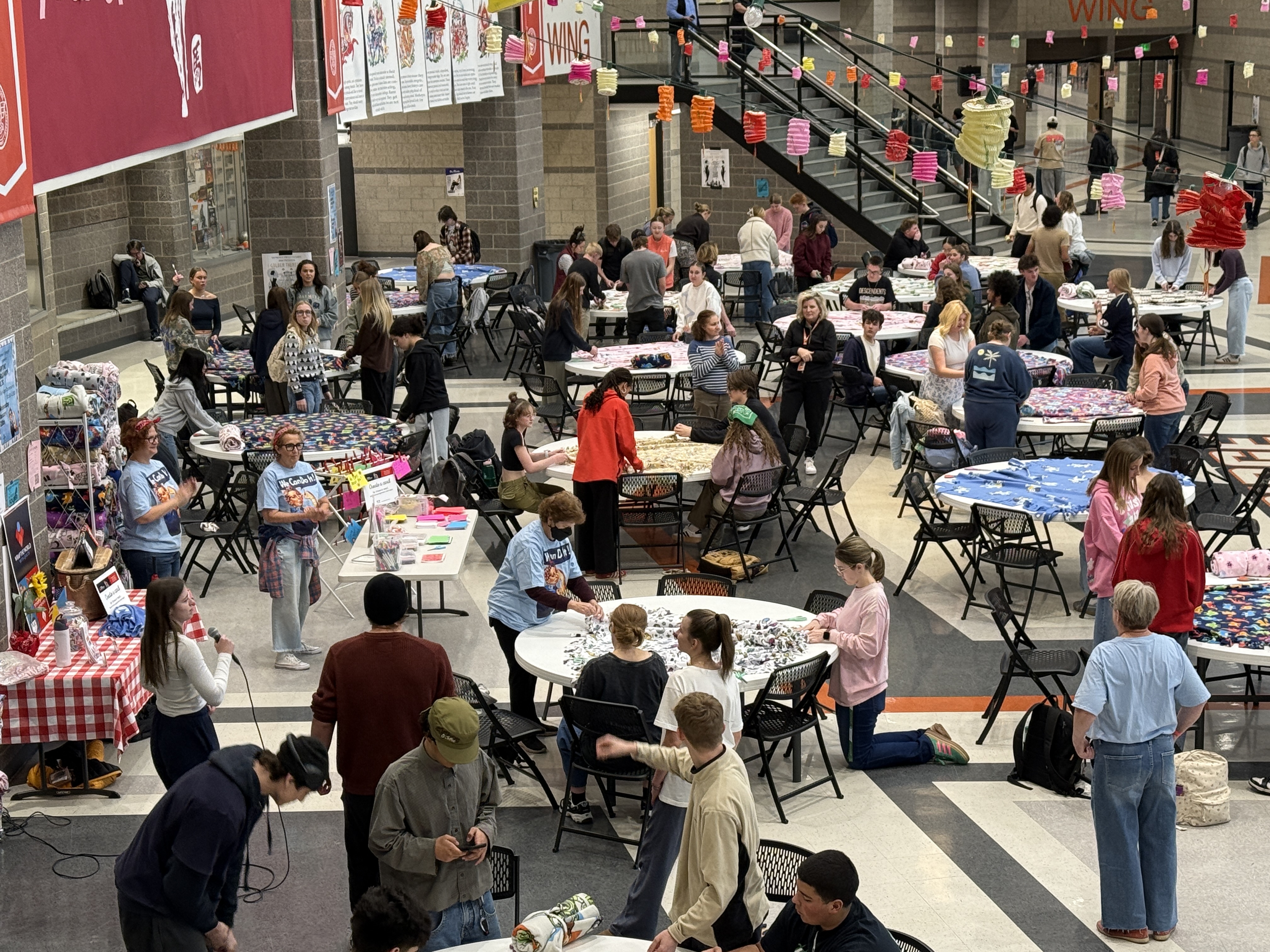
About 100 students at Skyridge High School gathered Wednesday, Jan. 28, in the school’s Commons area to tie quilts for people affected by war and natural disasters, turning an early-release school day into a hands-on humanitarian effort.

The event partnered with Wrap the World with Quilts, a Lehi-based nonprofit that collects and distributes handmade quilts and blankets to refugees, disaster survivors and communities facing humanitarian crises. Students worked in small groups throughout the Commons, cutting fabric and tying knots, while volunteers guided them through the process. Each time a quilt was completed, students rang a bell, and nearby classmates paused to cheer.
Student leaders said the project was valuable far beyond the number of quilts produced. The event was designed to give students a tangible way to serve others and to help them better understand how small actions can have a global impact.

“We’re tying blankets for people in need — refugees around the world,” said Skyridge student leader Grant Weekley. “They’re sent wherever the need is. It’s a simple thing, but it makes a big difference.”
Organizers estimated the event would produce between 120 and 150 quilts by the end of the afternoon. All students were welcome to participate, whether they tied a single blanket or completed several. Teachers and staff members also stopped by throughout the day to observe and encourage students.
The nonprofit behind the project was founded in Lehi following a deeply personal moment at the start of the war in Ukraine.
Gina Halladay, founder of Wrap the World with Quilts, said the organization began when her husband, who had worked remotely with women in Ukraine, received photos of them fleeing across the border into Poland, carrying little more than grocery bags filled with clothing.

“He asked me, ‘You’re a quilter — can we send them a handmade quilt?’” Gina said. “They were shocked that someone in America cared about what was happening to them.”
After Gina shared the idea on social media, quilts began appearing on her Lehi porch almost immediately. What was initially expected to be a modest collection effort quickly grew. Within a short time, the group became an official nonprofit and changed its name from Wrap Ukraine With Quilts to Wrap the World With Quilts to reflect a broader mission of responding wherever humanitarian needs arise.
The organization now partners with Lifting Hands International, a humanitarian nonprofit based in American Fork that ships cargo containers of aid worldwide. Each container requires thousands of quilts and blankets, far more than many organizations can collect on their own.
Since then, Wrap the World with Quilts has collected more than 64,000 quilts over the past four years, all through donations and volunteer labor. Gina estimates the quilts represent about 82 tons of aid, valued at $32 million. The organization is entirely volunteer run, with quilts arriving daily from across the country.
Community partnerships have played a significant role in the nonprofit’s expansion. Gina said Thanksgiving Point in Lehi donated workspace to the organization, providing volunteers with a centralized location to sort donations, sew quilts and coordinate shipments.
“That donated space changed everything for us,” Gina said. “It gave people a place to show up, use their skills and be part of something bigger than themselves.”
In addition to providing physical warmth, the quilts are designed to offer emotional comfort. Each quilt is registered through the nonprofit’s system, allowing donors to include notes of encouragement. When quilts reach their destinations, recipients can send messages back, creating a personal connection between people who may never meet.
The nonprofit has also established sewing centers in Lehi, Poland and Ukraine. One sewing center operates in the basement of an elementary school in Ukraine, allowing children to remain creative and engaged while sheltering during air raid alerts.
At Skyridge, organizers said the quilt-tying event also helped foster connections among students. Many worked alongside classmates they did not previously know, turning the activity into both a service project and a social experience.
A similar quilt-tying event is planned for Wednesday, Feb. 25, at Lehi High School, also during an early-release school day. Wrap the World with Quilts continues to accept quilt and blanket donations and encourages community members, volunteer groups and businesses interested in supporting the effort to get involved. For more information, visit www.wraptheworldwithquilts.com

Elizabeth Spencer | American Fork Citizen
Members of the American Fork High School Football team and the AFHS marching band traveled to St. Louis, Missouri, for recognition on the national stage for good sportsmanship. The recognition wasn’t because of the football team’s performance on the field, but because of their conduct in the bleachers. Every fall, when AFHS hosts the Mount Timpanogos Marching Band Competition, the football team files into the stands to support fellow Cavemen as they march on the football field.

In 2024, a social media post about the event went viral, attracting national attention. That’s when the Musial Awards picked up the story. The awards are named after former St. Louis Cardinal and baseball hall of famer, Stan Musial, who exemplified good sportsmanship through class, character, kindness, selflessness, and perseverance.
The Musial Awards are sponsored under the leadership of the St. Louis Sports Commission and the National Sportsmanship Foundation. CBS broadcasts the event nationwide annually. Instead of recognizing athletic abilities, the Musial Awards honor outstanding sportsmanship. The awards are given to those offering humble acts of kindness. The organization spotlights those acts as powerful examples for others to follow.


Tim Ryan, Director of Communications for the foundation, commented on how the Musial Awards came across the AFHS Football team’s story. “We are always looking for things that are a little unique or different than what you’re used to seeing when it comes to sportsmanship, and we thought that this one fit that bill perfectly.”
“If there’s a story, we’re all about it. We try to select managers, team managers, all sorts of different stories. It’s not an athletic achievement award; it purely focuses on spotlighting and rewarding great sportsmanship.” Recognition can come to anyone involved in sports, from little league or recreational sports to high school and collegiate levels, all the way up to the professional world.

Past recipients of the Musial Awards have included iconic athletes such as Wayne Gretzky, Jackie Joyner-Kersee, Cal Ripken Jr., Hank Aaron, Arnold Palmer, Albert Pujols, and more.
Among the 2025 honorees was professional ice skater Kristi Yamaguchi, who received the Lifetime Achievement award for Sportsmanship, which is the pinnacle honor the organization bestows. After finishing her competitive ice-skating career, Yamaguchi has been a mentor for Asian American skaters and an ambassador for the ice-skating world. “She was every bit as genuine and classy and kind and generous with her time in person as she was said to be,” said Ryan of Yamaguchi.


The AFHS football team and marching band got to share the Stifel Theatre’s stage with the iconic ice skater. Madden Jensen, one of the captains on the football team, said, “It was a super great experience.” The team got the red-carpet treatment, with flights and hotels paid. The organization took the players on a tour of the Busch Baseball Stadium, home of Major League Baseball’s St. Louis Cardinals, and the team got to see the famous Gateway Arch.
AFHS Principal Peter Glahn shared, “One of my favorite things about American Fork is the camaraderie shared by our faculty and staff. It’s even better when students feel like they can cross invisible barriers and appreciate their peers when they excel in different spaces at the school. It was such an honor for this small thing to be recognized on a grand stage. We hope that this sense of community continues throughout our students’ lives wherever they go.”
As the football team was being honored, the AFHS band played a jazz arrangement of the Caveman fight song, arranged by the band’s bassist, as well as the theme from the movie “Rocky.” Senior Band Member Calan Spens shared, “It was overall just a fun experience. It was really cool to see a bunch of people enjoy the performance we did up on stage.”
AFHS Football Coach Aaron Behm has had players attend the marching band’s competition for years. But up until last year’s social media post went viral, there wasn’t much recognition for the kind act.
“What I find most fulfilling about the experience is that Aaron (Coach Behm) was taken aback by receiving the award. I remember him saying something like, “We’ve been doing this for nine years. I don’t understand why it’s such a big deal now?” And that’s why he received the award and what the award represents. Aaron had his team come because he knew it would create a better community and culture here at the school,” shared AFHS Band Director, Orien Landis.
“He never expected or wanted recognition for it. He just did it because he wanted to be a builder and molder of men. It was awesome to see him get that recognition because there are thousands of football teams across the country, and none have done what the Cavemen have. It was a role reversal one that has made the team and the band better,” added Landis.
One inspiring moment highlighted during the Musial Awards included Behm teaching his players a philosophy he learned as a young athlete. Behm encourages athletes to adopt an outward-looking mindset, using the mirror room and the window room. The philosophy teaches young men that they can choose to focus on themselves or others.
“I was fortunate to play small college football at Trinity International University, under Head Coach Andy Lambert. Coach Lambert truly used football as a vehicle to build up young men and gave me a vision for what I wanted to do with my life. He used the analogy of the mirror room and the window room often,” wrote Behm.
“I wish we had more time and could support more of what goes on at the school, but we cross paths with the band often during the Fall. Sharing the field, coming and going at practices, and they have had such a long history of being great, we felt like it would be a good opportunity to learn from them, support them, and do something that is entirely focused on other people and others’ success rather than our own,” added Behm.
“It’s a real thrill,” said Ryan of working with those receiving the honor for good sportsmanship. “They are every bit the genuine, sincere, good-hearted person that they have appeared to be.” He said recipients of the award “couldn’t be more gracious.”
Ryan said the celebrities are often blown away by the stories of the other recipients, like those of the AFHS Football team. “Through the power and reach of the Musial awards, it (good sportsmanship) can spread to the entire country and to sports celebrities on the highest levels that are also involved in this special event,” remarked Ryan.
Spens says of good sportsmanship, “It helps create a better sense of community within the school and allows one to meet more people.”
“More fun that way,” Jensen said of showing good sportsmanship. He thinks you can connect with more people when you support others. He believes what goes around comes around, saying the band will be more willing to support the team since the team has supported the band.
“Attending the awards show was a top-notch, once-in-a-lifetime opportunity. They do such a great job with the entire event; they truly go all out to celebrate the best sides of sports. The other stories that were celebrated at the Musials were amazing as well. What the city of St. Louis does with the Musial Awards is outstanding, and it was so fun to be a part of it,” shared Coach Behm.
“The experience was amazing! The Musial Awards made it special not only for the football team but also for the band members. Everyone felt like an honored guest,” concluded Landis.
Regarding the Musial honorees, Ryan shared, “We have a deep belief that their stories are incredibly important to tell now more than ever.”
The AFHS Football team received a special, custom-made trophy shaped like the number 6, Musial’s baseball jersey number when he played for the Cardinals. A video of the AFHS Marching Band presenting the Musial Award to the football team is on YouTube.
Megan Wallgren | American Fork Citizen
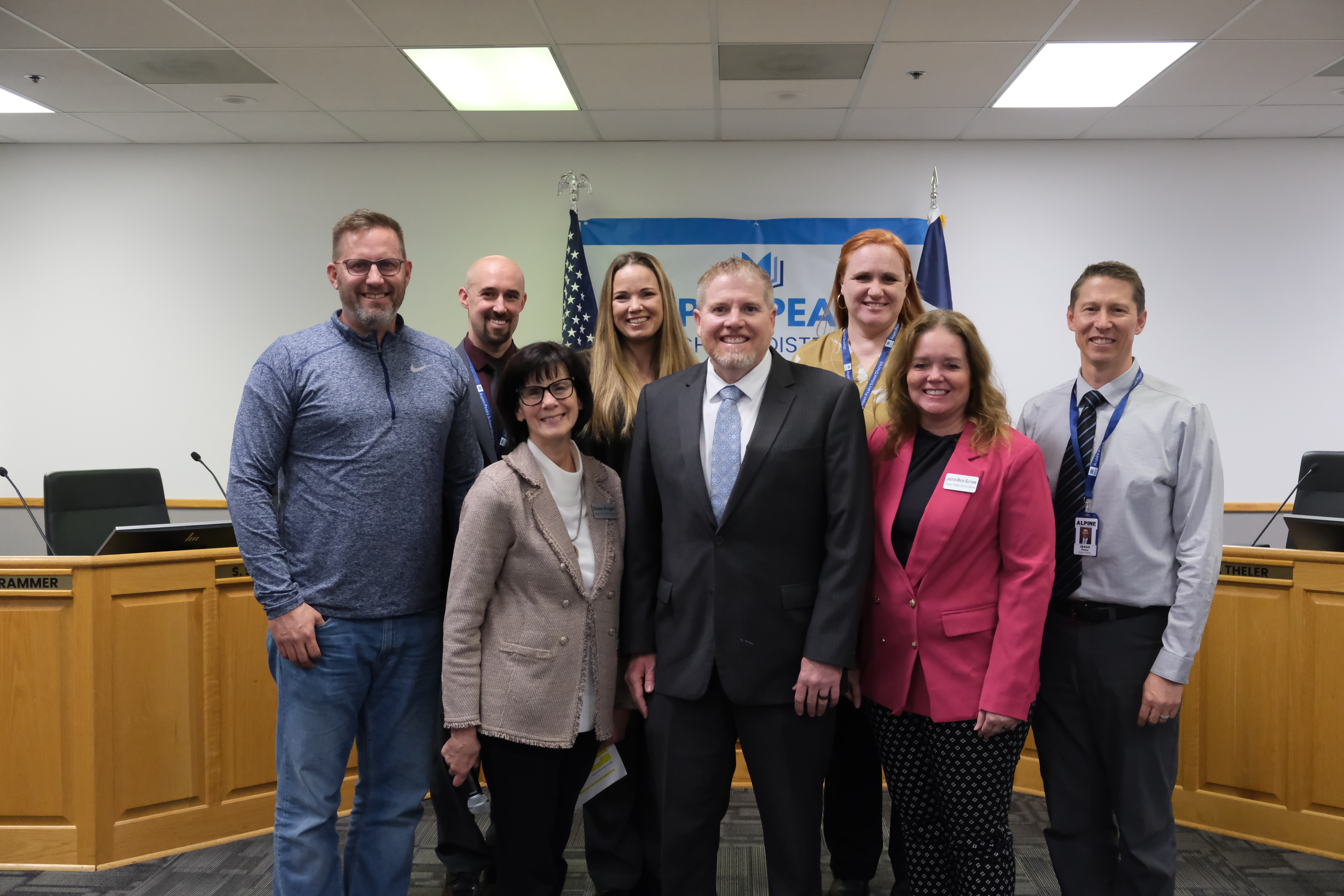
The Aspen Peaks School Board unanimously voted Monday night to appoint Joel Perkins, Ph.D., as the first superintendent of the newly formed Aspen Peaks School District, marking a milestone in creating the district’s leadership team.

Board member Steve Sparti made the motion to nominate Perkins, which was seconded by board member Jeanne-Marie Burrows. Board voting was unanimously affirmative.
Since 1999, Perkins has served in a wide range of roles in the Alpine School District. He began his career teaching social studies and coaching athletics at Lehi High School.
After seven years in the classroom, he moved into school administration at Orem High School, where he helped coordinate the construction and transition to a new building.
Perkins served as principal of Lehi Junior High School and was selected to open Skyridge High School as its founding principal. Under his leadership, Skyridge became the first school in Utah to be recognized as a National Unified Champion School in 2019.
After six years at Skyridge, Perkins advanced to district-level leadership, serving as Executive Director of Teaching and Learning, Chief of Staff, and most recently, Associate Superintendent.
Perkins holds three degrees from Brigham Young University, including a doctorate in educational leadership earned in 2017.
The vote followed an extensive search and interview process that included feedback from more than 70 parents, educators, administrators, and community leaders. The board received applications from 20 candidates, and the community committee helped narrow the field to the final interview round.
Several board members noted the strength of the applicant pool and the difficulty of reaching a unanimous decision. Board member Nicki Brammer said that while the decision initially seemed daunting, the board reached consensus on the second day of interviews.
“Do you know how hard it is [for the decision] to be unanimous?” Brammer said. “But it was clear. We believed Dr. Perkins was the right leader for this moment.”
After reaching a unanimous decision, the Aspen Peaks Board moved quickly to secure Dr. Perkins for the position, as he was also interviewing with the newly formed Lake Mountain and Timpanogos school districts. Board members said they did not want to risk losing a candidate they felt was uniquely suited to lead the new district.
Board President Diane Knight said the board was seeking a leader who would respect and build upon the strong foundation already established in local schools.
“We were looking for a leader who would honor the strong foundation of excellence already in place,” Knight said. “Dr. Perkins brings extensive experience in the Alpine School District, wisdom, and a deep understanding of innovation.”
Knight said she personally contacted his references and reviewed his letters of recommendation, noting that “almost every single one mentioned innovation,” along with repeated stories that illustrated Perkins’ character.
One story shared during the meeting highlighted Perkins’ compassion and one-on-one leadership in supporting a special needs student while principal at Skyridge High School. “That story shows you where Joel’s heart is,” said board member Jason Theler. “He is deeply committed to student success, support, and excellence.”
Theler spoke about his long professional connection with Perkins, sharing a guiding principle he lives by: “Never let a problem to be solved be more important than a person to be loved.”
Burrows emphasized that the board was not simply searching for the best superintendent on paper, but the best superintendent for Aspen Peaks at this pivotal moment.
“We are building a new district right here and right now,” Burrows said. “We wanted someone who has been a teacher, who understands what it really means to be educating our children today. After meeting phenomenal candidates, it became very clear that Dr. Perkins met all of the criteria.”
Board member Amber Bonner highlighted Perkins’ experience opening Skyridge High School and intentionally building a strong school culture.
“Opening a high school is a huge responsibility, and he did it thoughtfully and successfully,” Bonner said. “When we looked at the parallels to opening a new district, I felt confident Dr. Perkins would be careful, deliberate, and student-centered.”
Board member Jason Hart said a personal conversation with Perkins early in the board’s formation stood out to him.
“He cares deeply about community and about what kind of people our students become, not just academic outcomes,” Hart said. “That’s the community we’re creating.”
Following the vote, Perkins was sworn in, signed both an interim and permanent employment agreement, and officially began serving immediately. His permanent contract will begin July 1, 2026.
Perkins thanked the board for its trust and emphasized gratitude as a guiding principle.
“The secret of my success has always been surrounding myself with good people and supporting them in their work,” Perkins said. “This new district truly stands on the shoulders of giants. Alpine School District laid a foundation of excellence that we will only build upon.”
A community meet-and-greet and question-and-answer event with Perkins is scheduled for Wednesday, January 28 at the Alpine School District office from 6-8 p.m. Community members may submit questions in advance to [email protected].

Megan Wallgren | American Fork Citizen
The Aspen Peaks School District is involving the public in its search for the district’s first superintendent by holding a public question and answer event with candidates applying for the position.
Hiring a district superintendent is a key milestone in establishing leadership and systems for the new district, which will begin operating independently in 2027 following the Alpine School District split.
A Superintendent Community Review Committee has completed its review of applications, and the school board is now conducting interviews to narrow the field of candidates.
“The search for a Superintendent of the Aspen Peaks School District has been a great experience,” said School Board President Diane Knight. “We received applications from 20 highly qualified candidates. More than 70 community leaders, parents, teachers, administrators, and staff members helped narrow the field for our first round of interviews. School board members are currently conducting these interviews and are in the process of selecting finalists.”
Once the applicant pool has been narrowed to two or three finalists, the district will invite the public to meet the candidates at a Superintendent Community Open House on Wednesday, Jan. 28, at the Alpine School District Office.
The event will begin with a moderated question-and-answer session from 6 to 7 p.m., led by John Dougall. A one-hour meet-and-greet with the finalists will follow, allowing community members to interact directly with the candidates.
The public can submit questions for the Q&A session by emailing them to [email protected]. Questions must be submitted by Jan 26.
“We are excited for our community to meet the finalists,” Knight said. “Giving community members an opportunity to ask questions and get to know the candidates will help ensure that our district’s superintendent will be a good fit for Aspen Peaks and the families it serves.”
District leaders say community involvement will remain a central part of the process as Aspen Peaks School District continues to build its leadership team ahead of becoming a standalone school district.

OPINION: The ripple effect

Annual flag retirement ceremony set for April 15

American Fork student selected for prestigious National Jazz Ensemble

‘BIGGEST LOSER’ CONTESTANT FROM AF DIES TRAGICALLY

Aspen Peaks School Board “Meet the Candidates” night recap

Tragedy Strikes American Fork: Local Couple Found Dead in Apparent Murder-Suicide
-

 Local News1 month ago
AFHS students march in blizzard to protest ICE
-

 Local News1 month ago
Elected officials discuss North Utah County’s big issues
-

 Local News1 month ago
Man with Lehi heritage vies for a seat in congress
-

 AF City News1 month ago
Utah County Commissioner Seats A and B candidates profiled
-

 Local News3 weeks ago
Utah appeals court case could redefine survivorship rights after unpaid divorce settlement
-

 Local News4 weeks ago
Volunteers invited to help protect the Jordan River
-

 Art/Culture4 weeks ago
AFHS goes green with their “Shrek”tacular musical
-
Opinion1 month ago
OPINION: Meals on Wheels asks for support in March
-

 Local News3 weeks ago
Northwest Utah County to receive UTA On Demand transit service
-

 Politics1 month ago
Utah County Clerk candidates profiled