
Local News
Suicide Prevention Month: shift perspectives, raise awareness


Jennifer Thomas | American Fork Citizen

September is Suicide Prevention Month, an important time to shift perception, spread hope and raise awareness of this urgent crisis. The goal of the National Alliance on Mental illness (NAMI) during September is to ensure that individuals, friends and families have access to the resources they need to discuss suicide prevention and to get help.
Suicidal thoughts, like any mental health condition, can affect anyone regardless of demographic. Though common, suicidal thoughts should not be considered normal and often indicate more serious issues. The community impact of suicide makes it a serious public health issue. Unlike many other leading causes of death, suicide continues to claim more lives each year.
In 2022 in the U.S., more than 49,000 people died by suicide and another estimated 1.6 million people attempted suicide, according to the Centers for Disease Control and Prevention (CDC). This amounts to one death by suicide every 11 minutes. Utah’s suicide rate has been consistently higher than the national rate for more than a decade. Utah had the fourteenth highest suicide rate in the U.S. in 2021, according to the Utah Department of Health & Human Services.
Suicide is preventable. Recognizing the warning signs can help prevent it. Research shows that certain behaviors may indicate someone is thinking about suicide, including but not limited to:
● Talking about wanting to die.
● Expressing great guilt or shame.
● Feelings of hopelessness, emptiness or having no reason to live.
● Feeling like a burden to others.
● Feeling extremely sad, anxious or full of rage.
● Experiencing unbearable emotional or physical pain.
● Change in behavior, such as taking risks or increased drug or alcohol use.
● Withdrawal from friends and family, saying goodbye or giving away important items.
“Risk factors for youth suicide include things like having an important relationship end, a perceived failure at school, a sudden loss of personal freedom, the death of a loved one, receiving a serious health diagnosis, an unwanted move or depression,” said Chelsea Frost, prevention coordinator at Lehi Cares Coalition.
Caitlin Thomas—a graduate of Lehi High School, Miss Lehi 2015 and an assistant drill team coach for the Pionettes—is a mental health counselor at Serenity Recovery and Wellness. She spent her year of service as Miss Lehi advocating for suicide prevention, and now it has become her profession. She feels that suicide ideation differs from person to person, but one of the best ways to prevent suicide is to stay connected and take the time to check in with each other.
“The signs of suicidal ideation and suicide vary and can differ from person to person. The best thing we can do for those in our communities is check in and not be afraid to ask uncomfortable and sometimes scary questions,” said Thomas. “If someone you know is struggling, it’s ok to ask them if they have an active suicide plan. Help them recognize there is no shame for having thoughts and that you will be there to help them. If someone does disclose that they have an active plan, seek immediate help from a trusted adult or a professional.”
Studies show that asking someone if they are having thoughts of suicide does not increase the likelihood of a completed suicide, nor does it increase suicidal thoughts.
As a mental health counselor, Thomas feels that we should challenge our personal biases regarding depression and suicide if we want to reduce suicide rates in our communities.
“The greatest thing we can all do is work on our own biases and ideas about what depression and suicidal ideation look like. It is also important for us to challenge our discomfort on these topics so that we can be a true safe space for someone who is struggling. Individuals who struggle with suicidal ideation already believe themselves to be a burden to those in their lives, so becoming distressed when someone discloses to you their feeling could potentially result in them further isolating. It’s important that we validate their feelings without judgment and seek help when necessary. Remember, it is not on you to solve their struggles, but rather to sit with them and help them remember that they are not alone,” said Thomas.
Helen Gardner of Lehi lost a brother to suicide. She is an advocate of suicide prevention and shares her story in hopes of spreading awareness of suicide.
“I will never forget the morning of June 13, 2012. My kids were just 7, 4, 3, and 1 years of age. It was summer, and we were just hanging out at home. My phone rang, and I was excited to see my mom’s name as the caller. As soon as I heard her voice, I knew something was wrong. She told me my brother Anthony had passed away. I didn’t believe it,” Gardner shared.
“Anthony was my big brother, and in my eyes, he was always indestructible. He was my best friend. I finally had the courage to ask my mom how he passed away, and she told me he took his own life. I dropped the phone and just sobbed. I couldn’t believe it. Anthony was a successful actor and model and appeared to be very happy. He was living in Florida at the time, and I lived in Utah. None of my family lived near him, so we were completely unaware that he had been struggling. I wish so badly that I had known that he was having a tough time. I wish I had asked him more how he was really doing and what he was experiencing. I wish I could have helped him,” she continued.
Parents should not be afraid to have hard conversations with their children about suicide.
“Talking about suicide with your child is important for many reasons, but most important, it helps dispel misinformation,” said Thomas.
According to Kristin Francis, child and adolescent psychiatrist, “Suicide impacts almost everyone, directly or indirectly. Hearing about it from a trusted source, like a parent or caregiver, will assist your child with the right information so they can speak to others about it accurately.”
“The best way to help teach children about mental health, specifically suicide, is to be direct and compassionate while also being developmentally aware. A 4-year-old may not be able to comprehend the idea of death by suicide, but we can begin allowing them to recognize their big emotions and create space for them. Eliminating the stigma around emotions is a great place to start with children. As they get older, the conversations can become more expansive,” said Thomas. “You do not have to be perfect or exceptionally astute when having these hard conversations. It will feel scary and a little messy—this is OK. Have the conversation anyway. Model to your children that sometimes being alive means being uncomfortable, but that you are willing to sit with them through it.”
The vast majority of people who have depression do not attempt or die by suicide, but depression is linked to a greater risk of suicide. NAMI reports that “in 2021, 40.9% of adults in Utah reported symptoms of anxiety or depression. 26.4% were unable to get needed counseling or therapy.” Also according to NAMI, “51,000 Utahns aged 12-17 have depression.” Based on these statistics, it is important to work to build a stronger mental health system that provides the care and support needed to help people build better lives.
Gardner said, “I truly believe that there are more people struggling with mental health and depression than we know. I personally dealt with depression four years ago following some medical issues, and it was the hardest thing I’ve gone through. I felt so hopeless and numb, I had no idea what was going on because I had never been through it before. Depression is so scary to experience.”
“While I do feel we have made great progress in recent years eliminating stigma and opening up conversations, there is still more to be done. We can all do our part by educating ourselves and seeking our own level of care when needed,” said Thomas.
There are many resources available within the community to help those struggling with their mental health. One effective and life-saving resource is the 988 Suicide and Crisis Lifeline. 988 was launched in 2022 and is a federally-mandated service that has been a lifeline for those struggling with behavioral health crises by connecting them to local crisis workers and community-based resources through a simple three-digit call. 988 is available 24 hours, seven days a week in Spanish and English.
“Anyone can call or text 988 at any time and be connected to a professionally trained and certified counselor. They will help talk you through your experience, whether it is your own or your child’s, and help to connect you with local resources for care,” said Thomas. “Another great place to seek help is the SafeUT App. SafeUT is a crisis chat and tip line that provides real-time crisis intervention for students, parents and guardians, and educators through live chat and a confidential tip line—right from your smartphone. The website, safeut.org, offers resources to educators, parents and students in need of support and care.”
The SafeUT app became available to Utah’s middle and high schools in early 2016. The program was developed with state funding, and the original app was designed and donated by a private company. After seeing its success, the University of Utah redesigned the SafeUT app to ensure its future capabilities to respond to mental health and school safety crises. Starting in 2018, SafeUT expanded its services to Utah elementary schools, higher education institutions and colleges, the Utah National Guard, and Utah’s first responders and their families.
“While we’re still in the early phases of building out our action plan for Lehi youth, we currently provide resources from Live On Utah at our booths that we hold at local events throughout the community. We absolutely recommend that everyone in the community go to liveonutah.org and go through the Suicide Prevention Playbook. It breaks down exactly how every person can play a role in checking in on those around us and what resources we can access for support,” said Frost.
Additional protective factors include frequent contact with providers and effective mental health care.
Thomas said, “Oftentimes we make the mistake of seeing therapy as the last line of defense. However, as a clinician, I see therapy to be much more helpful when sought out before the major crisis. Think about your car—if you do routine maintenance and upkeep, the life of your car is extended. Is routine maintenance sometimes expensive and often inconvenient? It certainly can be, but if we fail to do it, we face much bigger repairs down the line. Therapy can be helpful for anyone at any time. Making time for yourself and your own care is crucial and something each one of us deserves.”
The Centers for Disease Control and Prevention (CDC) recommends a comprehensive public health approach to suicide prevention and it identifies several strategies that communities can undertake. These include such measures as “teaching coping and problem-solving skills to help people manage challenges, expanding options for temporary assistance for those in need and connecting people at-risk to effective and coordinated mental and physical health care.”
Suicide can have lasting effects on individuals, families and communities. The good news is that suicide is preventable. Anyone can help prevent suicide by learning the warning signs, promoting prevention and resilience, and utilizing community resources.
“I am so grateful for those in the community who share their experiences with mental health struggles and share information and resources. I definitely feel like my experience with my brother has made me more aware of those around me. I know that someone can look fine on the outside but be facing the biggest battle on the inside,” Gardner said. “I wish so bad my brother would have had someone to turn to. I can’t change the fact that he didn’t, but I will do everything in my power to take his experience and help those around me.”
“Working as a clinician, I get to witness individuals choose every single day to do the hard work and reclaim their lives. There is so much hope, but it takes each of us to look inward and choose to sit with people in their discomfort compassionately. Remember, you are not alone and there is much more to learn and experience. Please reach out and seek help,” said Thomas. “We are not able to eliminate suffering and hardship, but we can continue to expand our empathy and create a world that is safer for everyone.”
Suicide Prevention Month is more than an important time to shift perception: it is a time to spread hope and awareness throughout the community and remember that you are not alone.


Elizabeth Spencer | American Fork Citizen
Friday night’s football game started a little differently at American Fork High School as players and fans took a moment to remember 9/11. The Cavemen started and ended their game with a big win, honoring those who made the ultimate sacrifice 25 years ago.
Players, along with volunteers from Follow the Flag (FTF), unfurled their massive “Lady Liberty” American flag on the field. Teacher Sam Beeson, in his last year of teaching at AFHS, led the national anthem, followed by a breathtaking Apache helicopter flyover.
Military, police, and firefighters received free game admission and free concessions. A generous donor made the evening possible and remains anonymous in our community. The game was a “USA-Out,” which means that students were asked to wear red, white and blue.
“We have a community that really embraces our first responders, police, fire, vets, and active military duty. It’s just a feel- good event. It’s nice when you can help put something on that supports those people that take care of us,” said Jeremy Lewis, Athletic Director at AFHS.
“It’s always important to have perspective, especially at the young age of high school,” said a member of the Navy who attended the game. He said some of these [high school] kids are going to go straight into the military, so it’s important to understand that the community respects and acknowledges that it is an important lifelong decision.”

“We are here to serve the community and those that need our help,” said AF Firefighter Justin Whatcott, who was on shift Friday evening. “As for 9/11, the biggest thing for me is remembering those who served in the military at both the Twin Towers, the Pentagon, and the Flight 93 crash site. They are the ones we need to never forget, and we need to remember the sacrifice they made for our community. I feel like it’s so important to remember those that gave it all.”
Whatcott said seeing the flag ceremony stirred feelings. “It’s an honor to be here and to be a part of that with the youth and be able to support this program that they have honoring those that gave it all”
“I just love being part of something that recognizes those people who responded: the firefighters, the police, the paramedics, the military and the veterans. It’s really special to be a part of that and to recognize them without worrying about political differences. It’s really an important time just to set those things aside and say thank you,” said Lewis.
Delmar Dade was on the field during the flag ceremony. As a police officer, he has served the community of Crystal Lake, Illinois, a suburb of Chicago, for 16 years. Dade flew in for the occasion and to watch his nephew, a senior, play football. “I thought it was awesome to be able to be out there and honor those who gave their life and sacrificed for our country.”

“These kids weren’t alive when 9/11 happened. It’s like they always say to ‘never forget,’ it’s easy when times are okay to kind of forget where we’ve come from or forget the sacrifices. It’s important for them to see that there are people that came before them that had to sacrifice,” added Dade.
Senior Christian Hanshaw plays tight end. He was also on the field during the pre-game event and said he could feel the sacredness and solemnity. “We are doing this to honor everyone who died and trying to honor something very sacred to our American culture. It was really cool to honor our country.”
“I hope our players honor our servicemen and women and first responders by emulating and living their lives with discipline, service, and being selfless. I think for our kids, that is the best way to honor them,” shared AFHS Football Coach Aaron Behm. “I think there is so much our kids can learn from 9/11 about unity, service, and how much we have to be grateful for living in this country.”
“It was really cool to honor everything that happened 25 years ago today. It’s nice to recognize everyone who sacrificed their lives that day. It means a lot,” said Captain Sam Thompson, who plays linebacker.
Speaking of 9/11, Lewis added, “I think for people in our generation, this is our JFK moment. This was the big moment for us where we remember where we were and what we were doing.”
“I remember hearing what was happening on the news that morning, and calling Carrie (his wife) and telling her to turn on the TV. Like so many other Americans, we couldn’t stop watching the news, and honestly, we didn’t sleep well for weeks afterward,” shared Kyle Fox, founder of FTF.
“It felt like the whole world had changed. But I also remember what happened after, when Americans seemed to forget their differences for a while and just stood together. Twenty-five years later, that’s something worth remembering. For Follow the Flag, honoring those who lost their lives and those who ran toward danger is also a way of reminding the next generation what that kind of sacrifice and unity looks like,” added Kyle.
“I think one of the most important things we can do twenty-five years later is make sure September 11th doesn’t become just another date in a history book, especially for a generation that wasn’t alive to experience it. I vividly remember watching the news that morning while my two young sons played on our living room floor. It changed me forever. There was so much heartbreak that day, but there was also an incredible sense of unity in the weeks that followed,” shared Carrie Fox.

“I love that AFHS is creating a moment where young people can stop, remember, and honor those who sacrificed. Seeing that giant flag carried onto a high school football field is an awesome reminder that remembering is now our responsibility,” concluded Carrie.
Honoring 9/11 at AFHS didn’t begin that evening on the field. During the school day between class breaks, inspiring patriotic songs played over the loudspeaker, reminding kids that 9/11 is a unique day of reflection, remembering those who sacrificed.
Fittingly, AFHS took home the win, 45-0.


Alixel Cabrera | Utah News Dispatch
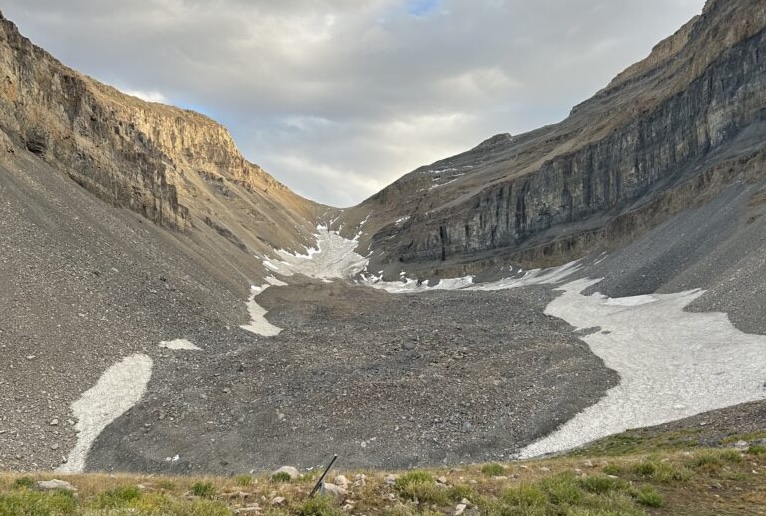
With a novel 3D technique, a University of Utah team has brought to light the unaccounted masses of ice hidden at the Timpanogos Rock Glacier, finding both a good measurement of how much ice it contains, and also how the rock glacier located near Salt Lake City and Provo formed.
The Timpanogos Rock Glacier stores 1.5 million cubic meters of ice, a University of Utah news release says. That’s enough frozen water to fill 600 Olympic-sized swimming pools. The number is also similar to the volume of the largest pyramid in Giza, Egypt, said Bronson Cvijanovich, a former graduate student in the Department of Geology & Geophysics.
“Timpanogos Rock Glacier is surprisingly ice rich. It is 83% ice and 17% loose rock,” said Cvijanovich, lead author of a study measuring the internal ice content of the rock glacier.
Rock glaciers are common in the Wasatch and Uinta ranges. Timpanogos is one of 836 in the state. While their footprints can be outlined with satellite imagery, “the 3D shape, depth and ice they obscure is harder to reveal,” the university said in the release.
“There’s a lot of ice that’s hidden in Utah’s mountains,” said Leif Anderson, a glaciology professor who oversaw the study. “When we are high in the mountains and walking across loose rocks or rubble, you don’t realize there could be 120 feet of ice buried beneath your feet.”
To estimate the ice content, a team hiked about five miles in an elevation gain of 3,500 feet to get to the rock glacier on different occasions in 2024, hauling sensitive instruments, like a gravimeter, and took gravity readings at 232 spots separated by about 80 feet in a grid atop the rock glacier.

The gravimeter measures density differences between rock and ice, the university said in the release, which allowed the researchers to calculate the 3D shape of the buried ice body. After those measurements were collected, the team had to correct them to take into account differences in gravity due to factors like the position of the sun and the moon, the location’s terrain, latitude and elevation.
But how does ice get into the rock glacier in the first place? Another study from U of U researchers showed with a new mathematical model that rock glaciers gain mass because “rockfalls bury persistent snow in the upper parts of rock glaciers,” according to the release.
“In the Wasatch, the mountains themselves are eroding and burying the snow, and that’s why the rock glaciers exist,” Anderson said.
Despite climate change, the Timpanogos Rock Glacier apparently keeps on adding ice, the researchers said.
“Rock glaciers flow downhill just like a glacier or river, but the important distinction here is that the thick carapace of loose rock actually protects and hides the ice, making these climate-resilient water storage sites that may still be adding frozen water. From a water resource standpoint, it is really important, especially in a warm and arid state like Utah,” Cvijanovich said.
This story was originally published by utahnewsdispatch.com and written by Alixel Cabrera. Adjustments for style and clarity have been made.

Elizabeth Spencer | American Fork Citizen
September 17 marks 239 years since the signing of our nation’s Constitution, which established America’s government and citizens’ rights. American Heritage School (AHS), in American Fork, honors this day annually, with learning focused on the founding of our country.
During the school day, kindergarten through eighth grade students step out of the classroom and onto the school’s football field, journeying back in time. The field becomes a present-day history experience as students rotate through interactive stations. Each station includes people from the colonial period, with stories that connect youth with founders of the USA. Lives of people like Betsy Ross, the young George Washington, Thomas Jefferson, and Patrick Henry are just a few characters to be portrayed at this year’s Constitution Day. Students participate as if they are living in that era as performers share stories, historical experiences, and perspectives from their lives hundreds of years ago.
“It is so important that the children understand the celebrations we have for America, because if they are not explicitly taught, they won’t know. When we share with them what Constitution Day is about or anything else to do with America and the celebrations we have, if they don’t get taught the specifics of it, they won’t come to appreciate and understand the depth of the sacrifice and those that have come before us,” said AHS Assistant Principal Charne Adams.

“At American Heritage School, we hold a deep conviction that our faith is intimately connected to the blessing of living in a nation where God-given freedoms are safeguarded by the United States Constitution,” shared AHS employee Jennilyn Burr. “Through our annual September Constitution Day celebrations of learning, students engage in interactive rotations that bring our heritage to life. By highlighting the diverse men and women whose sacrifices—both quiet and monumental—have preserved our nation’s freedom, we teach the rising generation to love, honor, and carry forward the legacy of liberty.”
The Constitution Day Celebration supports the school’s desire for students to learn about America’s founding. “When they [the students] learn specifically the sacrifices of all those that came before us, they’ll appreciate it more. They won’t take it for granted,” said Adams.
AHS invites the entire community to commemorate Constitution Day that evening during a celebration. Neighbors and friends are welcome to join from 5-9 p.m. at AHS to experience inspiring presentations on freedom through music and activities that invite reflection and gratitude for our rights.
The festival includes activities such as bounce houses, face painting, a petting zoo, colonial stations and games on the field, along with food trucks. The America 250 Celebration Program and Fireworks show begins at 8 p.m. on Thursday, September 17.
Spectators are invited to bring a picnic or purchase food at the event and enjoy the program and fireworks on a blanket or lawn chair. Tickets are available on the AHS website at af.americanheritageschool.org.

David Condos | KUER 90.1
Many Utah cities want to ditch thirsty grass. But trees are a different story. It comes down to cooling. As climate change ramps up Utah heat, a leafy canopy provides relief from the blistering sun in ways that grass can’t.
“Ask yourself: Would you rather park next to a small lawn or would you rather park under the shade of a tree?” said Doug Bennett, conservation manager with the Washington County Water Conservancy District. “It makes the point very quickly.”
On a bright, 100-degree day in St. George, Bennett walked beneath the shadow of a mesquite tree. It’s one of roughly 200 trees growing at the Red Hills Desert Garden, which the conservancy district runs on a cliff above downtown.
He aimed a handheld infrared thermometer at the concrete sidewalk next to his feet. The shaded surface read 93 degrees. The exposed asphalt parking lot nearby registered 45 degrees warmer. That’s a good example of how Southwest native trees like mesquite, desert willow and palo verde can mitigate urban hot spots while barely sipping on the region’s precious water.
“This garden uses about 11 gallons per square foot per year,” Bennett said. “That is about one-fifth of what people would apply to a lawn.”
Now, the water district is paying residents to swap their grass for some drought-tolerant shade. This summer, it began offering a $100 incentive to motivate people to plant trees as part of a lawn makeover.
Residents can qualify for the “treebate” by notifying the district of their plans and confirming the desired species is on the list of climate-appropriate options. People can get one tree rebate for every 700 square feet of landscaping that’s replaced. In northern Utah, the Jordan Valley Water Conservancy District and Central Utah Water Conservancy District offer a similar rebate at $50 per tree.
Just one-tenth of a typical urban area is devoted to landscaping, Bennett said.
On one hand, that means cities can’t expect plants to fix all their warming problems. Dark roofs, asphalt and concrete block walls contribute to heat islands, too. On the other, it means cities need to get the biggest possible impact from that small sliver of green space. Grass isn’t holding up its end of the bargain.
“The biggest misconception is that lawns are cooling our urban areas,” Bennett said. “Don’t get me wrong — if you lay down on well-watered grass, you’re going to feel a cooling effect. That cooling effect is not the grass. It is the water being transpired out of that grass and past you to the atmosphere.”
That’s a big part of why grass requires so much irrigation, he said, which runs afoul of the district’s conservation efforts.
One recent study of desert cities worldwide suggests that grass can actually warm things up because the water it releases has minimal cooling impact and its dark leaves absorb plenty of the sun’s heat.
That finding may be skewed by parts of the world that don’t irrigate grass as much as the U.S. does, said Diane Pataki, chief scientist and vice president of science with the conservation group National Wildlife Federation. But it points to a tricky balance arid communities need to strike.
“If we stopped irrigating cities, they’d get a lot hotter,” Pataki said. “So, we have to use some water, and the question is how much.”
Pataki previously researched urban heat and landscaping as a professor at the University of Utah, seeking to find the best tradeoff between landscape cooling effects and water use.
Because trees generally need a different style of irrigation than lawns — less frequent, more targeted — she said they can provide a lot of cooling on a small water budget. Trees can even make grass less thirsty.
“We found that adding trees to landscapes can lower the water requirement of the landscape, even if you don’t do anything else,” Pataki said. “It’s counterintuitive because you’re adding more plants, and you think, ‘Oh, I have to add more water now because I added more trees.’ But the shading effect reduces the water requirement of the lawn so much that you can actually lower the water requirement of the whole landscape.”
That illustrates how the benefits can start with a single tree, she said. Another high-impact planting spot is on the west side of a home, where a tree could keep the living space cooler and reduce air conditioning demand.
“It’s definitely worth doing in your own backyard,” Pataki said, “even if you’re the only person on your block doing it.”
As Utah cities rapidly grow and the state gets hotter, she said it’s vital for communities to consider trees’ cooling benefits as part of their future designs.
This article is published through the Utah News Collaborative, a partnership of news organizations in Utah that aims to inform readers across the state. Adjustments have been made for style and clarity.

Staff Writer | American Fork Citizen
Utah County has confirmed its first human case of West Nile virus this season. The patient developed a rare, serious form of the illness, prompting health officials to urge residents to take precautions against mosquito bites.
The patient developed neuroinvasive disease, which can affect the nervous system and may require hospitalization. The Utah County Health Department said it will not release additional information about the patient to protect the individual’s privacy.
“This case is an important reminder that West Nile virus is present in our community and can cause serious illness,” Aislynn Tolman-Hill said in the department’s announcement. “Residents can reduce their risk by using insect repellent, wearing protective clothing, and removing standing water around their homes.”
The Health Department and Utah County Mosquito Abatement are reviewing mosquito-surveillance information and conducting an additional assessment in the area associated with the case. Decisions about mosquito-control measures are based on surveillance results, mosquito activity, weather conditions and established intervention thresholds.
Most people infected with West Nile virus do not develop symptoms; about one in five experience a fever or symptoms such as headaches, body aches, joint pain, vomiting, diarrhea or a rash.
Less than 1% of infected people develop neuroinvasive disease, which can include meningitis, encephalitis or acute flaccid myelitis. Warning signs may include a high fever, severe headache, neck stiffness, confusion, seizures, tremors or muscle weakness. The department advises people with severe or concerning symptoms to seek medical care promptly.
Mosquitoes that carry West Nile virus are most active around dawn and dusk. Residents can reduce their risk of being bitten by using insect repellents containing DEET, picaridin or oil of lemon eucalyptus; wearing long sleeves and pants when possible; and checking that window and door screens are intact.
Residents are also encouraged to remove standing water around their homes. Residents can report heavy mosquito activity or standing water that cannot be eliminated to Utah County Mosquito Abatement. Those reports help crews locate and treat hidden mosquito-breeding areas before populations increase.
Mosquito trap counts, spray schedules, treatment maps, educational materials and an online service-request form are available at https://health.utahcounty.gov/mosquito-abatement.
STAFF WRITER | American Fork Citizen
Two new schools serving students with disabilities have opened at the former Sharon Elementary School in Orem.
Alpine School District held a ribbon-cutting ceremony Monday, Aug. 17, for Silver Peak School and the Timpanogos Transition and Education Center. The renovated facility is located at 525 N. 400 East within the boundaries of the future Timpanogos School District.
Silver Peak will serve students with severe disabilities in grades pre-K through 12. Principal Dan Heaps said students will have access to teachers and therapists who can address their individual needs.
“Every child deserves an education built around who they are, not in spite of it,” Heaps said.
The Timpanogos Transition and Education Center, or TTEC, will serve students ages 18 to 22. Its programs will focus on life skills, recreation and preparation for greater independence within the community.
TTEC Principal Melanie Adams said the school will provide individualized support as students prepare for life after school.
“This new facility will give us an even better opportunity to support our adult students right in their communities,” Adams said.
Both schools will begin serving students during the 2026-27 school year.
Jennifer Thomas | American Fork Citizen
Utah’s unemployment rate stands at a low 3.6% with roughly 67,900 residents looking for work. Yet job hunting has grown increasingly frustrating as the labor market slows. To bypass online application backlogs, upcoming events like the Utah Valley Job Fair offer face-to-face access to recruiters and on-the-spot interviews.
The Utah Valley Job Fair will be held on Tuesday, Aug. 25, from 2-5:00 p.m. at the Utah Valley Convention Center in Provo. “The Utah Valley Job Fair is Utah’s largest community job fair with more than 100 participating employers,” said Allison Keller, Public Information Officer for the Utah Department of Workforce Services.
Searching for a job can feel like a frustrating bottleneck, as many applicants frequently report sending dozens of digital resumes without a response, making the search feel like an isolated uphill battle.
“Search for a job is frustrating because you can spend so much time applying and rarely hear anything back, sometimes not even a rejection email is sent. I get hopeful because I wonder if I still have a chance only to realize later that I will not ever get a response,” said Shailey Stubbs, Lehi City resident.
A job fair can help with the bottleneck because it allows direct, face-to-face connection with employers. The Utah Valley Job Fair is a “dynamic, in-person event which connects job seekers and employers for a day of meaningful conversations, career exploration and real hiring opportunities,” according to Keller.
The free event offers job seekers opportunities to meet with employers and find open jobs that could lead to real interviews and possible offers of employment.
“The Utah Valley Job Fair is a great opportunity to explore career options for anyone just starting their career or those looking for a new opportunity to meet with more than 100 employers across various industries,” said Mark Middlebrook, Director of Outreach at Mountainland Technical College. “Job seekers should prepare for the fair by updating their resume and preparing a 30-second elevator pitch to share with potential employers.”
Visit utahvalleyjobfair.com or https://www.linkedin.com/events/2026inpersonutahvalleyjobfair7416487168564441088/ for more details and a list of participating employers.

Chabeli Carrazana | The 19th News
Pencils are more expensive. So are notebooks, scissors, glue sticks — just about every back-to-school item that families will load into their carts this summer has gone up in price at a time when American families already feel crushed by rising costs.
According to one analysis of the 21 most common school supply items by the Groundwork Collaborative and The Century Foundation prices are up about 7.7% with parents paying an average of $173.45 for their school supply haul. That’s an even bigger jump than last year. Add to that an 11% hike in prices for school lunch essentials — from the literal tons of blueberries needed to feed young children to apple juice — and costs balloon to nearly $4,000 a year to cover supplies and meals.
That data was first shared exclusively with The 19th. The analysis is based on weekly retail transaction data on millions of products collected by NielsenIQ from about 50,000 retailers.
With school supply costs outpacing inflation, many families — and especially the women who do the majority of purchases in American households — are going to feel the sticker shock, said Lindsay Owens, the president and CEO of the Groundwork Collaborative.
“Women in this country are rip-roaring mad about the price hikes that they’re absorbing. They’re trying to manage household finances and budgeting. They’re trying to feed their kids healthy food,” Owens said. “The work is getting harder of providing for your family.”
Here are the school supplies with the biggest spikes in price:
- Lunch boxes are up 27%
- Notebooks, notebook paper, tissues and index cards are all up about 20%
- Scissor costs rose 14%
- Dry erase markers and glue sticks are up 8%
- Headphones, binders, crayons, colored pencils and No. 2 pencils increased 5-7%
On the lunch side:
- 12 ounces of blueberries are up a whopping 48%
- A loaf of sandwich bread is up 22%
- Apple juice prices have risen 20%
- A pound of oranges has risen 17%
- A box of packaged animal crackers will run you nearly 16% more
- A package of chocolate chip cookies is up 14%
Driving up some of these costs are tariffs and the war on Iran.
Take blueberries, which American families have increasingly been eating more of every year, particularly those with berry-aged children who pop them like M&Ms. About half of the berries Americans eat are imported, many from Peru, which is now increasingly selling its berries to China instead of the United States because of tariff increases.
The other half of America’s blueberries are grown domestically, a good portion of them in Maine, the top producer of wild berries in the country. But tariffs on steel and aluminum have made it more costly to purchase the equipment needed to harvest the crops.
“Our consumers, our manufacturers, our blueberry growers, and more will all continue to pay the price,” Sen. Susan Collins, the Republican from Maine, wrote to the Department of Commerce in December.
Similarly, many school supplies are produced overseas, like pencils and crayons, which are predominantly imported from Brazil, China, Mexico and India. The war in Iran, which has raised fuel and shipping costs, has directly impacted imports, and those price increases are being passed on to consumers. Though inflation is showing signs of cooling, oil prices hit a six-week high in late July.
“Gas prices filter through to everything, but especially food,” Owens said. “The cost of transporting food goes up. The cost of farming goes up because the cost of diesel is up. The cost of plastic goes up, so the packaging around pencils or deli ham gets more expensive. All of that is going to filter through to higher food prices and higher prices for consumer goods like back-to-school staples.”
The problem is parents don’t have a lot of wiggle room on the matter, said Julie Margetta Morgan, the president of the Century Foundation. Kids need the supplies to be successful during the year, and parents, whether they’re low- or high-income, want to ensure their kids can thrive.
About half of parents expect to take on debt to cover back-to-school shopping this year, up from 34% in 2024, according to a survey of parents with kids under 18 conducted this summer by Intuit Credit Karma. One in five parents say they also feel pressure to keep up with what other parents are buying their kids, a June NerdWallet survey found.
“There’s a really strong actual cost — but also emotional cost — to having to make really impossible choices about caring for yourself and caring for your family in order to bear the costs of tariffs and of a war that seems impossible to explain why we’re involved in it,” Morgan said. “It is weighing particularly heavily on mothers.”
Many families cite living under that financial stress, said Ailen Arreaza, the executive director of ParentsTogether, a national nonprofit that works to engage parents politically. In the organization’s surveys, about 70% of parents cite experiencing financial strain, with little relief in sight.
It’s all further complicated by the loss of government benefits over the past year. More than 4 million Americans, including 1.5 million children, have lost their benefits through SNAP, the food assistance program that helps low-income people buy groceries. That makes family budgets even tighter going into the new school year.
“It feels like we are a little bit at a breaking point,” Arreaza said. “The concern and the situation just feels untenable right now.”
To get by, parents are searching their local back-to-school fairs for supplies, or seeking out backpack giveaways and school supply distributions. Some families are working more over the summer to cover increased costs.
By the time November’s midterm elections roll around, some of this pressure is likely to be on parents’ minds in an election that will no doubt center affordability. Both parties face uncertainty heading into the midterms.
Right now, Arreaza said, “parents are so busy and focused on their day-to-day and November feels far away and the election can feel far away for parents, but the reality of what is happening everyday feels very real for families.”
Even if folks aren’t thinking about the election, she said, “they’re thinking about the system that is making it harder for them and they’re noticing the differences.”
This story was originally published by 19thnews.org and written by Chabeli Carrazana. Adjustments for style, length and clarity have been made.

Kelcie Moseley-Morris | Stateline
A new study examining pollution levels across a 16-year span found that while general pollution levels from sources such as cars and industry have significantly declined, recent increases in wildfire smoke air pollution have offset those gains and could be contributing to negative outcomes for pregnant women and babies such as low birth weight and preterm births.
Published by Frontiers in Environmental Health, the study included data from about 64.5 million pregnancies between 2003 and 2019, covering more than 2,800 counties in 48 states. Even in regions that are not strongly associated with wildfire, such as the southeast region of the U.S., wildfire pollution rates grew substantially during that time period. The study did not account for any movement between counties or regions during pregnancy, or whether pregnant people used any protection against smoke such as masks, air filters or temporary relocation.
Wildfire pollution is included in the same type of pollution as exhaust from cars or industrial outputs, but the study authors looked at two models of pollutants, one of which removed all fire-related pollution to determine how much of it was correlated with wildfire. Over the study period, about 65% of the days that recorded pollution levels above the National Ambient Air Quality Standard could be attributed to wildfire smoke.
Menglu Liang, leading author of the study and assistant clinical professor of biostatistics at the University of Maryland, said in a news release that efforts to reduce other forms of pollution have not been in vain.
“Those gains have genuinely protected pregnant people and unborn babies, and without them, exposures today would be considerably worse,” Liang said. “What our findings show is that wildfire smoke is offsetting a growing share of these hard-won improvements.”
The study time period does not include some of the most recent, most explosive wildfire seasons in the United States and Canada, such as 2020, 2024 and this year. By mid-July this year, there were more than 800 wildfires burning across Canada, leading to hazardous levels of wildfire smoke across parts of the Midwest and northeast, and in late July, a rash of wildfires across Oregon created hazardous air over much of the northwest.
Recent reports show Oregon is on track to have its worst fire season on record, with nearly 1.8 million acres already burned and at least two months left of the peak season. The previous record was set in 2024, with 1.9 million acres burned.
The study found that some regions were disproportionately affected by the smoke, including in the Northwest, where rates of pollution from wildfire more than doubled over that period. The study noted that the burdens were highest in low-income, rural areas with significant populations of American Indian and Alaska Native communities, and areas with maternity care shortages.
Recent studies have correlated wildfire smoke exposure with an increased risk of preterm birth, low birth weight and other negative outcomes such as stillbirth and some congenital anomalies. Scientists believe the body’s inflammatory responses to wildfire smoke can be harmful to the placenta, which is central to fetal survival, and some of the pollutants could cross the placental barrier and affect fetal growth and development.
“These outcomes matter well beyond the delivery room and harms experienced before birth can echo for decades,” Liang said in the release. “That makes prenatal exposure a particular public health concern.”
This story was originally published by stateline.org and written by Kelcie Moseley-Morris. Adjustments for style and clarity have been made.
Local News
A recent Utah court decision may let homeownership transfer before required payments are made

Sally Francom | American Fork Citizen
Is it possible for a Utah homeowner to lose their recorded interest in a home if they never received the required payment and never signed the deed to transfer that interest?
A recent Utah Court of Appeals decision suggests the answer could be “yes.”
The case Slaughter v. Alleman, decided on May 29 as 2026 UT App 85, now sets a precedent in Utah for situations where divorce, death, joint tenancy, and unfinished obligations come together.
A married couple, April Slaughter and John G. Alleman, owned their home as joint tenants with right of survivorship. Their March 2024 divorce decree awarded the home to Alleman and ordered him to pay $200,000 to Slaughter by May 31, 2024, to equalize the marital estate. It stated that “upon receipt” of the payment, Slaughter would immediately sign a quitclaim deed transferring her interest.
Alleman died by suicide on April 24, 2024. He had not paid $200,000, and Slaughter had not signed the quitclaim deed. The recorded deed identified both former spouses as joint tenants when he died.
The district court later pointed out that Alleman never tried to pay the $200,000 or trigger Slaughter’s obligation to transfer the home between the decree and his death.
Before Alleman died, Slaughter provided wire-transfer instructions and said a check could be delivered to her home.
Shortly before the deadline, Alleman’s estate attorney emailed Slaughter’s counsel claiming he had payment and proposed a meeting without the clients. According to Slaughter, no check or proof of funds was produced, no wire was sent, and no check was delivered to her home.
However, the court opinion says that on May 31, the special administrator “tendered payment” to Slaughter’s lawyer. It does not say what kind of payment was offered or if anything was physically delivered. Slaughter disagrees that a proper payment was made and says she got neither a wire nor a check.
Saying payment was made is not the same as actually delivering it with proof.
In October 2024, the district court ruled that the joint tenancy remained intact and that Alleman’s interest passed to Slaughter through the deed’s right of survivorship. It declared her the sole owner of the home and awarded her attorney fees.
The Utah Court of Appeals reversed the district court decision in May.
The appellate court held that the divorce decree itself severed the joint tenancy by operation of law, converting the former spouses’ interests into a tenancy in common. It further concluded that the decree awarded Slaughter’s interest to Alleman when the decree was entered.
With this interpretation, ownership did not depend on Alleman paying $200,000 or Slaughter signing a quitclaim deed. The court saw “upon receipt” as setting the order of steps, not as a requirement that had to be met before ownership changed.
Since the opinion was published, its legal conclusions may guide Utah courts in similar cases. The decision also affects title companies, probate lawyers, estate planners, and others who use recorded deeds to figure out ownership. If former spouses are still listed as joint tenants, the deed might not tell the whole story if a divorce decree changed their interests without a new recorded deed.
In practice, this ruling means ownership can transfer before the required money is paid and before the recorded deed shows the change. The person who is owed money might have to sue for payment and lose the security of owning part of the property.
Recorded deeds usually make ownership clear. Court orders should also be understood as they are written. Most people would think that if a deed is to be signed “upon receipt” of payment, the money should come first.
The Court of Appeals decided that this kind of language may only set the timing, while ownership can transfer earlier. People going through a tough divorce probably would not realize this difference.
This decision serves as a warning for family-law attorneys when drafting documents. If payment must come before ownership changes, future decrees may need to say so clearly as a condition precedent. Still, homeowners should not have to use special legal terms to make sure payment and ownership stay linked when the order seems obvious.
Slaughter’s lawyer is preparing a petition for a writ of certiorari, asking the Utah Supreme Court to review the decision. The Court of Appeals denied a rehearing, and the lawyer got a 30-day extension to prepare the petition.
The Supreme Court does not have to take the case just because a petition is filed, and even if it does, a review does not mean the decision will be reversed. Still, these questions deserve a look from Utah’s highest court.
The justices should clarify when survivorship rights end, whether “upon receipt” is an enforceable condition, and whether ownership can transfer before payment is made and the deed is signed.
Utah homeowners should be able to understand their rights from deeds and court orders. They should not have to face a death, an estate and years of litigation to learn that “upon receipt” may not require actual receipt at all.

Cavemen competing well in Region 3 golf tourneys

American Fork harriers sweep events in Park City

Caveman football routs Layton

‘BIGGEST LOSER’ CONTESTANT FROM AF DIES TRAGICALLY

Aspen Peaks School Board “Meet the Candidates” night recap

Tragedy Strikes American Fork: Local Couple Found Dead in Apparent Murder-Suicide
-

 AF City News4 weeks ago
Mayor silences cheers as Booker announces lawsuit against AF Police
-

 Local News1 month ago
August brings “catastrophic” wildfire conditions to Utah
-

 AF City News4 weeks ago
American Fork disclosures show gaps, unanswered questions
-

 Local News1 month ago
Wildfire smoke is now the primary pollutant affecting pregnancy, study shows
-

 Local News1 month ago
A recent Utah court decision may let homeownership transfer before required payments are made
-

 Local News1 month ago
You’re not imagining it: Your kid’s school supplies cost more this year
-
Opinion1 month ago
OPINION: Brick by brick
-

 AF City News1 month ago
American Fork Citizen honors journalist and friend Brynn Carnesecca
-

 AF City News1 month ago
AFHS Marching Band kicks off hotter-than-usual season
-

 Local People4 weeks ago
AFHS drum major follows mother’s musical example