
Schools
Proposition 11: Timeline and facts regarding a potential Alpine School District split


Matt Hemmert | American Fork Citizen

On November 5, residents in Alpine, American Fork, Cedar Hills, Draper, Highland, and Lehi will decide whether to leave the Alpine School District and form what is currently named the “Central School District.” The question will appear on November General Election ballots as Proposition #11. In a simultaneous move, Saratoga Springs, Eagle Mountain, Cedar Valley and Fairfield residents will vote on forming what is currently called the “West School District” with Proposition #14.
In a special meeting on April 29, the Lehi City Council unanimously voted to initiate proceedings to enter into an interlocal agreement to start the process of a possible split from the Alpine School District. The city councils of the other cities in the interlocal agreement did the same. This began the mandatory 45-day notice and public comment period that included two public hearings for each member city.
On August 6, the Central School District area cities unanimously approved the interlocal agreement, and the Utah County Clerk approved Proposition #11 to appear on city residents’ ballots. Local elected leaders share similar reasons for moving forward with the interlocal agreement and promulgating Proposition #11.
Cedar Hills Mayor Denise Anderson said entering the interlocal agreement was a proactive step. “We realized that if we didn’t act as well, a decision would be made for us that might not be in the best interest of our city,” Anderson said. She also added that providing Cedar Hills residents an option for more localized representation and administration is in the city’s best interests.
“Six city councils have all acted unanimously to let voters decide whether to create a new school district, showcasing broad-based support for empowering voters with the facts to make an informed decision,” said Lehi City Councilmember Heather Newall. “I have been actively involved with this issue for many years and look forward to continuing to engage the public in making the best decision for them and their children.”
“We knew that a vote to start the process gave us some time to gather feedback and explore the viability of a central school district,” American Fork City Councilmember Staci Carrol said. “[The City Council’s] collective thoughts made it clear that the best option was to join the interlocal agreement.” Carrol further explained that providing residents with an option to create a school district now with geographically centric cities would minimize the future disruption of a split or multiple splits.
Lehi City Councilmember Paul Hancock said Proposition #11allows “the needs of the entire [proposed] district and for the community to feel heard.” Hancock explained that even with excellent local board member advocacy, Alpine School District board representation is diluted in high-growth areas that need increased resources for students and teachers. “[We’ve] seen the [Alpine School District] board prioritize keeping small schools operating, even pouring bond funds into them, rather than addressing the glaring needs in other parts of the district.”
“The Alpine School District board was split on how to move forward with [their independent feasibility] study,” Lehi City Councilmember Chris Condie said. Condie continued by explaining that after studying many options, including the existing Alpine School District split proposals, it was clear that the best path was to provide the residents of Lehi with an opportunity to vote on Proposition #11.
Proposition #11 and Proposition #14 have caused public clamoron social media, including between the district board’s voting majority and the board members representing the district’s fastest growing cities. Additionally, groups have been formed to oppose and support any split from the district.
Stronger Together is an Orem-based group opposing Proposition #11 and Proposition #14 and was successful in helping defeat Orem’s proposed departure from Alpine School District in 2022.
Stronger Together’s opinions for opposing Proposition #11 are:
• Splitting the district may increase all taxpayers’ costs to support public education
• There will be negative impacts to administrators, teachers, and students
• A decrease in pooled district funds can impact enhanced student learning programs
• A larger district can better address changing demographics and economic fluctuations
• Smaller districts struggle to provide students with special education services, gifted programs, and other specialized curricula
• Splitting the district may have a dramatic impact on students, taxpayers, and communities for decades
Yes on Prop 11 is a group managed by residents located in cities which will be voting on Proposition #11. Yes on Prop 11’s positions in support of Proposition #11 are:
• Alpine School District has over 85,000 students and is growing and is larger than approximately 99.9% of school districts nationwide
• A smaller district better understands, represents, and addresses localized student needs and community concerns
• Proposition #11 represents a fair and balanced division: the proposed Central School District represents 41 percent of Alpine School District’s current student enrollment and 45 percent of its current taxable value
• The proposed Central School District will not reduce student programs or opportunities, nor will it have a negative impact on teachers and administrators
• The proposed Central School District will be the sixth largest district in the State of Utah and will not lose the economy of scale in its operations
• The proposed Central School District has a solid tax baseand is financially viable
The Utah County Clerk will provide additional voter information to residents in cities included in an interlocal agreement. The information will include statements for and against the proposition listed on residents’ ballots.
More information related to Proposition #11 can be found here:
Lehi City information page: https://www.lehi-ut.gov/know-before-you-vote-proposition-11/
Central School District information page: https://centralschooldistrict.org/
Proposition # 11 opponent resources: https://www.strongertogethercommunity.com/https://www.facebook.com/share/p/Tv2acRf6cz7WgwnV/
Proposition #11 proponent resources: https://prop11utah.org/https://www.facebook.com/profile.php?id=61565143283252https://www.facebook.com/groups/3356818031233061
Proposition #14 resources: https://www.westdistrict.org/
*Utah’s Interlocal Cooperation Act (Utah Code Title 11-13) allows local municipalities to collaborate and coordinate public services to provide them more efficiently and effectively. In conjunction with the Interlocal Cooperation Act, Utah Code Title 53G-3-301.4 outlines the process for municipalities to propose the creation of a new school district.


The American Fork High School marching band presented their spectacular competition show during the halftime festivities at Homecoming on October 2. This was a preview of the performance they’ll be giving at the Bands of America Grand National Championships, which takes place November 12–14 at Lucas Oil Stadium in Indianapolis, Indiana.
Photos by Jim Ballard.


Megan Wallgren | American Fork Citizen
*This story was updated on Oct.2, at 7:33 p.m.
An email sent on September 15 to Alpine School District classified employees left some recipients feeling attacked, despite the good news it contained.
The email announced an additional $250 to a one-time payment of $500 for classified employees added during contract negotiations with the Alpine Education Support Professionals union earlier this year. “The Board of Education and District leaders are pleased to announce an additional $250 to the one-time payment of $500, making a total of $750 to be paid to classified employees in the fall of 2026, prorated based on the employee’s contract or hours worked each week,” the email stated.
The bonus announcement was followed by a statement calling out bad behavior during the negotiations.
“Let us be very clear, the additional payment is in spite of the poor behaviors, inaccurate depictions and statements about the board and superintendent’s value of and support for this essential group of team members in both public and private settings by several leaders of AESP during the negotiation process, ratification meetings, and proposal consideration in official public meetings,” the email read.
“Our hope is this message will acknowledge the unfortunate situation created by a few individuals as an opportunity for us all to self-reflect and seek improvement while inviting future AESP leaders in the new school districts to return to long-standing, positive, and mutually beneficial discussions, solutions to problems and validation of all members involved in this important work – serving children, parents, team members and communities.”
Alpine Food Services employee Sarah Fotheringham said, “We were all jaw-wide open with the letter. We felt like it was written in bad taste and intended to intimidate us.” Fotheringham continued, “I’m very happy the School Board came through with their willingness to give us additional compensation after giving us a .5% COLA.”
Classified employees are support personnel who handle non-instructional and operational roles critical to running the district. These include school office staff, facilities and maintenance crews, and transportation and nutrition services workers, along with other various part-time employees.
The cost-of-living adjustment (COLA) pay increase, just 0.5%, that classified employees received in their paychecks for the ‘27 fiscal year was a sticking point in negotiations earlier this year. The union rejected the initial contract proposal. As part of a compromise, the contract included a one-time bonus payment.
The email stated, “This additional [$250] payment reflects the long-standing commitment of the board of education and superintendent to invest in and advocate for our “hands-on” technicians and support team members, which group has and will always be a high priority to the leaders of Alpine School District.”
ASD Superintendent Robert Smith addressed the controversy by affirming Alpine’s commitment to its classified employees. “Alpine’s Board of Education and Superintendent value their classified employees,” he said. “In the negotiation agreement, a statement to revisit the amount of the one-time bonus was included. This message was the announcement of that review and determination.”
Of the paragraphs that raised eyebrows, Smith said, “The intent of the message and section you referenced was to decouple the increased amount from a process this year that was unlike any experienced in the past 20 years with AESP.”
Smith continued, “Wording of any communication could be improved, which is true in this case. The intent was to celebrate our employees, follow through on a commitment, and invite a more positive dialogue in the new districts.”
When asked who wrote the email, Smith responded, “The message was approved for distribution by a majority of the Board and Superintendent and sent by the ASD communications team.”
Fotheringham also wants to leave any bad feelings between Alpine and classified employees behind. “My hope is that, with the new school board and new AESP boards, they will work together better with patience and understanding. I’m hopeful that the employees will be valued by the new school boards more than what was displayed in the announcement,” she said.

Megan Wallgren | American Fork Citizen
Aspen Peaks School District is asking parents, residents, and other community members to weigh in on school boundary concerns as the district prepares for potential future boundary studies.
The district’s online Boundary Feedback Tool is open now through Oct. 1 on the district website, aspenpeaks.org. The survey allows residents to identify concerns and suggest potential solutions as the district plans for changing enrollment patterns while minimizing disruptions for students and families.
Aspen Peaks Board President Diane Knight said boundary issues have been a consideration for the district since its creation. Board members have discussed challenges including declining enrollment at some schools on the east side of the district and rapid growth at several schools on the west side.
“We realize that our patrons may see things we don’t,” Knight said. “They live in these neighborhoods, drive these roads, attend these schools and experience these situations every day.”
The board initially considered launching a comprehensive, district-wide boundary study, but after continuing to examine enrollment, school capacity, and other factors, Knight said district leaders determined that a targeted approach would be more effective.
Over the past several months, a boundary committee has studied enrollment at individual schools, building capacity, traffic concerns, and input from school administrators. Some boundary issues have already been addressed.
On the west side of the district, boundary changes involving North Point, River Rock and Dry Creek elementaries were implemented for the 2026-27 school year. Because those changes have only recently taken effect, district officials are monitoring their impact.
On the east side, Aspen Peaks reached a joint agreement with Timpanogos School District regarding students attending Deerfield and Barratt elementary schools. Under the agreement, parents will have the opportunity to choose which school their children will attend next year. The agreement also affects students attending Mountain Ridge Junior High, American Fork Junior High and American Fork High School.
Knight said the district wants to avoid making repeated boundary changes which require students and families to move between schools.
“We want a permanent home for every student,” she said. “But we also want to be purposeful and intentional in how we make these important decisions.”
Rather than launching a formal boundary study for every school, the district will use the feedback collected through the survey to determine where additional study may be necessary.
The district plans to review each concern submitted through the tool, looking for common issues, possible solutions and areas that may warrant further examination.
“This will allow us to be much more targeted in our approach,” Knight said.
Knight said community input is particularly important because residents may identify issues district officials have not seen or suggest solutions the district has not considered.
“We want to solve these issues together,” she said.
No public hearings on school boundaries are currently scheduled. Knight said the district will first use the feedback period and time spent monitoring the recently implemented boundaries to determine whether formal boundary studies are needed.
“If the board votes to open a formal boundary study, public hearings will be an important part of that process,” Knight said.

Elizabeth Spencer | American Fork Citizen
The firing of a cannon marks the official start for K-12 students, who are known as the “Patriots” attending American Heritage School (AHS). On the first day of school, students, parents and faculty gather on the football field for the annual opening ceremony. The program honors our nation, its heritage, and Old Glory.
“For us, it signifies the beginning of another school year, that we’re all in. This is a big start. The cannon goes off, and that’s it. Here we go, we’re in it together,” said Assistant Principal, Charne Adams.
The anticipated highlight of the morning is when former AHS teacher Jared Cornell, dressed in colonial attire, fires off his old cannon. The big boom is the official signal to students that a new school year has begun.
“Every year, we have gathered students and faculty on the first day of school to kick it off with a bang. We pay respect to our nation’s flag as part of the opening ceremony. It has also been a way to show respect to those on whose shoulders we stand, those who founded our country through military service,” shared Cornell.
The tradition dates back over two decades. In those first years, a full-scale Revolutionary War cannon was sometimes used.
During the opening ceremony, the entire school community gathers around the flag for a moment to remember the freedoms we are given by living in the United States. The cannon inspires students to carry on the legacy of those who sacrificed before them. The tradition connects students to previous generations whose footsteps they now try to follow.
“It helps them see something different and special on the first day, but also pulls in history, which is part of what we do here. We focus a lot on the history of the country and especially the sacrifice and the stewardship that is ours because of the people who have gone before us,” said Adams.
“Traditions are essential for any family, group, or organization that wants to be deliberate and intentional about its culture and values. Like many educational institutions, American Heritage School holds to important traditions that ingrain in its students many core values,” shared Chase Hale, AHS American Fork Campus Principal. Hale added, “First-day traditions focus mainly on our core values of remembering, sacrifice, reverence and patriotism.”
This year, AHS added a new first-day tradition for kindergarten students. Following the cannon firing, seniors lined the west side of the track to form a “Patriot Walk” welcoming new students. Seniors formed a tunnel to welcome the children. AHS Seniors are examples to the kindergartners of where they are headed. The experience will give new students a positive start to their academic journey.
“It’s so fun to see the older children embrace the little ones and help them feel like they belong, even on their first day of school,” said Adams.
Seniors aren’t the only ones rooting for the kindergarteners. Adams noted how involved parents are at the AHS. “The children know they’ve got a big cheerleading team from home to their teacher.”
“It takes a village to raise a child; each of us is a villager in that child’s story, and that’s where the power is. We’re in it together,” concluded Adams.

Staff Writer | American Fork Citizen
The Timpanogos School District (TSD) Board of Education voted unanimously Wednesday, Aug. 26, to move forward with formal closure studies involving 13 schools as part of the district’s ongoing boundary study.
This pivotal action marks the “Optimize” phase of the district’s comprehensive boundary study, known as MOABS (Mother of All Boundary Studies). The initiative was launched to ensure every TSD school is fully equipped to deliver optimal academic and social opportunities for all students.
The Board emphasizes that the study aims to strengthen schools, optimize district resources, ensure equitable, high-quality academic experiences for all students, while empowering educators to build environments where students thrive.
The schools include Canyon View, Oak Canyon and Orem junior highs, as well as Aspen, Bonneville, Foothill, Lindon, Northridge, Orchard, Orem, Parkside, Rocky Mountain and Windsor elementary schools. No final decisions have been made yet. The Board stresses that thorough study and community input are required before determining final consolidations. Three junior high schools will be studied for one potential closure, and 10 elementary schools will be studied for three to five closures.
Shifting from traditional models that only notify schools facing almost guaranteed closure, TSD is deliberately naming a broader group of potentially affected schools. This ensures all impacted communities are formally notified and invited to participate in the upcoming 90-day public feedback process.
Potential closures remain strictly secondary to the study’s primary mission: creating robust, high-quality learning environments district-wide, guided by TSD’s core vision, values and robust school criteria.
“In the Timpanogos School District, students will always come first,” said Superintendent Joe Jensen. “I want to reassure our families that the overriding, primary goal of these studies is to make school absolutely awesome for each and every child in our community. This is a focused effort to guarantee that regardless of where your family lives, your child will have access to the school culture, opportunities, and support systems that will allow them to learn to thrive.”
Board President Jen Lyman voiced TSD’s commitment to putting the community first. “We recognize that discussions around school boundaries and consolidations naturally bring anxiety and uncertainty to the families in our district. We want our community to know that a few of us on the board have lived through consolidations and closures. We know how hard it can be and we know how great it can be on the other side. We are fully committed to listening to parents, teachers, families, and others as we evaluate different options and determine what will be best for our kids and our community.”
“As a Board, we pledge to be as transparent and open as we possibly can be throughout the process of evaluating all the available options to strengthen our schools and the academic opportunities for our children,” shared Board Vice President Sterling Hilton. “Our decisions will be guided by the Robust School Criteria that came out of intensive engagement with the public. Any structural changes we eventually make will be designed to expand opportunities and ensure we can truly cultivate joyful, thriving students in a culture of exceptional care.”

Staff Writer | American Fork Citizen
Utah Valley University (UVU) has launched the Freshman Concurrent Enrollment Merit Scholarship, aimed at rewarding high school students who took college courses through its concurrent enrollment program. Qualifying students can earn up to $20,000 toward their degree.
UVU’s Concurrent Enrollment Program has long given high school students access to real college courses that are affordable and high-quality, allowing them to jump start their higher education. The new scholarship builds on that foundation, ensuring those students have an even clearer and more affordable path to completing their degree once they arrive on campus.
The scholarship offers two tiers of awards ranging from $3,500 to $5,000 per year, based on the number of UVU concurrent enrollment credits a student completed in high school. Both awards are renewable for up to four years, meaning qualifying students could receive as much as $20,000 over the course of their college career.
“When concurrent enrollment students arrive on campus as college freshmen, they have already proven themselves academically. They come in disciplined, prepared, and eager to advance their education,” said Senior Director of Concurrent Enrollment, Spencer Childs. “What we have not had, until now, is a scholarship that truly reflects that. This is the first scholarship at UVU built specifically to reward that effort, and we think it will make a real difference, not just for students who are already enrolled in concurrent enrollment courses, but for students who now have a reason to start.”
The new scholarship structure is designed to encourage high school students to start pursuing college coursework earlier. Students who earn more concurrent enrollment credits while still in high school may qualify for a higher scholarship tier, meaning the effort put in before graduation can pay off in a big way. For students who might have been on the fence about enrolling in college courses early, this scholarship offers a tangible financial incentive to get started and to keep going.
Since all UVU Concurrent Enrollment students are automatically admitted as UVU freshmen, students only need to submit an official high school transcript during their senior year by Feb. 1. For more information about this opportunity, visit uvu.edu/concurrent/merit-scholarship.
Staff Writer | American Fork Citizen
The Timpanogos School District (TSD) Board of Education considered a formal proposal to launch public boundary studies and evaluate potential school consolidations and closures during its meeting on Wednesday, Aug. 26.
This pivotal action marks the “Optimize” phase of the district’s comprehensive boundary study, known as MOABS (Mother of All Boundary Studies). The initiative was launched to ensure every TSD school is fully equipped to deliver optimal academic and social opportunities for all students.
The Board emphasizes that the study aims to strengthen schools, optimize district resources, ensure equitable, high-quality academic experiences for all students, while empowering educators to build environments where students thrive.
No final decisions have been made yet. While specific schools will be named for evaluation, the Board stresses that thorough study and community input are required before determining final consolidations. Three junior high schools will be studied for one potential closure, and 10 elementary schools will be studied for three to five closures.
Shifting from traditional models that only notify schools facing almost guaranteed closure, TSD is deliberately naming a broader group of potentially affected schools. This ensures all impacted communities are formally notified and invited to participate in the upcoming 90-day public feedback process.
Potential closures remain strictly secondary to the study’s primary mission: creating robust, high-quality learning environments district-wide, guided by TSD’s core vision, values and robust school criteria.
“In the Timpanogos School District, students will always come first,” said Superintendent Joe Jensen. “I want to reassure our families that the overriding, primary goal of these studies is to make school absolutely awesome for each and every child in our community. This is a focused effort to guarantee that regardless of where your family lives, your child will have access to the school culture, opportunities, and support systems that will allow them to learn to thrive.”
Board President Jen Lyman voiced TSD’s commitment to putting the community first. “We recognize that discussions around school boundaries and consolidations naturally bring anxiety and uncertainty to the families in our district. We want our community to know that a few of us on the board have lived through consolidations and closures. We know how hard it can be and we know how great it can be on the other side. We are fully committed to listening to parents, teachers, families, and others as we evaluate different options and determine what will be best for our kids and our community.”
“As a Board, we pledge to be as transparent and open as we possibly can be throughout
the process of evaluating all the available options to strengthen our schools and the academic opportunities for our children,” shared Board Vice President Sterling Hilton. “Our decisions will be guided by the Robust School Criteria that came out of intensive engagement with the public. Any structural changes we eventually make will be designed to expand opportunities and ensure we can truly cultivate joyful, thriving students in a culture of exceptional care.”
The meeting where the proposal was launched was held on Wednesday, Aug. 26 at the Alpine School District Special Education Office in Lindon. Live-stream and agendas are available at
timpsd.org.
Jennifer Thomas | American Fork Citizen
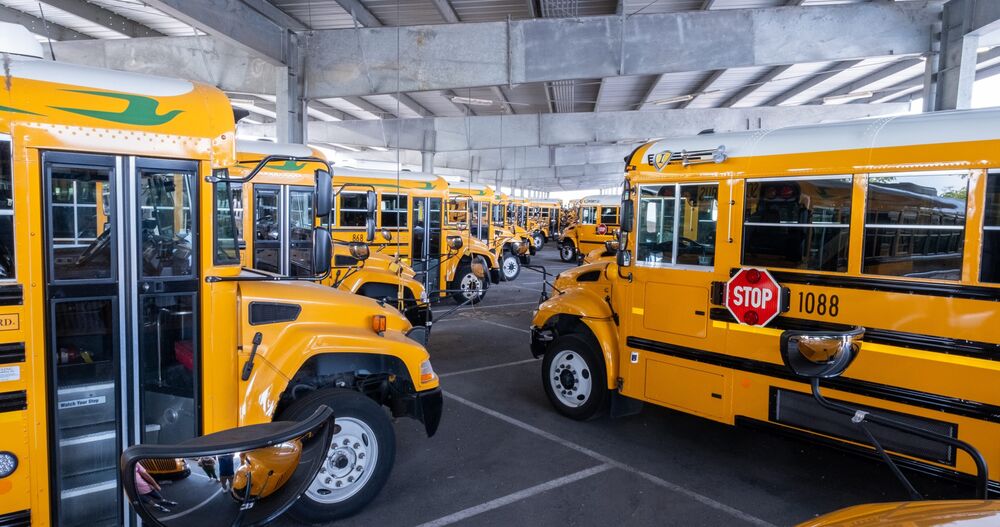
The Timpanogos School District (TSD) and the Aspen Peaks School District (APSD) have finalized a joint transportation agreement to share maintenance facilities, parking infrastructure, and personnel for an upcoming fleet of roughly 80 buses.
According to TSD, it has established a Memorandum of Understanding with APSD. Under the agreement, TSD will lease space at the APSD transportation facility.
“This collaborative arrangement is designed to provide safe, reliable, and cost-effective services for the district’s anticipated fleet of approximately 80 buses,” TSD officials said. They will reportedly have at least 90 parking stalls and two-and-a-half maintenance shop bays.
“In the split, each district will get a number of buses to commensurate with the student population in that district,” said Tyler Vigue, Timpanogos School District Director of Communications.
According to Vigue, both districts will “share five support personnel.”
“The shared support personnel will generally provide the same maintenance and fleet service to the buses owned by each district, reducing redundancies in those roles. Each district will have their own ‘Transportation Director’ to administer the work of transportation for their respective district fleet,” stated Vigue.
“There will be overlap in maintenance, but there will be clear divisions within the space for the parking of the buses,” continued Vigue.
The TSD Board of Education approved a three-year lease payment plan. They will pay the first two years by giving APSD their allocated “vehicle parts inventory” to cover lease costs. They will pay the final year by “transferring ownership of a portable administrative office trailer that TSD will install at the site,” according to TSD officials.
“This is a three-year agreement that could be renewed in the future,” clarified Vigue.
The collaborative arrangement aims to optimize operational efficiency, ensure high-quality vehicle safety and lower overall overhead costs for area taxpayers.
“We are so grateful for our partners in Aspen Peaks who have been willing to accommodate our needs and have afforded us this opportunity to continue our collaborative working relationship,” said Superintendent Joe Jensen. “And we appreciate the support of the public as we worked through this process, while striving to maximize resources that keep our focus on our core mission of helping every student thrive.”
“We know that at the end of the day, everyone involved cares about all of the students and employees impacted by this reconfiguration of school districts, and we are so grateful for the collaborative approach of those who have made this arrangement possible; especially our counterparts in Aspen Peaks,” stated Vigue. “Considering the timing and many other challenges facing these new school districts, we are thrilled to have this opportunity to avoid unnecessary expenses and burdens on employees, administrators, citizens and taxpayers.”

Megan Wallgren | American Fork Citizen
Community members gathered to learn more about the upcoming division of Alpine School District into three new districts during a Let’s Learn Utah event at the Cedar Hills Country Club.
Alpine School District Superintendent Rob Smith was the featured speaker. He provided an update on the transition to the Aspen Peaks, Timpanogos and Lake Mountain school districts and answered questions from community members.
Candee Myers, a candidate for the Utah Senate District 21 seat, organized the event. Myers said she organized the non-partisan event after speaking with residents who had questions and concerns about the district split.
“As I’ve talked to people through my campaign, the school district seems to be a concern, and I didn’t have the answers,” Myers said. “I wanted to organize this event where people can come and listen to the speaker and enjoy the community. Sometimes, when people are upset, it’s because they don’t understand what is going on. Information calms. My hope is that we can get the facts and then move forward.”
Smith spoke to an audience made up of ASD parents and residents, as well as several officials from the three new school districts and elected officials from cities currently within ASD boundaries.
He said the transition from Alpine to the three new districts remains on schedule for major steps, such as dividing assets and liabilities and hiring three new superintendents, as Alpine prepares to cease operations when the three new districts begin full operation on July 1, 2027.
Smith said that when he came out of retirement to serve as Alpine’s superintendent during the transition, he identified four primary goals: maintaining student achievement, helping create three strong school districts, providing ample support for the new districts, and supporting employees through the transition.
“Student achievement is our moral compass and our contract with parents,” Smith said. “We have continued to provide for those students.” He said Alpine reached its highest post-pandemic success in several key measures this past school year. Those included 74% of third graders reading at grade level, 87% of junior high and middle school students on track for graduation, and a 93% district-wide graduation rate.
To facilitate a smooth transition to 3 new school districts, Smith said Alpine staff created a “playbook” for each department to help guide the transition and held joint training and learning sessions with new district school boards and staff.
The three new boards are already functioning and working with their respective superintendents, business administrators and other staff members. “We’re really proud of the work those three boards did,” Smith said. “We acted as a coach, providing information, but they’ve done the hard work to set things up.”
State law requires the new districts to make employment offers to district employees by January 2027. Smith said Alpine expects to complete that process by the end of the week, several months ahead of the statutory deadline.
However, many employees of the new districts are also currently filling roles in Alpine School District. Smith said some employees are working on transition responsibilities after hours and on weekends and receiving stipends for the additional work.
Smith said Alpine and the three future districts currently operate as one organization while staff members work toward the transition. That relationship will gradually change as Alpine winds down its operations and the new districts ramp up. “Alpine is one, the three are part of us, and we are part of them. We will support each other to keep us working as smoothly as possible through the transition,” Smith said.
Audience members had questions about the financial outlook for the three districts. Of particular interest was the per-student dollar allocation and how financial projections compare with actual numbers. Smith said the district will not have a complete picture until the current year’s budget is closed and the audit is completed, expected in early September; however, the district’s projections appear relatively close to actual figures so far.
The new boards will begin developing their own budgets in September or October using audited numbers as a starting point.
School boundaries are another significant issue facing the new districts. Individual school boundaries sometimes cross both city and future district boundaries, making boundary decisions particularly complicated.
Utah’s open-enrollment policies mean families can choose where their children attend school, Smith said, adding that district leaders do not control student numbers but can respond to enrollment trends.
In response to questions about possible future school closures or boundary changes, Smith said school boards for the new districts will have to address enrollment patterns as the new district takes shape. “The future district boards will ultimately have to determine how to address that challenge,” he said.
Future boards will also determine whether student-to-teacher ratios or other staffing decisions change as enrollment patterns become clearer.
Community members also asked how the split could affect special education programs and extracurricular activities.
Smith said each new district has already begun discussing whether programs will remain the same or whether individual districts will take different approaches. The districts will also have to consider growth, enrollment and available resources when making those decisions.
Smith said the community will need to give the new districts time to establish themselves before judging what comes next.
“Let the dust settle, get year one under, and then what happens next,” he said.

Elizabeth Spencer | American Fork Citizen
Entering high school is a big deal for most students, but staff and teachers at American Fork High School are easing newcomers’ nerves. AFHS sophomores received warm welcomes from AFHS teachers and staff at their homes this past week. As the class of 2029 enters high school, they will hopefully recognize a few familiar faces, instilling confidence and comfort.
Incoming sophomore Shae Waldvogel wasn’t home when her visit came, but with efforts made to welcome her, she’s feeling more comfortable as she enters a new school and school year.
Her mother, Stacy, shared, “I think the kids felt so special having the staff come. It showed they care. When I told Shae they came, she was really surprised and got a really big smile and started laughing. ‘They came here? To our house?’ It was a really nice surprise.”
Head football coach and teacher Aaron Behm isn’t just preparing the team for the upcoming season; he’s preparing his students for a successful start to their new year.
“Visiting the incoming sophomores is starting to become a pretty great tradition at a school that already has a lot of great traditions. It is a fun way to get to know some of the sophomores. I saw some of them on my roster already for the first day of school, so it is also nice as a teacher to know a few more faces when all the kids file into the classroom,” shared Behm.
Cole Blackhurst was home when Behm and teacher Jason Herrud appeared at his door. “It’s cool they spent their morning going to see dozens of kids,” shared Cole.
As a former teacher, his mother, Ashley, added, “I know that the days leading up to back-to-school are insanely busy. Between getting your classroom ready and professional development meetings, there’s not much time leftover. I’m not sure how the teachers fit these visits in. Getting out and welcoming the kids seems like the absolute best use of time. Every person feels the need to belong. This task was a great first step.”
Vera Petersen also received a warm welcome from staff. Vera was surprised to see her visitors on her porch and called them “very sweet.” She thinks welcome visits like this are important to soothe first-day nerves.
Vera’s mom, Jenilyn, saw the message from the school that they were going to try to come by and welcome the sophomores. “I thought surely they won’t go to every single student, but then I asked my kids and they said they came by,” Jenilyn shared. “It’s above and beyond probably what they get paid to do. … The kids are nervous to go to a new school, especially high school, so I thought it was really sweet.”
“If they’re making this a priority, then they really care about the kids,” said Jenilyn. “We’ve loved AF. I think it’s such a great school. All the teachers and staff we’ve had interactions with have been awesome.”
Along with the visit, students were given a pencil pouch, bumper sticker, ball, calendar and a flyer about upcoming school events.
Welcome, class of 2029! May you find success and joy in your new journey at “Good Ole AF High.”

Cavemen claim both silver trophies at state XC meet

Cavemen place 15th at State MTB competition

Utah County Planning Commission meeting disruption ends in protester’s arrest outside commission chambers

‘BIGGEST LOSER’ CONTESTANT FROM AF DIES TRAGICALLY

Aspen Peaks School Board “Meet the Candidates” night recap

Tragedy Strikes American Fork: Local Couple Found Dead in Apparent Murder-Suicide
-

 AF City News1 month ago
Incorrect measuring led to oversized AF structure approval; Lehi neighbor files court injunction
-

 Local News4 weeks ago
ASD classified employee announcement brings controversy despite one-time payment
-

 Local News1 month ago
Trump DOJ uses case of Utah letter carrier to highlight allegations of voting fraud
-

 Local News1 month ago
Peck family donates Mill Pond to Lehi City
-

 Local News1 month ago
Student struck by car; Lehi residents rally for SR-92 pedestrian walkway
-

 AF City News1 month ago
AF City sells south side property for $1.4 million
-

 AF City News1 month ago
Council approves hotel parking reduction against planning commission’s recommendation
-

 Obituaries1 month ago
Travis Parley Deming
-

 AF City News1 month ago
American Fork beats state deadline of Oct. 1 to allow backyard housing
-

 AF City News2 weeks ago
American Fork City and 13 AFPD officers sued by four plaintiffs in ‘Reckless Ben’ saga